Search Results:
Search Results:
Search Results:
Search Results:
A simmerstat, also called an infinite switch or infinite heat control, is an electromechanical device that regulates the power delivered to a resistive heating element. It is the standard control used in most domestic and commercial electric cooktops. The name comes from its core function: providing enough control to hold a pot at a gentle simmer without the heat cycling between full-on and completely off.
A simmerstat connects in series with the heating element. Turning the control knob adjusts the ratio of time the element spends energised versus de-energised within each cycle. At minimum, the element is on for only a small fraction of each cycle. At maximum, it is on continuously. This produces an average power output that corresponds to the knob position, giving the user smooth, repeatable heat adjustment across the full range.
The internal mechanism uses a bimetallic strip that heats up when current flows through a small internal heater. As the strip warms, it deflects and breaks the main contact, cutting power to the element. The strip then cools, returns to its original position, and closes the contact again. The knob position changes the mechanical tension on the strip, which determines how quickly it deflects and how long the off-period lasts. This cycle repeats continuously while the control is in use.
A simple on/off switch gives only two states: full power or no power. That is not sufficient for cooking, where the ability to hold heat at a specific level matters. A simmerstat provides continuous adjustment across the full range. It also operates without electronics, making it robust, inexpensive to manufacture, and straightforward to replace when worn. This explains why simmerstats have remained the standard cooktop control technology for decades.
Understanding the operating principle helps electricians diagnose faults and select the correct replacement. The simmerstat is a purely mechanical device, relying on thermal expansion and contraction to switch the load.
The duty cycle is the percentage of time the element is energised within a complete on/off cycle. A duty cycle of 50% means the element is on for half of each cycle and off for the other half, delivering roughly half the rated wattage as average power. At 100% duty cycle, the element receives full power continuously. At minimum settings, the duty cycle may be as low as 5 to 10 percent.
Because the element cycles on and off rapidly relative to the thermal mass of most cookware, the pan or pot sees a relatively stable average heat input. The element itself cycles, but the contents of the pot experience this as a smooth, sustained heat level. The mass of the cookware acts as a buffer, smoothing out the rapid switching into a near-constant temperature effect.
Simmerstats are designed specifically for resistive loads: elements that convert electrical energy directly into heat. The resistance of a heating element is largely constant across the operating range. This predictable behaviour suits the bimetallic switching mechanism, which produces consistent duty cycles for a given knob position. Hot plate elements and fan forced oven elements are the most common loads.
The term "infinite control" refers to the stepless nature of the adjustment. Unlike a rotary switch with fixed positions (high, medium, low), a simmerstat allows the knob to be set to any position between minimum and maximum. There are no defined steps or detents, giving the user continuous control over heat output.
Simmerstats appear in a range of domestic and commercial heating equipment. Their reliability and simplicity make them suitable wherever stepless heat control of a resistive element is required.
This is the primary application. Most electric cooktops manufactured over the past 50 years use one simmerstat per hotplate zone. Each knob on the cooktop corresponds to one control. When replacing a faulty simmerstat on a cooktop, the replacement must match the amp rating of the original and use the same shaft diameter and mounting arrangement. Cooktop parts are stocked for a wide range of brands and models.
Some ovens use simmerstats for the grill and bake elements, particularly in older models and simpler designs. Commercial warming drawers, bain-maries, and food holding equipment also use infinite controls where temperature does not need to be precise, only consistent within a range. Grill elements and oven thermostat switches are related parts often serviced at the same time.
Industrial heating plates, laboratory hot plates, and some commercial food service equipment use simmerstats for basic heat control. In these applications, the current rating of the control must be carefully matched to the load, as commercial equipment often runs at higher wattages than residential cooktops.
A simmerstat is rated for resistive loads only. Using one outside its design specifications will reduce its life or cause failure.
Resistive heating elements, including hotplate coils, solid cast iron plates, ceramic glass elements, and oven bake and grill elements, are the intended load. These elements present a stable, non-inductive impedance to the supply. The simmerstat switches them cleanly, and the bimetallic mechanism operates predictably within rated current limits.
Simmerstats must not be used to control motors, fans, fluorescent lighting, variable speed drives, or any inductive load. The switching action produces voltage spikes that damage electronic components, and the duty-cycle control has no meaningful effect on motor speed. Using a simmerstat on an inductive load will also shorten the life of the internal contacts. For motor control and lighting, different controller types are required.
A simmerstat does not measure temperature. It has no feedback mechanism. If ambient conditions change, if the element ages and changes resistance slightly, or if the supply voltage varies, the actual heat output at a given knob position will shift. This is normal and expected. For applications requiring precise temperature control, a thermostat with a sensor is the correct choice.
Important: Never use a simmerstat as a substitute for a thermostat in applications where temperature accuracy is critical. A simmerstat regulates duty cycle, not temperature. The actual temperature reached depends on the load, the insulation of the equipment, and ambient conditions.
Each control type serves a different purpose. Choosing the wrong type for an application causes poor performance or early failure.
A thermostat uses a sensor to measure actual temperature and switches the load to maintain a setpoint. A simmerstat has no sensor and no feedback. It sets duty cycle, not temperature. A thermostat is the correct choice when holding a specific temperature matters. A simmerstat is appropriate when the user adjusts heat manually by feel and observation, as in normal cooktop cooking.
| Feature | Simmerstat | Thermostat | Dimmer |
|---|---|---|---|
| Control method | Duty cycle (time-proportioning) | Temperature feedback | Voltage reduction |
| Sensor required | No | Yes | No |
| Suitable load | Resistive elements only | Heating or cooling loads | Incandescent / LED (rated) |
| Temperature accuracy | None - manual adjustment | High - maintains setpoint | None |
| Typical application | Cooktop, hotplate | Oven, water heater | Lighting |
| Cost | Low | Medium to high | Low to medium |
A dimmer reduces voltage to the load, either by phase cutting (TRIAC) or other means. Resistive loads such as incandescent globes respond predictably to voltage reduction. However, using a dimmer on a heating element is not appropriate: the voltage reduction is not matched to the thermal mass of the element, and a standard dimmer is not rated for the sustained current draw of a cooktop element. Simmerstats switch full voltage on and off; dimmers reduce the voltage level.
Digital PID controllers use temperature sensors and algorithms to maintain setpoints precisely. They are appropriate for laboratory, industrial, and food processing applications where temperature tolerance matters. A simmerstat is simpler, more robust, easier to replace, and lower in cost. For domestic cooktops and basic commercial equipment, the simmerstat remains the practical and cost-effective solution.
Selecting the correct replacement simmerstat requires checking several specifications. Fitting the wrong unit risks poor performance or premature failure.
The most critical specification is current rating. The simmerstat must be rated at or above the current drawn by the element it controls. A 2400W element on a 240V supply draws 10 amps. Most residential simmerstats are rated at 10A or 16A. Using a control rated below the element's current draw will overheat the internal contacts and shorten the control's life significantly.
Some simmerstats are configured for single-pole switching (one live conductor switched). Others are configured for use with dual-element hotplates that switch between two element sections. Confirm the wiring configuration of the original control before ordering. Single-pole simmerstats are the most common type in residential cooktops.
Simmerstats installed in cooktops operate in a hot environment. Units intended for cooktop replacement are designed to handle sustained operating temperatures. Do not substitute a simmerstat from a different application type if it is not rated for the installation environment.
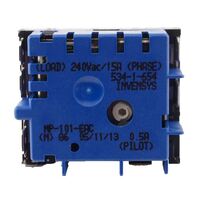
Universal simmerstats, such as the Global Components MP-101, are designed to replace a wide range of original equipment controls across multiple brands. They use standard shaft diameters and terminal configurations. Model-specific units are designed for a particular appliance brand and may include mounting brackets or wiring harness connectors specific to that brand. Universal controls suit most residential repairs where the original is no longer available.
Before ordering a replacement simmerstat, confirm the following specifications. Where possible, photograph the original control and note the part number printed on the body.
Not all simmerstats deliver the same service life. The following factors distinguish reliable units from those that fail prematurely.
A quality simmerstat produces a consistent duty cycle at each knob position. Low-quality units may have inconsistent calibration, meaning the same knob position produces different heat output on different days, or the minimum setting is too high to hold a gentle simmer. This is often noticed as difficulty controlling heat at low settings.
The internal bimetallic strip and contacts cycle many thousands of times per hour of operation. A simmerstat in regular use on a domestic cooktop may complete millions of switching cycles over its life. Contact material quality and the robustness of the bimetallic element determine long-term durability. Quality-rated units from established manufacturers show consistent switching behaviour over extended service.
Simmerstats are mounted inside cooktop panels and exposed to sustained heat. The housing material, terminal quality, and insulation must handle continuous elevated temperatures. Units that show cracking, discolouration, or terminal corrosion after a short service period are an indication of below-standard materials.
Simmerstats sold in Australia for appliance repair must comply with applicable electrical safety requirements. Replacement parts from established suppliers, such as Wilson Elements, have a track record in the Australian market. Avoid unbranded units where no compliance information is provided.
The following are the most common simmerstat faults encountered in field service. In all cases, isolate the appliance from the power supply before opening the cooktop or accessing any components.
If a hotplate runs at full power regardless of knob position, the simmerstat contacts have welded together in the closed position. This is a contact failure, usually caused by overloading or arcing during switching. If the hotplate produces no heat at any setting, the contacts have failed open, or the element itself has failed. Test the element separately to isolate the fault.
If the hotplate produces varying heat at a fixed knob position, or the heat output seems to drift over a cooking session, suspect wear in the bimetallic strip mechanism. Inconsistent contact pressure leads to variable duty cycles. This is a sign the simmerstat is approaching end of life.
If the hotplate works intermittently, check the connection at the simmerstat terminals first. Loose terminals are a common cause and are easily corrected. If the terminals are secure and the element has been confirmed functional, the simmerstat itself is the likely cause. Check for continuity through the control using a multimeter.
A burning smell from the cooktop control area may indicate a loose terminal connection causing arcing, an overloaded simmerstat, or a failing contact generating excess heat. Isolate immediately and do not use the appliance until the fault is identified and rectified by a licensed electrician.
The following signs indicate the simmerstat requires replacement. Most of these faults develop gradually, giving early warning before complete failure.
The clearest sign of a failing simmerstat is loss of heat adjustment. If the knob no longer changes the heat level, or only affects heat across a limited portion of its travel, the internal mechanism is worn. A new control will restore the full range of adjustment.
If heat output changes suddenly at a fixed knob position, particularly jumping from low to high without any adjustment, the bimetallic strip is behaving erratically. This is a mechanical wear fault. The control should be replaced before it causes a cooking accident or damages the element through overheating.
If the knob turns freely but does not change heat output, the internal coupling between the knob shaft and the mechanism has failed. This may be a broken shaft or a stripped cam. The control cannot be repaired and must be replaced.
Visible signs of damage include discolouration of the control body from excess heat, cracked housing, melted terminals, or evidence of arcing (black or charred deposits near terminals). Any of these warrant immediate replacement. Do not continue to use an appliance with a visually damaged control.
Systematic testing isolates whether the fault is in the simmerstat or the element. Always isolate the appliance before opening any panels.
Start with a visual inspection of the simmerstat body, terminals, and wiring. Look for discolouration, cracking, loose terminals, and evidence of arcing. A loose terminal connection is a common cause of intermittent faults and is quick to check. Confirm the element terminals are secure and the element body is not visibly damaged.
With the appliance isolated, disconnect the simmerstat and test it with a multimeter set to continuity or resistance. With the knob at maximum, you should read continuity (zero or near-zero ohms) through the main switching contacts. With the knob at minimum, the contacts should be open. If the contacts do not open at minimum or do not close at maximum, the control is faulty. Test the element separately: a functioning element will show a low, stable resistance appropriate for its wattage rating.
If continuity testing shows the simmerstat is functioning correctly, the fault is in the element or the wiring. A failed element will show open circuit (infinite resistance) on a multimeter. A short in the element wiring may show abnormally low resistance. Isolating the fault to the correct component before ordering parts saves time and money.
All internal work on fixed appliances in Australia must be performed by a licensed electrician. Testing with a multimeter on an isolated, de-energised appliance is permitted for diagnostic purposes. Reconnecting wiring, replacing components, and re-energising the appliance requires a licensed person. Refer to the appliance parts section for replacement components once the fault is confirmed.
Understanding failure modes helps with prevention and improves diagnostic accuracy.
The main contacts inside a simmerstat switch on and off thousands of times per hour of operation. Over time, arcing during switching erodes the contact surfaces. As contact material is lost, the resistance at the contact increases, generating heat and accelerating further wear. This is the most common failure mechanism in simmerstats that have reached end of service life.
Running a simmerstat above its rated current causes contact overheating. This accelerates contact erosion and may cause contact welding (contacts fusing in the closed position). Always confirm the element wattage and verify the simmerstat is rated for the resulting current before installation.
Simmerstats installed in poorly ventilated cooktop cavities are exposed to sustained elevated temperatures. Excess ambient heat above the control's rated operating temperature causes insulation degradation and bimetallic strip calibration drift. Ensure the cooktop underside has adequate clearance to the cabinet below, as specified by the appliance manufacturer.
The bimetallic strip mechanism experiences mechanical stress with each thermal cycle. Over years of service, the strip may fatigue, reducing accuracy and causing inconsistent duty cycles. This is normal end-of-life wear. A simmerstat that has given 10 to 15 years of regular service is approaching the expected service boundary for the component type.
Simmerstat replacement is a routine appliance repair task for licensed electricians. The procedure is straightforward when the correct replacement is available.
Before starting any work, isolate the appliance at the dedicated circuit breaker or fuse and verify isolation with a voltage tester. Cooktops are connected to a dedicated 20A or 32A circuit in Australian installations. Confirm zero voltage at the appliance terminals before touching any internal wiring. Do not rely solely on the appliance's own controls for isolation.
Photograph the existing wiring before disconnecting any terminals. Terminal markings on a simmerstat are not always standard across brands. The active (line) terminal, load terminal, and neutral terminal (where applicable) must be connected correctly. Incorrect wiring may result in the element not functioning or the simmerstat running in a reverse duty-cycle mode.
The simmerstat body mounts to the cooktop panel via a nut on the shaft. The shaft must align with the knob opening in the panel. Confirm the shaft length and diameter match the original before fitting. Some universal controls include an adjustable shaft kit to accommodate different panel thicknesses. Fit the mounting nut and tighten to a firm, finger-tight plus quarter-turn: over-tightening can crack the control body.
In all Australian states and territories, replacing a simmerstat in a fixed appliance constitutes licensed electrical work. The work must be performed by a licensed electrician. After replacement, the electrician should test the control function across the full range and confirm the appliance operates correctly before returning it to service. Non-licensed persons must not perform this work.
Most residential electric cooktops in Australia connect via a plug and socket (either a 20A surface-mounted socket or a 32A cooktop socket) or are hardwired. Plug-connected cooktops can be isolated at the socket for service. Hardwired cooktops require isolation at the dedicated circuit breaker. Confirm the connection type before starting work.
Simmerstat replacement is consistently the lowest-cost repair option compared to cooktop replacement. Understanding the cost structure helps clients make informed decisions.
Budget universal simmerstats provide basic functionality and suit one-off replacements where longevity is less critical. Premium units from established brands use better contact materials and more stable bimetallic assemblies, providing longer service life under regular use. For a frequently used domestic cooktop, a quality unit is the better long-term value.
Simmerstat controls in Australia typically range from around $15 to $60 per unit, depending on the brand, specification, and whether the unit includes a shaft kit or pilot lamp assembly. The control cost is a small fraction of the labour cost for a cooktop repair. Selecting a quality control reduces the likelihood of a callback within months of the original repair.
Electricians working in appliance repair services benefit from keeping a stock of common universal simmerstats. Stocking the most common shaft sizes and current ratings reduces turnaround time on cooktop repairs. Sparky Direct provides trade pricing and fast delivery on simmerstat controls and associated hot plate elements.
A simmerstat replacement restores a cooktop to full function at a fraction of the cost of a new appliance. For cooktops that are otherwise in good condition, repair is almost always the economically rational choice. The decision shifts toward replacement only when the cooktop body, glass surface, or element wiring has sustained damage beyond the simmerstat itself.
Simmerstats do not require scheduled maintenance. However, operating practices affect how long they last.
The most important factor in simmerstat longevity is matching the control rating to the element. An undersized simmerstat runs hot, accelerating contact wear. Confirm the element wattage when replacing a simmerstat and select a unit rated at least equal to the element's current draw. If any doubt exists, select the next rating up.
Cooktop installations with restricted underside clearance run hotter than those with adequate ventilation. This is primarily a concern in built-in cooktop installations where the cabinet below has limited airflow. If a simmerstat is failing repeatedly in the same installation, check whether the installation meets the manufacturer's clearance requirements for the cooktop model.
Watch for early signs of simmerstat wear: reduced range of adjustment, inconsistent heat at low settings, or any evidence of sparking or unusual odours during use. Addressing a worn control before it fails completely avoids situations where a hotplate becomes stuck at full power.
A simmerstat showing reduced adjustment range or inconsistent performance is not far from complete failure. Proactive replacement avoids an emergency callout and is often more cost-effective when combined with another service visit. Stock common sizes to make early replacement practical during routine appliance service.
Simmerstat repairs are a recurring part of domestic appliance service work. The following applications represent the most common scenarios encountered in trade.
Residential cooktop simmerstat replacement accounts for the majority of simmerstat sales. The most common failure pattern is a single zone losing adjustment range while others function normally. Replacing only the failed control is sufficient in most cases. A complete replacement of all controls on an older cooktop may be considered if multiple controls are showing wear simultaneously.
Commercial hotplates and cooking equipment use simmerstats rated for higher currents than residential units. Always verify the current rating of the original control in commercial applications. Commercial equipment runs at higher duty cycles and longer continuous sessions than domestic appliances, which places additional demands on the control.
Appliance technicians and maintenance electricians in strata and property management roles service cooktops regularly. Keeping a stock of universal simmerstats, along with common hot water elements and hot water thermostats, reduces site response times and improves first-visit completion rates.
Electrical safety requirements apply to all simmerstat replacement and testing work in Australia.
Electrical work in Australia is governed by AS/NZS 3000:2018 (Wiring Rules) and the relevant state electrical safety legislation. Appliance repair work that involves accessing internal wiring constitutes electrical work and must be performed by a licensed electrician. Replacement parts used in appliance repairs must meet applicable product safety standards.
Unlicensed electrical work on fixed appliances is illegal in all Australian states and territories. Beyond the legal risk, incorrect wiring of a simmerstat can result in the element being permanently energised, presenting a fire and burn hazard. The cost of engaging a licensed electrician for simmerstat replacement is low relative to the risk of DIY repairs on high-current appliances.
Always isolate the appliance and verify isolation before touching any internal components. Use a calibrated voltage tester, not a visual assumption, to confirm isolation. When handling a simmerstat that has been in service, allow it to cool completely before removing terminals. Worn contacts may have sharp edges from arcing. Handle the unit carefully and dispose of it safely.
Installing an undersized simmerstat is a safety risk. An overloaded control will overheat, potentially igniting nearby combustible materials inside the cooktop cavity. Always confirm the element wattage and select a control with adequate current rating before installation. If the element wattage is unknown, check the appliance rating plate, which must be present on all compliant appliances sold in Australia.
Simmerstat controls are available from electrical wholesalers and appliance parts suppliers. For trade buyers, online supply with fast delivery is the most efficient option.
Online electrical wholesalers offer broader range, better availability, and competitive pricing compared to bricks-and-mortar appliance parts stores. Trade accounts provide additional pricing advantages and the ability to place orders outside business hours. Confirm that the online supplier stocks the specific model or a compatible universal replacement before ordering.
A reliable supplier will list complete technical specifications for each simmerstat, including current rating, shaft diameter, terminal configuration, and compatible models. Suppliers who stock brands with an established track record in the Australian market are preferable to those who offer unbranded imports with no compliance information. Access to product support for compatibility queries is also a practical advantage.
Sparky Direct supplies simmerstat controls to licensed electricians and appliance repair technicians across Australia. The simmerstat range includes universal controls suitable for most residential cooktop brands. Related parts including fan forced oven elements, grill elements, and oven thermostat switches are available from the same supplier, reducing the number of orders required to complete a repair.
Watch Global Components MP-101 | INFINITE CONTROL SPSC PILOT 6mm Shaft | Simmerstat video
Watch INFINITE CONTROL EGO | Simmerstat | 50-56078-007 video
Watch Infinite Stove Controller Single Pole c/w Pilot & Shaft Kit | Simmerstat | M553-14 video

I purchased two Simmerstat MP 101 over the Internet, they arrived in less than 48 hours. A marking number on them was not the same as shown on the website photo, so I sent an e-mail asking if they are the same. I got a reply within 20 minutes. Impressed and very happy with your service, tank you.
I recently purchased a replacement switch for our hot plates (MP-101) . I ordered on line and within 3 days the switch arrived by courier at our front door. The switch was as described and worked perfectly. Thanks Sparky Direct excellent service!
Great product as a like for like replacement in a Westinghouse product . Easy to install and worked perfectly . Customer happy when mentioning the previous job after a call back 3 months later regarding other job
Quality products in stock • Fast Australia-wide delivery • Competitive trade pricing
Browse Simmerstat Controls → Get Expert Advice →Yes, repeated use and heat exposure can cause gradual wear.
Sparky Direct supplies simmerstats Australia-wide, offering reliable appliance control components with convenient delivery.
They are securely packaged and delivered via standard courier services.
Unused items are usually eligible for return according to the seller’s returns policy.
Warranty coverage varies by manufacturer and generally covers defects in materials or workmanship.
Yes, simmerstats are typically sold as individual replacement components.
Yes, electrical appliance repairs must be completed by licensed professionals.
They generally require no maintenance beyond normal appliance care.
Using the wrong rating can affect safety and appliance performance.
They are designed for long service life under normal household use.
Faulty simmerstats can overheat or fail to regulate power correctly.
Clicking during operation is normal and indicates power cycling.
Replacement should be carried out by a licensed electrician or qualified appliance technician.
A simmerstat is an electric heat control switch used in cooktops and ovens to regulate element temperature by cycling power on and off.
Yes, poor heat control can lead to uneven or unpredictable cooking.
Common signs include inconsistent heat, elements staying on too long, or no heat at all.
They contribute to controlled heating when functioning correctly.
Replacement simmerstats are available for many common appliance models.
They are commonly used in traditional electric cooktops, while newer models may use electronic controls.
Yes, simmerstats come in various current and power ratings to suit different appliances.
They control heat by cycling the element rather than maintaining a fixed temperature.
Voltage ratings vary and must match the appliance’s electrical specifications.
Some simmerstats are appliance specific, while others are universal, depending on electrical ratings and shaft configuration.
Simmerstats are generally manufactured to meet relevant AS/NZS electrical safety standards, depending on the product.
They are commonly used in electric cooktops, hot plates, and some oven appliances.