Search Results:
Search Results:
Search Results:
Search Results:
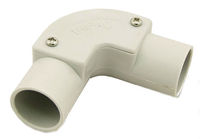
Inspection elbows sit between two lengths of conduit at a 90-degree change of direction. The defining feature is the small access cover on the outside of the bend. Remove two screws or unclip the lid and the cable inside the bend is exposed. This single design choice changes how cable is pulled, how faults are traced, and how future upgrades are handled.
The body is a moulded PVC fitting with two sockets that accept rigid conduit ends, and a shallow chamber across the bend is sealed by the removable plate. Cables enter through one leg, travel around the inside of the chamber, and leave through the other leg. With the plate off, you can guide draw wires and conductors around the corner one cable at a time, and with the plate fitted the bend looks and seals like a standard sweep.
Pulling cable through a long run with multiple sealed bends builds friction quickly, because each 90-degree turn adds tension to the pull. An access point at every change of direction breaks the pull into shorter sections, which reduces stress on insulation and lowers the risk of jacket damage. It also means a tradesperson can re-pull a single cable later without disturbing the rest of the run.
Both fittings deliver a 90-degree change of direction in the same physical footprint, but the practical difference is access. A solid elbow is a sealed unit, and once it is glued in, the cable inside is fixed for the life of the run. An inspection elbow keeps that path serviceable, with a small trade-off in unit cost and a minor reduction in mechanical strength at the cover plate.
Maintenance access is the long-term value of these fittings. A switchboard upgrade, a circuit fault, or a rewire ten years later is far simpler when every bend in the system can be opened. Without inspection points, a single damaged cable may force the removal of an entire conduit run.
Quality inspection elbows from National Light Sources (NLS) and Clipsal share the same core design with minor differences in cover fixing and PVC formulation.
The Sparky Direct range covers the standard configurations used in Australian electrical work.
The default fitting is a single-plane 90-degree elbow with one access cover on the outer face. This suits the majority of surface and concealed conduit runs at wall, ceiling, or floor transitions.
Sizes are matched to conduit nominal diameter, with each option suiting a different load. The 20mm fitting is the most common for lighting and general circuits in residential work, while the 25mm version handles mains-rated cables and most commercial sub-circuits. The 32mm fitting is used for sub-mains, larger cable bundles, and industrial runs, and the 20mm conduit junction boxes and 25mm conduit junction boxes are sized to the same conventions.
Most inspection elbows in Australia use the solvent weld pattern: the conduit end is coated with PVC cement, pushed home into the socket, and held in place. The bond cures in minutes and is permanent, and although push-fit variants exist in the air conditioning fitting range, the solvent weld pattern remains the standard for electrical work.
NLS and Clipsal both produce inspection elbows that meet AS/NZS 2053. Subtle differences include cover fixing style, access chamber depth, and the moulding tolerance at the socket. Mixing brands within a single run usually works but should be checked at fit-up rather than assumed.
Rigid PVC is the standard material because it is non-conductive, resistant to most chemicals found on building sites, and dimensionally stable across normal Australian temperatures. PVC elbows pair with rigid conduit in both grey medium duty and orange heavy duty grades.
Outdoor installations need fittings rated for ultraviolet exposure, because standard grey PVC degrades under direct sun over time and becomes brittle. UV-stabilised PVC and the orange heavy duty grades hold up better, so for exposed runs, match the elbow grade to the rest of the conduit system.
PVC has temperature limits, and continuous exposure above 60°C will soften the material. Direct contact with solvents, fuels, or strong oxidisers can also affect PVC, so in these conditions metallic conduit systems are the correct choice.
Indoors and protected from sun, a PVC inspection elbow has a service life that typically exceeds the wiring it carries. The cover plate gasket area is the most likely failure point in damp or dusty environments, so the seal should be inspected each time the cover is removed.
Conduit fittings used in Australian electrical installations must meet several standards. Compliance is the responsibility of the licensed electrician installing the system.
AS/NZS 2053 is the conduit standard, and it sets dimensional requirements, mechanical properties, and marking conventions for rigid PVC conduit and fittings. An inspection elbow that meets this standard will fit cleanly with other compliant conduit and accessories from the same range.
The Wiring Rules govern how conduit systems are installed, supported, and terminated, with cable bend radius, fill ratios, and segregation rules all applying at inspection elbow positions. AS/NZS 3000:2018 is the current edition for new work in both Australia and New Zealand.
AS/NZS 3017 covers inspection and testing of completed installations, and accessible inspection points support visual checking of cables and connections. Cover plates that can be opened without disturbing the run make periodic testing far easier and faster on site.
All fixed electrical work in Australia must be carried out by a licensed electrician, with compliance covering product selection, installation method, and final certification. Using fittings that meet AS/NZS 2053 is the starting point, not the finish line.
Inspection elbow size must match the conduit running into it. A 25mm conduit needs a 25mm elbow. Mixing sizes through a plain reducer is permitted at a transition, but the elbow itself stays sized to the section it joins.
| Size | Typical application | Cable examples |
|---|---|---|
| 20mm | Lighting, general power, residential | 1mm and 1.5mm twin and earth |
| 25mm | Mains, sub-circuits, commercial | 2.5mm and 4mm twin and earth, 4mm three-core |
| 32mm | Sub-mains, larger bundles, industrial | 6mm and larger TPS, multi-core control cables |
The Wiring Rules limit how full a conduit can be, with the fill ratio depending on cable type, number of conductors, and the length of the run. The inspection elbow itself does not change the fill calculation, but the access chamber gives a useful visual check that the cable count is sensible.
An undersized elbow makes pulling difficult and damages cable insulation, while an oversized elbow wastes material and creates loose joints if the conduit does not seat fully. Match the size to the actual conduit nominal diameter, not to the cable size or the largest fitting available.
Surface-mounted runs in industrial sheds and plant rooms benefit most from inspection elbows, because the access cover faces outward and stays reachable. Concealed runs in walls or above ceilings can also use these fittings, but the cover position needs to be planned at first fix so it is not buried behind plasterboard.
For concealed work, many installers prefer to use inspection elbows only at the start and end of a long run, with sealed sweep bends in between. This balances access with the practical reality of buried fittings, and sweep bends handle the intermediate corners cleanly.
Indoors, standard grey PVC fittings are fine. Outdoors and in damp areas, use UV-stabilised or orange heavy duty grades and check the cover plate seats correctly. Water entering through a poorly fitted cover can travel along the conduit and reach equipment downstream.
Three mistakes show up repeatedly on site, and each one is easy to prevent at the order stage. First, ordering inspection tees when inspection elbows are needed: the two fittings look similar in catalogues. Second, selecting the wrong size by matching to cable rather than conduit, and third, using indoor-grade fittings on a sun-exposed wall.
Workshops, garages, and external lighting circuits commonly use surface conduit with inspection elbows at every change of direction. The cover access makes future additions and circuit changes practical for the homeowner's electrician.
Commercial work uses inspection elbows in plant rooms, riser cupboards, and ceiling spaces above suspended grids. The fittings support the dense cable counts typical in office and retail fit-outs, and pair well with cable management systems.
Factories, warehouses, and process plants need conduit systems that can be serviced without shutting down production, and inspection elbows are standard at every directional change in industrial work for exactly this reason.
DC string runs from rooftop arrays to inverters often pass through several conduit bends, and inspection points at corners simplify fault finding when an array section underperforms. Combine these with appropriate UV-rated conduit and fittings for the rooftop sections of the run.
Cut the conduit square, then deburr both the inside and outside edges before fitting. Dry fit the elbow before applying glue to confirm the conduit reaches the socket shoulder. A loose dry fit usually means the conduit has been cut at an angle or the cut is rough.
Apply PVC solvent cement to both the conduit end and the elbow socket, using a dauber sized to the joint rather than a brush taken from the lid. Push the parts together with a quarter turn to spread the cement evenly, and hold for ten seconds while the bond sets.
The cover should face the direction a tradesperson will approach it, which on a wall is usually outward and in a ceiling space is downward. Plan this at the layout stage, because a perfectly compliant elbow with the cover facing a brick wall is no use to anyone.
With cables pulled and circuits connected, refit each cover and check the seal carefully. Any test or inspection that calls for a visual check of conductors at a bend will use these access points, and AS/NZS 3017 inspection routines depend on them.
The faults below come up regularly on commissioning inspections. None of them require expensive fixes if caught at first fix.
If the conduit does not enter the socket square, the elbow body twists and the cover plate no longer seats flush, and the result is a gap that lets dust or moisture in. Solve this by dry fitting both legs before solvent welding the joint.
Excess solvent cement runs into the chamber and cures into ridges that snag cable, so use the right amount of cement at the joint. The joint should show a thin bead of squeeze-out, not a flood, and any excess should be wiped off the inside of the chamber before it cures.
Covers fitted with screws facing a structural element cannot be removed once the building is finished, and the fitting effectively becomes sealed. Plan orientation early in the layout to avoid the rework.
An inspection elbow does not change the fill ratio rules, but cramming additional cables into a run because the access chamber looks roomy is a common error on site. Calculate fill based on the conduit, not the chamber.
Solid elbows are cheaper and slightly stronger but offer no access, so they suit short runs with no future maintenance plan. Inspection elbows cost more per unit but reduce labour costs on cable pulls and on any future work the building may need.
Conduit bodies are larger junction-style fittings used at complex changes of direction or where multiple cables join, and they are heavier and more expensive than inspection elbows. For a simple 90-degree corner with one cable bundle, the inspection elbow is the right tool for the job.
| Scenario | Best fitting |
|---|---|
| Short concealed run, no future access needed | Solid elbow |
| Surface run with future maintenance expected | Inspection elbow |
| Long pull through several bends | Inspection elbow at each corner |
| Complex multi-cable junction | Conduit body or junction box |
| Wide-radius pull for large cables | Sweep bend |
An installation built with accessible bends is easier to fault find, easier to upgrade, and easier to extend. The marginal cost per fitting is small compared with the labour saved over the life of the building.
Pulling tension increases sharply with each sealed bend, but opening the cover at a 90-degree turn lets you guide the cable through manually and drop the tension at the puller. For long runs with multiple corners, this is the difference between a one-person pull and a two-person pull.
Buildings change over time, and a circuit added in five years, a fault traced in ten, or a switchboard upgrade in fifteen all benefit from accessible conduit. The cost of the inspection fitting is repaid the first time someone needs to reach a cable inside the run.
Insulation damage at a bend often goes unnoticed until a fault appears years later, but inspection access lets the cable be checked at the highest-risk point of the run. Visible insulation in an inspection chamber is one of the simplest condition checks available to a tradesperson.
Periodic inspection is part of safe operation in commercial and industrial buildings, and inspection elbows provide the physical access these checks need. Without them, the same checks would need cable removal or destructive investigation of the conduit run.
Pricing varies by size, brand, and order quantity, with single-unit pricing on 20mm and 25mm fittings being low. Bulk packs from Sparky Direct's conduit fittings range bring the per-unit cost down further on larger orders.
Trade buyers running multiple jobs benefit from bulk packs of the standard sizes, while single units suit smaller residential jobs where only a handful of fittings are needed. Most projects sit somewhere in between, and ordering by the bag is usually the right call for working stock.
Very cheap imported fittings may not meet AS/NZS 2053, with the cover plate fit often loose, the PVC formulation unmatched, and the dimensions sometimes drifting outside tolerance. Compliance failures are not just regulatory: they cause practical problems on site during fit-up.
Sparky Direct ships compliant fittings nationally with trade pricing, and the same brands available through traditional wholesalers are stocked online with delivery to site or workshop. Compare unit pricing and freight together rather than just headline rates.
Inspection elbows in 20mm and 25mm are high-volume items and ship same business day from stock for most orders. Larger sizes and specific brands may have shorter notice depending on demand and the time of year.
Plan the conduit layout first, then mark every change of direction on the drawing. Decide which corners need inspection access and which can be sealed sweeps, and that single planning step gives an accurate fitting count before ordering.
Order check: Confirm size, brand, and pack quantity before placing the order. The most common returns happen when buyers select 25mm fittings for a 20mm conduit job, or order solid elbows when inspection elbows were specified.
Order around 10 percent more than the count from the layout drawing, because cover plates and screws can be lost on site, and dropping a fitting into wet concrete is a job-site reality. The spares cost less than a return trip to the supplier or a half-day delay.
Sparky Direct stocks the NLS inspection elbow range alongside the rest of the electrical conduits catalogue. Trade pricing applies on bulk orders, with freight available to most Australian metro and regional addresses on most working days.
Watch Inspection Elbow 25mm | IE25 video
Watch Inspection Tee 20mm | IT20 video
Watch Inspection Tee 25mm | IT25 video

This is a very compact tee and great if space is limited and looks so much better than the bulk inspection tees. Wires are easy to pass through the branch section, however consideration must be given to wire qty and sizing along with the number of through wires due to the minimal area for the radial turn of the branch wire, This tee was perfect for my job and I had no problem using it at all
This is the second time I am ordering from Sparky and I am satisfied with the prices, the products, the service and the delivery. I used all these products to make a crop protection cage for my backyard crop to protect from birds:)
Couldn't believe how quickly these items were shipped, and delivered. Product was supplied as described. Will be purchasing again.
Quality products in stock • Fast Australia-wide delivery • Competitive trade pricing
Browse Inspection Elbows → Get Expert Advice →Yes, access points help make cable installation and maintenance simpler.
Sparky Direct supplies inspection elbows Australia-wide, offering reliable conduit fittings with convenient delivery.
Inspection elbows are securely packaged and delivered via standard courier services.
Unused products are generally eligible for return according to the seller’s returns policy.
Warranty coverage varies by manufacturer and typically covers defects in materials or workmanship.
Yes, inspection elbows are typically sold as individual conduit fittings.
Yes, planning ensures future access without compromising compliance.
Yes, they are often used when modifying or extending existing conduit systems.
Quality inspection elbows are designed to withstand everyday installation conditions.
Yes, access points help reduce strain when pulling cables through bends.
Yes, they are commonly used in surface-mounted conduit installations.
Yes, they provide a clean solution while maintaining access to wiring.
They are designed to allow access while remaining secure once closed.
Inspection elbows are conduit fittings that change the direction of conduit while providing an access point for cable inspection and pulling.
Yes, they are a practical solution for conduit runs that require future access.
They provide access for cable pulling and inspection without dismantling the conduit.
Yes, they maintain conduit integrity while allowing access to cables when needed.
Yes, they are suitable for residential, commercial, and light industrial applications.
Yes, they are commonly used in indoor electrical conduit systems.
Yes, they are available to suit common conduit sizes such as 20mm, 25mm, and 32mm.
They are typically made from durable PVC or similar materials suitable for electrical installations.
They are commonly available in standard angles such as 90 degrees.
Yes, they are designed for use with rigid electrical conduit.
Quality inspection elbows are manufactured to meet relevant AS/NZS electrical and safety standards when installed correctly.
They allow easier access to cables inside the conduit for inspection, maintenance, or cable installation.