Search Results:
Search Results:
Search Results:
Search Results:
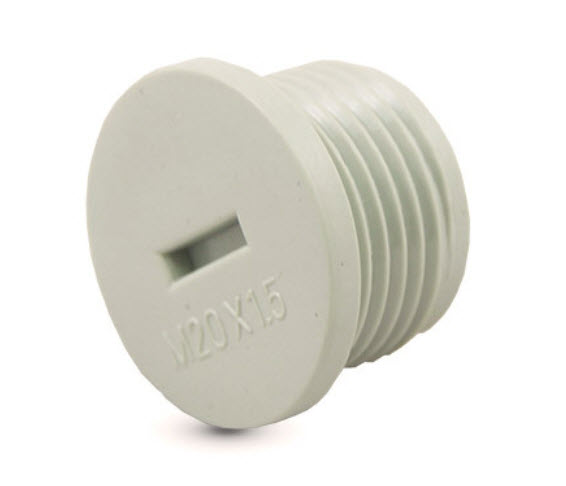
A conduit plug is a closed end-cap or solid stopper that fits into or onto the end of a conduit. It blocks the bore so nothing can travel through it. Threaded versions screw into the conduit thread or coupling. Push-fit and snap-fit versions seat into a plain conduit end with a friction or interference fit. Some are designed to be permanent, while others can be removed later when cabling is added.
An open conduit end is a direct path into the wiring system. Water, dirt, insects and small rodents will all use it. Plugging the end stops contamination, protects cable insulation and keeps the IP rating of any connected enclosure intact. On underground or outdoor runs, sealing is the difference between a clean pull and a blocked pipe.
Plugs sit inside the conduit bore. Caps fit over the outside of the conduit. Both seal the end, but the choice depends on whether the conduit terminates flush with a wall or projects out. Caps are more common on exposed pipework, while plugs are more often used at gland entries, junction boxes and switchboards.
Sealing the conduit end is part of overall ingress protection. Moisture causes corrosion at terminals and can wick along cable runs. Dust accumulation blocks future cable pulls and creates fire risk in some environments. Insects and rodents nest in unsealed conduits and chew cable insulation. A correctly fitted plug prevents all three.
Threaded plugs screw into the conduit thread or into a tapped opening on a fitting or enclosure. They suit rigid metal and IMC systems where a threaded engagement is the standard. The thread provides positive retention and a reliable seal when made up correctly with thread tape or sealant where required.
Push-in plugs are designed for plain PVC conduit. They press into the bore and rely on an interference fit to stay in place. Most are reusable and can be removed by hand or with a small tool when access is needed. They are quick to install and ideal for spare runs or temporary closures.
Weatherproof plugs include a sealing element such as an O-ring or moulded gasket. They are rated to specific IP levels and used where the conduit terminates at an outdoor enclosure or exposed wall. The IP rating of the plug must match or exceed the rating of the enclosure it seals.
Metallic plugs (steel or malleable iron) suit heavy-duty, high-impact, or hazardous-area installations. Non-metallic plugs (PVC, nylon, thermoplastic) suit corrosive environments, coastal sites and PVC conduit systems. Both have their place; selection depends on the surrounding conduit material and the environmental load.
Heavy-duty plugs are used where impact, vibration or high temperature is expected. They commonly appear on industrial switchboards, plant rooms and machinery enclosures. The weight and bulk of a metal plug is a feature, not a drawback, in these settings.
Plastic plugs avoid the galvanic corrosion issues of metal plugs in damp or salt-laden environments. They are the default choice on PVC conduit and pair naturally with PVC fittings, including conduit couplings and conduit bends.
Expansion plugs use a wing nut or screw to compress a rubber element against the bore. This creates a tight seal and accommodates small variations in conduit diameter. They are particularly useful for sealing test ends, draw pits and odd-sized runs.
Outdoor plugs need to handle direct sunlight without becoming brittle. UV-stabilised PVC and nylon are both rated for long outdoor service. Inspect outdoor plugs annually and replace any that show chalking, cracking or discolouration.
Australian electrical conduit follows metric trade sizes: 20mm, 25mm, 32mm, 40mm and 50mm are the most common. Conduit plugs are made to match each trade size. The 20mm and 25mm sizes cover most residential and light commercial work; 32mm and above appear on heavier circuits, sub-mains and communications runs.
Always match the plug to the trade size of the conduit, not a measured outside diameter. Trade size refers to the nominal bore. A 25mm plug suits 25mm medium duty rigid conduit and 25mm heavy duty rigid conduit alike, because the bore dimension is the same across both classes.
Australian installations use metric trade sizes. Imperial-sized plugs (typically from US-made rigid metal conduit) are not interchangeable with metric PVC fittings. Mixing systems leaves a gap that defeats the seal. Always source plugs from a supplier that confirms metric compatibility.
A loose plug is worse than no plug. It gives the appearance of a sealed end while still allowing ingress. If a push-fit plug feels loose in the bore, it is the wrong size. Check the markings, swap to the correct size, and verify the seat is firm before walking away.
20mm plug = 20mm conduit. 25mm plug = 25mm conduit. There is no acceptable cross-fit between sizes. If the marking is missing, measure the bore of the conduit at the cut end and match the trade size from the supplier's catalogue.
Match the plug to the conduit. PVC conduit takes a PVC or nylon plug. Rigid metal conduit takes a threaded steel or malleable iron plug. Mixing materials at a sealed end causes thermal movement to break the seal over time.
Indoor plugs can be standard PVC or nylon. Outdoor plugs must be UV-rated and weather sealed. Underground plugs need to handle long-term moisture exposure and soil contact. The electrical conduit and fittings range at Sparky Direct includes options for all three.
Match the plug's IP rating to the surrounding system. A plug terminating into an IP66 enclosure needs at least IP66 sealing performance. Anything lower compromises the rating of the entire assembly. Read the product datasheet to confirm before installing.
The most common errors are wrong size, wrong material and wrong IP class. Wrong size leaves a gap. Wrong material causes long-term breakdown. Wrong IP class undermines the enclosure rating. All three are avoidable with a 30-second check at the time of purchase.
Switchboards are designed with multiple conduit entries. Any entry that is not in use must be sealed to maintain the rating of the board. A conduit plug is the standard fitting for this. Boards with a high IP rating need plugs that match.
Pre-tapped knockouts on conduit junction boxes are commonly closed with threaded plugs. This keeps unused entries sealed and protects the internal terminations from dust and moisture during the box's service life.
Many installations include spare conduits for future cabling. Plugging both ends keeps the bore clean and ready. When the time comes to pull cable, the plug is removed, the cable is drawn, and the run is back in service without the need to clean out years of accumulated dust or debris.
Industrial, outdoor and underground installations all face higher ingress loads. Plug selection here is more critical. Weatherproof plugs, IP-rated assemblies and UV-stable materials are the norm rather than the exception.
Cut the conduit square. Deburr the inside and outside of the cut. A square, clean end gives the plug full contact and a reliable seal. Angled or burred cuts leave gaps and shorten the working life of the seal.
Thread the plug in by hand first to confirm alignment. Tighten with a spanner to the specified torque. Apply thread tape or sealant only where the plug datasheet requires it. Over-tightening cracks the plug or strips the thread.
Press the plug straight into the bore. A firm push should seat it fully with no rocking. If it goes in too easily, it is the wrong size. Conduit glue can be used on permanent installations where the plug is never expected to be removed.
Inspect plugs at the same intervals as the rest of the installation. Look for cracking, displacement, or signs of moisture ingress. Replace any plug that shows damage. A failed plug can compromise an entire enclosure rating.
Important: All electrical installation work in Australia must be carried out by a licensed electrician. Conduit plug selection and installation form part of the broader compliant cabling work covered by AS/NZS 3000:2018.
AS/NZS 3000:2018 (the Wiring Rules) requires that conduit entries to enclosures be sealed to maintain the rating of the enclosure. Unused conduit entries must be plugged. Sealing performance must be appropriate to the location: indoor, outdoor or hazardous.
Each enclosure has an IP rating that defines its dust and water resistance. The conduit plug forms part of that rated boundary. A board rated IP56 with an unsealed entry is no longer IP56 in service. Selection of the correct plug is part of compliance, not an afterthought.
Hazardous-area installations (Ex zones) require certified components throughout. Conduit plugs in these areas must be Ex-rated and installed per the certifying drawing. Substituting a standard plug for a certified one in a hazardous area is a serious compliance breach.
Buy plugs from suppliers that publish certification details. Look for compliance with AS/NZS 2053 (conduit and fittings) for PVC products. Reputable brands such as Clipsal and NLS provide datasheets that confirm certification, materials and ratings.
| Plug Type | Best For | Removable | Typical IP |
|---|---|---|---|
| PVC push-fit | PVC conduit, indoor and outdoor general use | Yes | IP54 to IP66 |
| Threaded steel | Rigid metal conduit, industrial | Yes (with tools) | IP65 to IP68 |
| Rubber expansion | Test ends, draw pits, mixed sizes | Yes | IP65 to IP68 |
| Glued PVC | Permanent terminations | No | IP66+ when sealed |
Permanent plugs are glued or designed for one-time installation. Temporary plugs can be removed without damage. Use permanent plugs only where you are certain no further access is needed. Use temporary plugs anywhere a future cable pull is possible.
Most threaded and push-fit plugs are reusable. Glued plugs and some snap-fit designs are single-use. Reusable plugs cost slightly more upfront but pay back when alterations are needed. Single-use plugs suit fit-and-forget terminations.
Rubber plugs handle dimensional variation and seal well, but degrade in UV. Plastic plugs are the standard for PVC systems and resist corrosion. Metal plugs handle impact and high temperature but corrode in damp or coastal locations. Match the plug to the environment.
Cheap plugs save cents per unit and cost dollars in callbacks. The cost difference between a budget plug and a quality compliant plug is small. The difference in performance and service life is significant. Buy quality and avoid the rework.
A correctly fitted plug stops everything that should not be in the conduit. This protects cable insulation, prevents nuisance tripping caused by moisture, and avoids the cost of pulling and replacing damaged cabling.
The enclosure rating depends on every entry being sealed to the same standard. A single missing or damaged plug drops the effective rating of the entire enclosure. Plug condition is part of any IP-rated maintenance regime.
Coastal, industrial and outdoor sites all shorten plug service life. Choose materials rated for the environment. Inspect more frequently in harsh conditions. Carry spare plugs for in-service replacement during planned maintenance.
There is no fixed replacement interval. Plugs are replaced based on condition during routine inspection. Outdoor plugs typically last five to ten years before showing UV damage. Indoor plugs in clean environments can last the life of the installation.
Standard PVC plugs in 20mm and 25mm sizes are inexpensive when bought in trade quantities. Larger sizes (32mm and above) cost more per unit, as do IP-rated and threaded metal versions. Pricing is competitive across reputable Australian wholesalers.
Buying in trade packs delivers the lowest unit cost. For regular work, keep a small stock of common sizes (20mm and 25mm). Plugs do not deteriorate in storage when kept in their original packaging.
Unbranded plugs from grey-market sources may not meet AS/NZS 2053. They may also not match the trade size they claim. The saving is not worth the compliance risk on a customer's site. Stick to branded products from reputable suppliers.
Online wholesalers like Sparky Direct combine trade pricing with fast dispatch. There is no need to drive to a counter for routine items. The full range of conduit fittings is available online with delivery to site or workshop.
Standard sizes are stocked and ship the same business day where ordered before cut-off. Less common sizes and specialist plugs may have a slightly longer lead time. Order ahead for jobs with tight deadlines.
Confirm three things before ordering: trade size, conduit material, and IP rating required. Get those right and the rest of the selection is straightforward. Add quantity buffer of around 10 to 15 percent to allow for damage and offcuts.
Ordering the wrong trade size is the most common error, followed by selecting standard plugs for outdoor or underground use. A second common mistake is buying too few; running short on a job means waiting for a top-up order to finish a board.
For a typical residential rough-in, 20mm and 25mm push-fit plugs in packs of 10 or 25 cover most needs. For commercial fit-outs, scale up and add 32mm and 40mm options to the stock list. Maintain spares in the van for in-service replacements.
Sparky Direct stocks the full range of conduit plugs from Clipsal, NLS, Trader, Tripac, General Trade Supplies and Rigid Conduit. Related products including sweep bends, solid elbows, inspection elbows, plain reducers, lock rings, straight gland fittings, PVC conduit saddles and TuffStuff cable lubricants are all available alongside.
Club Clipsal is Australia's largest electrician community offering trade rewards, business support, and exclusive benefits. When you nominate Sparky Direct as your preferred wholesaler, we automatically apply your Clipsal spend points to your Club Clipsal account daily.
Entry-level offering coaching, mentoring, and training discounts
Unlock exclusive industry tools and networking events
Access Toyota fleet offers and business software discounts
Maximum benefits, including VIP experiences and rewards
1. Sign Up: Create your Club Clipsal account at clipsal.com/club-clipsal or via the iCat mobile app
2. Nominate Sparky Direct: Select Sparky Direct from the wholesaler dropdown menu in your profile
3. Add Email: Enter your Sparky Direct account email address in the membership number field
4. Start Earning: Every dollar spent on Clipsal products earns points automatically
Redeem points from the rewards store, including gift cards, tools, and experiences. Access business summits, product training, and industry networking events. Receive early access to new product launches and special promotions. Connect with fellow electricians via the Club Clipsal community app.
Watch 20mm PVC Conduit Plug | 30276 video
Watch 25mm PVC Conduit Plug | 30277 video
Watch NLS SE20 | 20mm PVC Solid Elbow | 30081 video

This is a very compact tee and great if space is limited and looks so much better than the bulk inspection tees. Wires are easy to pass through the branch section, however consideration must be given.
This is the second time I am ordering from Sparky and I am satisfied with the prices, the products, the service and the delivery. I used all these products to make a crop protection cage for my backyard.
I couldn't believe the difference in savings on both products compared to the prices from the biggest electrical products supplier that I had using. I'll keep using Sparkie Direct without hesitation.
Quality products in stock • Fast Australia-wide delivery • Competitive trade pricing
Browse Conduit Plugs → Get Expert Advice →Yes, they provide a clean and professional finish to unused conduit ends.
Sparky Direct supplies conduit plugs Australia-wide, offering reliable conduit sealing solutions with convenient delivery.
Conduit plugs are securely packaged and delivered via standard courier services.
Unused products are generally eligible for return according to the seller’s returns policy.
Warranty coverage varies by manufacturer and typically covers defects in materials or workmanship.
Yes, conduit plugs are typically sold as individual electrical accessories.
Yes, selecting the correct size ensures a secure fit and proper sealing.
Once installed correctly, they generally require no maintenance.
Yes, they are commonly used when modifying or completing conduit runs.
They may be visible at conduit ends but are designed to be discreet.
Quality conduit plugs are designed to withstand everyday installation conditions.
Yes, sealing conduit ends helps stop insects and debris entering the system.
They are simple for trained professionals to fit as part of a compliant system.
Conduit plugs are electrical fittings used to seal the open end of a conduit run or unused conduit entry.
Yes, they are a standard finishing accessory in electrical installations.
They help keep conduit systems clean and protect wiring from environmental damage.
Yes, they are designed to work with standard conduit sizes and systems.
Yes, they help ensure conduit systems remain sealed and protected.
Yes, when correctly rated, they can be used to seal conduit ends in outdoor environments.
Yes, they are commonly used in indoor electrical conduit systems.
Yes, they are available to suit common conduit sizes such as 20mm, 25mm, and 32mm.
They are typically made from durable PVC or similar materials suitable for electrical installations.
Yes, they are designed for use with rigid electrical conduit.
Quality conduit plugs are manufactured to meet relevant AS/NZS electrical and safety standards when used correctly.
They are used to prevent dust, debris, moisture, and insects from entering conduit systems.