

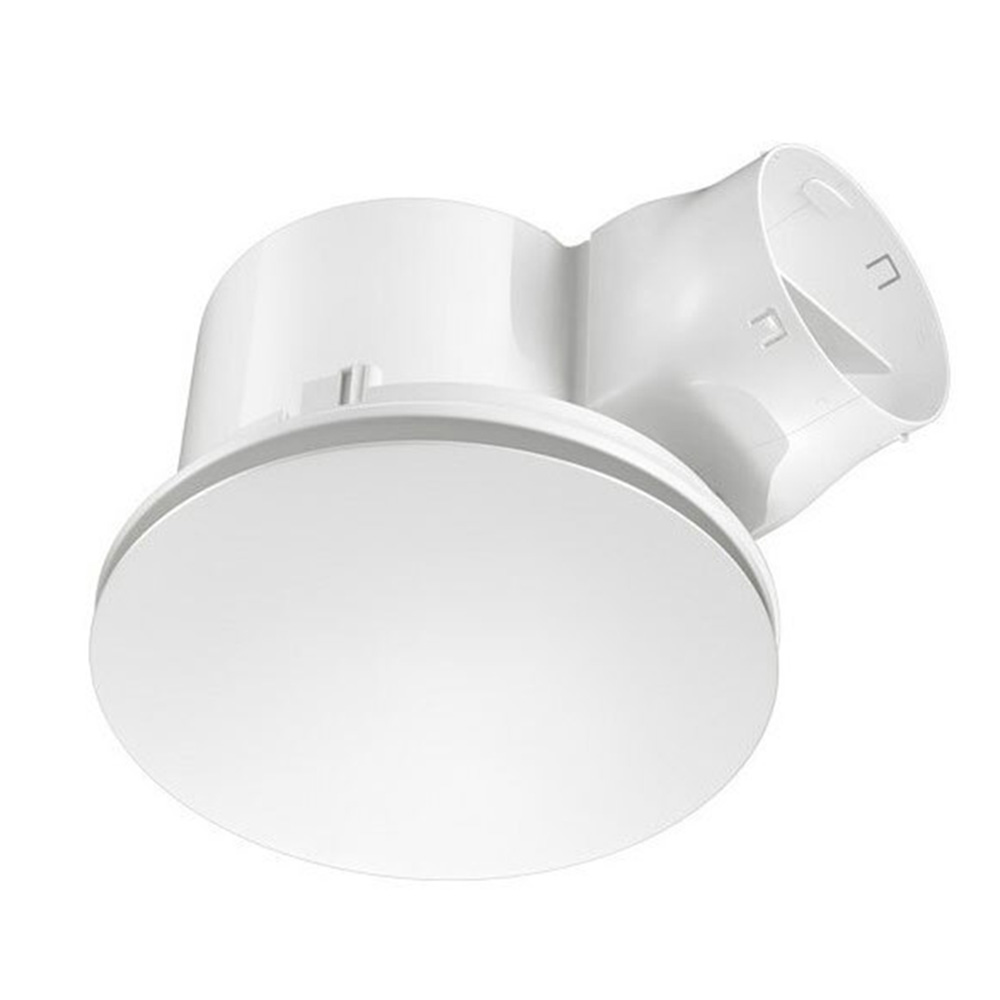


MARTEC MXFLFS25W | Flow Small Square 240mm Exhaust Fan with LED Tri Colour Light White
$129.75
$117.95 ex. GST
Search Results:
Search Results:
Exhaust fans with light combine two essential bathroom functions in a single ceiling penetration: mechanical ventilation to remove humidity, and general illumination for the wet area. The unit draws warm, saturated air upward and discharges it through ducting to the outside. Simultaneously, an LED module or replaceable globe housed within the same trim assembly illuminates the room.
In their simplest configuration, these are 2-in-1 luminaire-and-fan assemblies. A compact extraction motor drives an impeller or axial fan behind an intake grille, while an LED module (commonly tri-colour selectable or fixed warm white) illuminates the fixture perimeter or centre. Representative specifications, such as the Martec Flow Small Round 240mm, integrate a Martec exhaust fan with a tri-colour LED into a downlight-profile trim.
Ventilation and illumination operate on electrically separate circuits within the housing, each terminated at an independent switch mechanism. The extraction motor draws steam and odour-laden air through the grille, while the LED driver energises the luminaire independently. On 3-in-1 specifications, a dedicated third circuit switches the infrared heat lamps. This separation permits illumination without ventilation, or scheduled fan operation through a run-on timer after the lighting circuit de-energises.
The predominant installation scenarios include bathrooms, en-suites, laundries, and separate water closets. Kitchens occasionally receive them above island bench areas not served by a rangehood, although purpose-designed rangehood extraction remains the appropriate solution for cooking contaminants. Walk-in robes adjacent to bathrooms also benefit from combined fixture installation to clear residual humidity migrating through doorways.
Three main configurations dominate the Australian market, each suited to different room sizes and climate needs.
A 2-in-1 unit combines the extraction fan and an LED light. These units stay compact, usually under 280mm in diameter, and suit warmer regions where heat lamps are not needed. They also work well where another heat source already exists, such as hydronic or underfloor heating. Many 2-in-1 units use tri-colour LEDs (3000K, 4000K, 5000K) selected by a switch on the driver.
3-in-1 units add infrared heat lamps, typically 2 or 4 x 275W globes placed around a central fan and LED. The heat lamps warm a person directly with radiant heat rather than warming the room air. These are common across Victoria, Tasmania, and cooler parts of New South Wales. The Clipsal AIRFLOW 6600 series and the Brilliant Lighting Marvel are typical examples from the Clipsal and Brilliant Lighting ranges.
Inline systems place the motor inside the roof cavity, with a light-only grille visible at the ceiling. The fan vents through flexible ducting to an eave or roof vent. This layout is quieter at the ceiling and supports longer duct runs. Inline systems suit high-end bathrooms where low noise matters, or where the ceiling cavity is shared with other services.
Accurate sizing determines whether a fan clears steam within minutes or runs continuously without effective humidity control. Airflow is measured in cubic metres per hour (m³/h) or litres per second (L/s), and the target figure depends on room volume and usage frequency.
The standard calculation multiplies room volume by the required air changes per hour (ACH). For a representative bathroom measuring 2.5m x 3m x 2.4m, the total volume equals 18 m³. At 10 ACH, the recommended rate for typical bathrooms, required airflow equals 180 m³/h. Always round upward when selecting a fan capacity, because real-world airflow diminishes through ducting restrictions and terminal grille resistance.
ACH represents how often the total air volume within a room is replaced each hour. Bathrooms typically need 8 to 15 ACH, depending on how often they are used. Laundries sit at 6 to 10 ACH. Separate water closets need 8 to 12 ACH. A fan with a higher free-air rating than your calculation will cope better with long duct runs, bends, and terminal grille restrictions.
| Room Type | Recommended ACH | Example Volume | Target Airflow |
|---|---|---|---|
| Small bathroom/ensuite | 10 to 12 | 12 m³ | 120 to 145 m³/h |
| Standard bathroom | 8 to 10 | 18 m³ | 145 to 180 m³/h |
| Large bathroom | 8 to 10 | 30 m³ | 240 to 300 m³/h |
| Laundry | 6 to 8 | 15 m³ | 90 to 120 m³/h |
| Separate WC | 8 to 10 | 5 m³ | 40 to 50 m³/h |
A 150mm ceiling fan typically handles rooms up to 10 m². A 200mm fan suits rooms up to 18 m². A 250mm unit covers larger bathrooms and rooms with high ceilings. Free-air ratings on product specs assume zero ducting losses, so real-world output is often 30 to 50 per cent lower once the actual duct run is factored in.
Every bend, length of flexible duct, and terminal grille adds system resistance. A 6m run of 100mm flexible duct with two 90-degree bends can cut airflow by 40 per cent or more. For larger bathrooms or longer runs, step up to 125mm or 150mm ducting, or choose an inline fan with higher static pressure tolerance.
Calculate your room in cubic metres. Multiply by 10. That number is your minimum m³/h rating. If the duct run exceeds 3 metres or has more than one bend, add 25 per cent to the target.
Acoustic performance is one of the most common post-installation complaints from end users. Understanding dBA ratings and motor technologies helps trade buyers specify equipment that occupants will actually use.
Bathroom fan noise is measured in A-weighted decibels (dBA) at a standardised reference distance, conventionally 1 metre from the terminal grille. A rating of 30 dBA represents genuinely quiet operation, equivalent to a library environment. Between 40 and 50 dBA sits within a comfortable bathroom range. Ratings above 55 dBA become perceptibly intrusive. Confirm whether the stated dBA represents free-air or installed measurement conditions, because installed figures typically register 3 to 5 dBA higher.
Ball bearing motors last longer, typically 30,000 to 40,000 hours, and handle humidity better than sleeve bearings. Sleeve bearings cost less but can seize early, especially in humid bathrooms without enough drying time between uses. For a main bathroom cycled many times a day, ball bearings are the sensible choice.
Electronically commutated (EC) motors use a brushless DC architecture with integrated electronic speed regulation. EC equipment consumes approximately 30 to 50 percent less electrical input than shaded-pole AC motors delivering equivalent airflow, operates at reduced acoustic signature, and supports variable-speed modulation through compatible controllers. EC-specified exhaust fans command higher initial cost but recover the investment through reduced operating expense and extended service life. Where a standalone matching light is specified in the same installation zone, ceiling fan lights can complement the ventilation fixture.
Bathroom electrical fittings fall under statutory wet area compliance provisions. Correct specification is a licensing obligation, not a design preference.
IP denotes Ingress Protection classification. The first digit designates resistance to solid particles, while the second designates resistance to liquid ingress. For bathroom applications, the relevant ratings are IPX4 (splash-resistant), IPX5 (directed water jet resistance), and IPX7 (temporary submersion tolerance). The majority of ceiling-mounted exhaust fans with light carry IPX4 certification, which is generally adequate for the ceiling installation zones within residential bathrooms.
AS/NZS 3000:2018 (the Wiring Rules) defines bathroom zones according to distance from the bath or shower fixtures. Zone 0 encompasses the bath interior. Zone 1 extends vertically above to the ceiling plane. Zone 2 continues 0.6m beyond Zone 1 laterally. Zone 3 extends to 2.4m outward. Each zone carries minimum IP rating and operating voltage specifications. Ceiling fixtures positioned above shower installations must satisfy the relevant zone rating at actual installed height above finished floor level.
A conventional ceiling exhaust fan with light installed above the standard 2.25m shower head elevation typically sits outside Zone 1 classification in most residential bathrooms. Within Zone 1, only IPX4-rated fixtures protected by residual current device (RCD) circuit protection achieve compliance. Licensed electricians must verify zone boundaries at each installation because ceiling heights and bath positioning alter the zone calculations. Where a demist function is also needed, bathroom mirror demisters are a useful wet area accessory.
Licensed Electrician Only: Installation of mains-powered exhaust fans with light must be performed by a licensed electrician under AS/NZS 3000. DIY installation in bathrooms is not permitted in any Australian state or territory.
Contemporary exhaust fans with light have transitioned almost entirely to LED illumination. Understanding the differences helps trade buyers specify appropriate equipment for each installation.
LED modules within exhaust fan assemblies operate through an integrated electronic driver, typically rated between 8W and 12W, producing luminous output between 700 and 1,200 lumens. Many specifications incorporate tri-colour LED technology, permitting the installer or end user to select between 3000K (warm white), 4000K (neutral white), and 5000K (cool daylight) via a selector switch on the driver housing. Modern LED modules within fan assemblies achieve rated service lives between 30,000 and 50,000 hours.
Legacy exhaust fans used 40W incandescent globes or compact fluorescent lamps. LED now replaces both older technologies. An 8W LED delivers similar lumen output to a 40W incandescent while using 80 percent less power and running much cooler. Fluorescents dim over time and struggle in cold bathrooms, which is why LED has become the default across this category.
For most bathroom applications, 700 to 900 lumens from the exhaust fan luminaire proves adequate when complemented by supplementary wall or vanity illumination. Bathrooms without independent lighting should target 1,000 lumens or above. Colour temperature remains a preference-based decision, though 4000K represents a defensible middle ground that renders skin tones accurately while supporting wet area safety visibility.
Not all LED exhaust fan luminaires support dimming functionality. Verify the driver specification before pairing the fixture with a fan speed controller or compatible dimmer module. Smart-enabled equipment incorporating Wi-Fi or Zigbee connectivity is emerging but represents a minority specification within the category. The majority of installations continue to utilise conventional switch banks with independent fan, light, and heat circuit control.
The choice between 2-in-1 and 3-in-1 configurations depends on climate, existing heating, and bathroom use pattern.
Specify a 2-in-1 configuration, comprising fan plus light, in warmer climate zones where winter indoor minimums rarely drop below 10 degrees Celsius. Also specify 2-in-1 equipment in bathrooms that already have underfloor heating, heated towel rails, or ducted climate systems. The compact housing and smaller cut-out, typically 150 to 180mm, suits retrofits with limited ceiling cavity space.
3-in-1 units earn their place in southern climate zones and in older homes without central heating. The infrared heat lamps warm a person directly with radiant heat within seconds of activation, which matters more in a bathroom than warming the room air. They also suit guest bathrooms and en-suites used briefly at peak times.
A 2-in-1 unit costs less than an equivalent 3-in-1 and draws much less current. A 3-in-1 with 4 x 275W heat lamps pulls around 1,100W from the heating circuit alone, which means a dedicated switched circuit is needed in most installations. Check available circuit capacity before upgrading from a light-only fixture to a 3-in-1 specification.
| Feature | 2-in-1 (Fan + Light) | 3-in-1 (Fan + Light + Heat) |
|---|---|---|
| Typical wattage draw | 20 to 50W | 600 to 1,200W (heat on) |
| Cut-out size | 150 to 240mm | 240 to 320mm |
| Switch configuration | 2 gang | 3 gang (separate heat) |
| Best climate | Warm/temperate | Cool/cold winters |
| Warm-up time | Not applicable | Seconds (radiant) |
A correctly specified and installed exhaust fan with light delivers performance consistent with its rated capacity. Poor installation practice chokes airflow and generates moisture accumulation within the roof cavity.
Mount the unit close to the moisture source, which in bathroom applications means directly above or adjacent to the shower enclosure. Avoid positioning near doorways or windows, because air short-circuits from the opening rather than from the wet zone. Central ceiling positioning works effectively within small bathrooms. Over-shower placement, outside the shower head vertical projection, suits larger bathroom footprints. Products from the Airflow exhaust fan range are designed specifically for these positioning scenarios.
Specify rigid or semi-rigid ducting wherever physical constraints permit. Flexible aluminium or PVC ducting introduces substantial resistance and should be installed with minimum slack and maximum linearity. Minimum duct diameter remains 100mm for low-capacity fans, 125mm for mid-capacity equipment, and 150mm for high-airflow specifications. Keep duct runs below 6 metres total length, and use long-radius directional changes rather than acute 90-degree elbow fittings.
Discharging extracted air into the roof cavity is the single most damaging installation error. Moist air condenses on roof battens and insulation batts, causing timber decay, mould, and loss of thermal performance. All ducts must terminate outside the building through an eave vent, roof cowl, or wall outlet. Other common mistakes include crushed flexible ducting, reverse-mounted backdraft dampers, and over-tight grille fixings that distort the housing.
Every duct must terminate outside. Eave vents, roof cowls, or wall grilles with backdraft dampers are all acceptable. Never discharge into the roof space, soffit, or an adjacent room. This is both a moisture problem and an NCC non-compliance.
Beyond the basics of airflow and light output, a handful of features separate budget units from premium installations.
A well-built backdraft damper closes quickly when the motor stops, sealing the ductwork against reverse airflow. Budget units use loose plastic flaps that rattle in the wind. Premium units have spring-loaded or gasket-sealed damper mechanisms. The energy saving becomes measurable in cold climates where an unsealed duct continuously leaks warm indoor air all winter. Matching exhaust fan accessories, including external grilles and damper kits, can be specified alongside the primary fixture.
Humidity-sensing exhaust fans detect shower steam via an onboard hygrometer and run until relative humidity drops below a set threshold. This feature proves useful in rental properties and family bathrooms where manual switches are often neglected. Certain models combine humidity sensing with a run-on timer for belt-and-braces moisture control.
A run-on timer continues fan operation after the lighting circuit switches off. NCC energy efficiency provisions and some state-level building codes now recognise run-on timers as a compliant moisture management feature. A 5 to 15 minute run-on duration is usually enough to clear visible steam from a standard bathroom.
Matching the equipment to the installation requires thinking along three axes: the room's function, the space's size, and the features that matter most.
Bathrooms generally require elevated ACH targets and benefit from 3-in-1 configurations in cold climate zones. Laundries need moderate airflow but benefit substantially from humidity sensing, because washing machine cycles produce unpredictable vapour release. Kitchens are a distinct specification category: a rangehood is the appropriate primary extraction solution, and a bathroom exhaust fan is not engineered for grease extraction. Wall-mounted alternatives from the Airflow wall mount exhaust fans range suit rooms that cannot take a ceiling fitting.
Calculate volumetric capacity first by multiplying length, width, and ceiling height, expressed in cubic metres. Apply the ACH target from the sizing table. Round upward to the nearest available fan capacity rating. Where ducting imposes extended runs or multiple directional changes, upsize the specification by one increment.
For a master ensuite, prioritise low dBA, high lumens, and a dimmable driver where preferred. For a second bathroom or guest ensuite, a mid-tier specification with run-on timer functionality covers common usage scenarios. For a high-use family bathroom, build quality outweighs features, because the unit will cycle hundreds of operations weekly over its service life.
The Australian market includes premium manufacturers with decades of local distribution alongside budget imports that vary widely in quality.
Online electrical wholesalers typically offer better trade-tier pricing and a broader specification range than big-box retailers. Sparky Direct stocks Martec, Mercator, HPM, Ventair, and Fantech alongside Clipsal AIRFLOW, with same-week Australia-wide delivery for trade accounts. Additional ceiling-mount options are available in the Mercator ceiling mount exhaust fans range.
Budget units below AUD 100 typically use shaded-pole motors, thin plastic housings, and replaceable globe-style illumination. These tiers suit secondary bathrooms and rental property applications. Premium units above AUD 200 use ball bearing or EC motor technology, integrated LED drivers, superior damper mechanisms, and extended warranties. The price differential recovers through reduced callbacks and extended service life.
Verify cut-out dimensions against the existing ceiling aperture when replacing older equipment. Confirm the IP rating against the intended installation zone. Check that the luminaire is dimmable only where dimming is an actual specification requirement. Specify equipment carrying a minimum 2-year manufacturer warranty. Determine whether the globes or LED driver are field-replaceable or whether whole-unit replacement is required at end-of-life.
A correctly maintained exhaust fan installation delivers 10 years or greater service life. A neglected installation loses airflow capacity within months and can develop into a fire risk.
Clean the intake grille every 3 to 6 months. Dust-contaminated grilles can reduce effective airflow by approximately 30 percent. Isolate power at the wall-mounted switch before removing grille components. Clean with warm soapy water, dry thoroughly, and refit. Inspect impeller or blade assemblies for dust accumulation annually. Do not spray water into the motor housing.
Operate the fan throughout every shower and continue for 10 to 15 minutes following cycle completion. Leaving ventilation switched off causes condensation on wall and ceiling surfaces, which establishes mould colonisation within weeks in poorly ventilated bathrooms. A run-on timer automates this protocol. Inspect ceiling grille surfaces annually for water staining, which indicates ducting failure or roof-cavity condensation.
Replace the equipment if the motor becomes noisy, intermittent, or hot to the touch. Rattling blade assemblies indicate progressive bearing failure. Heat lamps cycling off prematurely may reflect loose electrical connections or degraded socket contacts. Upgrade to a contemporary specification if the existing fixture uses incandescent globes, lacks timer functionality, or exceeds 10 to 15 years of operational service.
Most exhaust fan problems trace back to a small set of underlying causes. Methodical progression through diagnostic steps usually identifies the fault.
The first diagnostic step is grille cleaning. If airflow remains weak, inspect the ducting for compression, kinking, or disconnection at the fan housing or external discharge point. Flexible ducting progressively develops sag over time and can pool condensation in lower sections. Replace any damaged sections. If the ducting is intact, the motor may be failing or the backdraft damper may be stuck closed.
A new or sudden rattle indicates loose impeller blade fixings, a lodged object, or bearing failure. De-energise the equipment, remove the grille, and inspect. A steady whine from a previously quiet fan suggests progressive bearing wear. A buzz without air movement indicates motor seizure or capacitor failure. Arrange replacement rather than field repair for most residential equipment.
For globe-based units, globe substitution is the first diagnostic. For LED equipment, verify that the driver is receiving supply voltage. Flickering LEDs often indicate a failing driver or an incompatible dimmer circuit. Certain LED exhaust fan modules are non-dimmable and will flicker or fail early when paired with a dimmer. Confirm the driver specification before replacing any switch.
Club Clipsal is Australia's largest electrician community offering trade rewards, business support, and exclusive benefits. When you nominate Sparky Direct as your preferred wholesaler, we automatically apply your Clipsal spend points to your Club Clipsal account daily.
Entry-level offering coaching, mentoring, and training discounts
Unlock exclusive industry tools and networking events
Access Toyota fleet offers and business software discounts
Maximum benefits, including VIP experiences and rewards
1. Sign Up: Create your Club Clipsal account at clipsal.com/club-clipsal or via the iCat mobile app
2. Nominate Sparky Direct: Select Sparky Direct from the wholesaler dropdown menu in your profile
3. Add Email: Enter your Sparky Direct account email address in the membership number field
4. Start Earning: Every dollar spent on Clipsal products earns points automatically
Redeem points from the rewards store, including gift cards, tools, and experiences. Access business summits, product training, and industry networking events. Receive early access to new product launches and special promotions. Connect with fellow electricians via the Club Clipsal community app.
Watch IXL12309 Tastic Prime 3 in 1 Bathroom Heater, Exhaust Fan & Light video
Watch MARTEC MXFLFR25W Flow Small Round 240mm Exhaust Fan with LED Tri Colour Light White video
Watch MARTEC MXFLFS25W Flow Small Square 240mm Exhaust Fan with LED Tri Colour Light White video

I had an older model which lasted 12 years, still works , but the fan would make banging noises while on and sometimes not even work. So I decided to get a new one and didn't want to cut a bigger hole or patch the existing hole for a different size fan. Went online and straight away found same looking fan with updated model on sparky direct website. Purchased and few days later delivered, that's how I like it. Got my sparky mate to install it and works a treat. Good stuff.
Heaps of air flow. 100mm duct required to plumb to external eves. Looks a lot like a downlight which keeps the fittings very similar if you've got downlights elsewhere. Seperate 10A plugs for the fan and light makes it very easy to plug in to an 413 in the roof space. Overall very happy with this exhaust fan light.
This light fan combo is simply stunning, very sleek. Two light temps, along with a powerful yet extremely quiet fan and intense heater. I bought two as a result !
Quality products in stock • Fast Australia-wide delivery • Competitive trade pricing
Browse Exhaust Fans with Light → Get Expert Advice →Noise levels vary by model, with many designed to operate quietly.
Sparky Direct supplies exhaust fans with light with fast Australian delivery to support effective ventilation and lighting solutions.
Yes, installation must be completed by a licensed electrician under Australian regulations.
Warranty coverage varies by manufacturer and typically applies to manufacturing defects.
Consider room size, airflow capacity, noise level, light output, and installation requirements.
Yes, products are available in various sizes and extraction capacities.
Many modern exhaust fans with light include integrated LED lighting.
Models designed for wet areas meet appropriate safety requirements when installed correctly.
Yes, they can be installed in older homes, subject to structural and wiring suitability.
Basic maintenance includes cleaning vents and light covers to maintain performance.
Low-profile models are available for installations with restricted ceiling space.
Some models are designed for intermittent use, while others may support extended operation.
By removing moist air, they can help reduce conditions that contribute to mould growth.
Exhaust fans with light are designed to provide both ventilation and illumination, commonly used in bathrooms, toilets, and laundry areas.
Many models allow independent control of the fan and the light, depending on wiring configuration.
Most models are simple to operate using a wall switch or control panel.
Yes, installation must be carried out by a licensed electrician in accordance with Australian regulations.
Yes, they are commonly used in laundries to help manage moisture and provide lighting.
Yes, models are available in different extraction capacities to suit small or large spaces.
Some models require ducting to vent air outside, while others may be designed for ceiling cavity exhaust, depending on application.
Many models use efficient fan motors and LED lighting to help reduce energy consumption.
In many cases, they can replace standard ceiling lights, subject to ceiling space, ducting, and wiring suitability.
Options include ceiling-mounted units, wall-mounted units, and models with LED lighting or integrated heat functions.
Yes, they are widely used in bathrooms to help remove moisture and provide functional lighting.
Exhaust fans with light supplied in Australia should comply with relevant AS/NZS electrical safety and ventilation standards.

