Search Results:
Search Results:
Search Results:
Search Results:
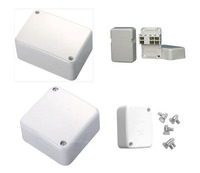
Find the best electrical junction boxes here at Sparky Direct. [ Read More ]
A junction box contains the point where two or more cables are joined. Inside the box, conductors are spliced using approved connectors, terminal blocks, or factory-fitted terminals. The enclosure keeps the joint mechanically secure and electrically isolated from anything outside.
The box also serves as an access point. If a fault develops in a buried or concealed run, an electrician can open the box, inspect the connections, and re-terminate without disturbing the rest of the cable.
The plastic or metal shell stops conductors from being pulled, crushed, or pierced by anything in the surrounding wall, ceiling, or slab. It also blocks airborne dust and contaminants that could foul a terminal over time.
For outdoor and damp installations, IP-rated boxes with sealed glands keep moisture out. Inside, terminals stay dry and corrosion-free for the life of the circuit.
Every accessible junction box is a service point. When inspections are scheduled or repairs are needed, the box gives a sparky direct visual access to the joins without cutting into the building fabric. This is why the wiring rules require boxes to remain accessible after installation.
Loose or exposed cable joins are a leading cause of electrical fires and shock incidents. A junction box prevents arcing between conductors and stops sparks from reaching combustible materials in walls and ceilings.
Quality boxes are made from flame-retardant polymers or steel, both of which contain a fault rather than feed it.
The Australian wiring rules require all live connections outside a fitting, accessory, or appliance to be inside an approved enclosure. This applies to every cable join in a domestic, commercial, or industrial circuit, including lighting tails, power circuit splits, and equipment supply runs.
Compliance reminder: Twisting wires together with insulating tape is not a compliant join. The connection must be made with an approved terminal inside an enclosure.
AS/NZS 3000:2018 sets the minimum standards for cable joins, enclosure type, and accessibility. The standard also references mechanical protection ratings, ingress protection (IP) for wet areas, and the requirement that all enclosed connections remain reachable for inspection. Any junction box installed in Australia must meet these requirements.
Indoor boxes are typically PVC and sized to suit common conduit diameters. They suit lighting circuits, power point splits, and any concealed join inside a dry building cavity.
Weatherproof models include compression glands at every entry. Look for IP56 minimum on outdoor wall-mounted boxes and IP66 for boxes exposed to direct rain or hose-down cleaning. The weatherproof box range covers these grades.
Fire-rated boxes are required when penetrating a fire-separated wall in commercial or multi-residential builds. They restore the rated barrier the wall provides.
Plastic boxes suit most domestic and light commercial work. Metal boxes are used where mechanical impact, heat, or industrial chemicals are a factor. Steel boxes also accept knockout entries for rigid metal conduit, which plastic cannot.
Box fill is the volume taken up by the cables, connectors, and devices inside the enclosure. Overfilling traps heat and stresses insulation. The standard sets minimum free volumes per conductor based on cable size.
A 1-way box accepts a single conduit entry and is suitable for a tee-off or change of direction. A 3-way or 4-way box accepts multiple entries and is used where several circuits converge. Always size up if there is any doubt about future expansion.
| Box Size | Typical Use | Cable Entries |
|---|---|---|
| 1 Way | Single tee-off or branch | 1 entry |
| 2 Way | Inline splice or angle change | 2 entries |
| 3 Way | Branch circuit or junction | 3 entries |
| 4 Way | Multiple circuit convergence | 4 entries |
Crowded boxes run hotter than open joins because heat cannot escape. Over time, the elevated temperature degrades insulation and can loosen screw terminals. Choose a deeper box if many cables enter a single point.
Surface boxes sit on top of the finished wall or ceiling. They suit retrofits, exposed brickwork, and any location where chasing into the wall is not practical. Surface boxes are also standard in plant rooms, garages, and workshops.
Flush boxes are recessed into the wall cavity behind plasterboard or masonry. They give a tidy finish in living spaces and are the default for new domestic builds. A recessed enclosure is the equivalent product for switchboards and larger gear.
Surface mounting is faster to install and easier to access later. Flush mounting looks cleaner but takes more time to fit and is harder to extend. The wiring rules require either type to remain accessible after the wall finish is in place.
For dry indoor work, a standard IP20 or IP40 plastic box is sufficient. These cover most lighting and power point joins inside the home or office.
IP ratings show how well the enclosure resists solid objects and water. The first digit covers dust, the second covers moisture. IP55 suits sheltered external work. IP66 suits direct rain and hose-down. Pair the box with the matching cable gland to maintain the rating at every entry.
Plant rooms, switchboards, and process areas often need a metal box rated for higher ambient temperatures. Look for an enclosure tested above 60 degrees Celsius if mounted near heat-producing equipment. The full electrical enclosures range covers heavier-duty options.
Glands grip the cable and seal the entry point. Grommets cushion the cable where it passes through a thin metal wall. Knockouts are pre-formed holes in metal boxes that punch out cleanly when needed. Each method has its place: glands for IP-rated work, grommets for general protection, knockouts for rigid steel installations.
Sharp edges inside the box can nick cable sheathing during installation. A grommet or gland bushing protects the insulation where the cable bends through the entry. This matters most where vibration or temperature change is present, since both will work the cable against the edge over time.
Every unused entry must be plugged. An open knockout breaks the IP rating and lets dust, insects, and moisture in. Use a conduit plug sized to the original opening to seal it cleanly.
The rules cover where joins may be made, what enclosure to use, and how the box must be fixed. They also set the requirement that all joins remain accessible for the life of the installation. Joins buried in concrete or sealed behind permanent finishes are not permitted.
In Australia, fixed-wiring connections must be made by a licensed electrician. This includes any work inside a junction box on a mains circuit. DIY work on the supply side of a fitting is not permitted under state electrical safety acts.
Boxes must be reachable without dismantling the building structure. A box behind plasterboard is accessible through a service panel or removable fitting. A box poured into a slab is not accessible and breaches the rules.
Fix the box to a solid substrate using the correct screw type for the material. Plasterboard fixings alone are not enough on a heavy box with multiple cables. Use a noggin or bracket where the box hangs in a void.
Strip the cable to the manufacturer's mark, twist solid conductors into the terminal, and torque the screw to spec. Pull-test each conductor after termination. A WAGO connector or screw connector gives a faster and more repeatable join than twist-and-tape, and both are approved methods.
A firm tug on each conductor after termination catches loose strands and under-tightened screws before the box is closed. This single check prevents most call-back failures.
Common errors include cutting cables too short to re-terminate, mixing different conductor sizes in a single terminal, and forgetting to seal unused entries. Each of these is a future fault waiting to happen.
Junction boxes appear at every cable join in domestic wiring. Lighting tails into batten holders, sub-circuit splits in roof voids, and power point branches all use them. Mini boxes are popular for in-ceiling lighting work because they fit through tight openings.
Commercial work uses larger boxes for the higher current circuits and the additional cabling that runs through suspended ceilings. Equipment supply tails and BMS controls often terminate in dedicated boxes near the load.
Garden lighting, pool pump supplies, and external sensor wiring all need an IP-rated box. The electrical conduits system feeds into the box through gland entries. UV-stable polymer keeps the lid from chalking and cracking after years of sun exposure.
Match the terminal rating to the load. A 20A box is fine for general lighting and power point work. Higher-current circuits, such as oven or air-conditioning supplies, need a box rated to at least the circuit breaker upstream. The Clipsal 554 series, for example, is a 40A heavy-duty box used on these larger loads.
Choose UV-stable polymer for outdoor sites, flame-retardant polymer for indoor work, and steel for industrial or impact-prone areas. Check the temperature rating where the box is fitted near transformers, motors, or hot pipework.
Pick a box one size larger than the current job needs. The cost difference is small and the spare entries make future additions straightforward. This is especially valuable in roof voids and switchboards where access is awkward.
Replace the lid gasket if it shows any sign of cracking or compression set. A perished gasket lets water in even when the box looks closed. Annual checks on outdoor boxes are good practice on commercial sites.
Heat is the silent killer of cable insulation. Avoid stacking boxes against insulation batts, and leave clearance around boxes that handle higher current. Cable should enter the box with a gentle bend, not a tight kink, so it is not stressed where it meets the gland.
Document the location of every concealed box at handover. A simple as-built drawing saves hours when a fault develops a decade later. The drawing also helps the next electrician comply with the accessibility rule when extensions are made.
Sparky Direct ships small junction boxes, large junction boxes, mini junction boxes, and adaptable boxes across Australia. The 20mm conduit junction boxes, 25mm conduit junction boxes, and 32mm conduit junction boxes are all available in shallow and deep configurations.
Hardware store boxes are made for occasional household use. Trade-grade boxes are sized to take the cable bend radius required by the standard, accept proper glands, and use polymer that holds up under sustained UV or heat. The price difference is small once the install time is factored in.
Check the IP rating, the maximum cable diameter, the number of entries, and the terminal current rating. Confirm the box is sold to AS/NZS standards. For outdoor use, check the UV stability data on the manufacturer sheet.
The range covers Clipsal for its full conduit and accessories ecosystem, National Light Sources for value-grade sparky kit, M-ELEC for fast-fit IP-rated work, Trader for outdoor termination boxes, and General Trade Supplies for conduit-system fittings.
An undersized box forces cables into tight bends and overheats the terminals. The job looks finished but the fault clock is already running.
Boxes installed behind permanent finishes or in inaccessible roof corners fail the wiring rules and create headaches at fault-finding time.
An indoor box on an outdoor wall fails within a season. Always match the IP rating and material grade to the environment, not the budget.
Intermittent power, flickering lights, or warm cover plates can all point back to a loose terminal in a junction box. Open the box, re-tension the screws, and pull-test each conductor. Replace the connector if the terminal is discoloured.
Green or white residue on terminals signals moisture entry. Replace the gasket, the gland, and any oxidised connectors. If the cable is wet beyond the box, cut it back to clean copper before re-terminating.
A box that runs warm to the touch is overloaded or undersized. Move some of the load to a second box or step up to a larger size. Heat is cumulative damage on cable insulation, so address it as soon as it is noticed.
Club Clipsal is Australia's largest electrician community offering trade rewards, business support, and exclusive benefits. When you nominate Sparky Direct as your preferred wholesaler, we automatically apply your Clipsal spend points to your Club Clipsal account daily.
Entry-level offering coaching, mentoring, and training discounts
Unlock exclusive industry tools and networking events
Access Toyota fleet offers and business software discounts
Maximum benefits, including VIP experiences and rewards
1. Sign Up: Create your Club Clipsal account at clipsal.com/club-clipsal or via the iCat mobile app
2. Nominate Sparky Direct: Select Sparky Direct from the wholesaler dropdown menu in your profile
3. Add Email: Enter your Sparky Direct account email address in the membership number field
4. Start Earning: Every dollar spent on Clipsal products earns points automatically
Redeem points from the rewards store, including gift cards, tools, and experiences. Access business summits, product training, and industry networking events. Receive early access to new product launches and special promotions. Connect with fellow electricians via the Club Clipsal community app.
Watch NLS 30300 | Small Junction Box With Connectors video
Watch Clipsal 554C4 | Large Junction Box 40Amp | Formerly the 554J4 video
Watch Trader HYJBIP3T | Junction Box IP56 with 3 Fixed Terminals | Hyena video

Needed some single entry 20mm Junction boxes for a renovation wiring project. Not use to buying small amounts of electrical fittings ?? Sparky Direct made it easier & simpler, at a competitive cost. Good price, and a varied range of fittings via a prompt post made it easier to finish my project. Saved running around 30 km + and sorting through numerous half depleted shelves, to come away with nothing useful. Direct to your door .....what you want .... easy choice!
Small yet robust product and ideal to safely accomodate the joining of three covered 240v mains cables. I used this one in a power supply project I was constructing for my internet modem and router
Great product. Used on an outdoor light to flood. Easy able to connect flex and TPS. Purchase 2 spare for the next problem job. Inclusion of corri connection helpful
Quality products in stock • Fast Australia-wide delivery • Competitive trade pricing
Browse Electrical Junction Boxes → Get Expert Advice →Yes, they help contain and manage cable connections neatly.
Sparky Direct supplies electrical junction boxes Australia-wide, offering reliable enclosure solutions with convenient delivery.
Junction boxes are securely packaged and delivered via standard courier services.
Unused products are generally eligible for return according to the seller’s returns policy.
Warranty coverage varies by manufacturer and typically covers defects in materials or workmanship.
Yes, junction boxes are typically sold as individual electrical enclosures.
Yes, choosing the correct size ensures safe cable management and compliance.
Once installed correctly, they generally require no maintenance.
Yes, they are commonly used when modifying or extending existing wiring.
They may be visible in surface-mounted installations or concealed depending on the setup.
Quality junction boxes are designed to withstand everyday installation conditions.
Yes, they shield connections from physical damage and environmental exposure.
They are straightforward for licensed electricians to install as part of a compliant system.
An electrical junction box is an enclosure used to house and protect electrical cable connections and terminations.
Yes, they are a standard component in electrical installations.
They protect electrical connections and help reduce the risk of damage or electrical faults.
Yes, they are suitable for residential, commercial, and light industrial applications.
Yes, they are commonly used in residential electrical systems.
Outdoor-rated junction boxes can be used externally when correctly specified.
Yes, many junction boxes are designed for indoor use.
Yes, they are available in a wide range of sizes to suit different wiring requirements.
They are typically made from durable plastic or metal, depending on the application.
Yes, they are commonly used with electrical conduit for cable entry and protection.
Yes, quality junction boxes are manufactured to meet relevant AS/NZS electrical and safety standards when installed correctly.
They are used to safely join, split, or terminate electrical cables within an installation.