Search Results:
Search Results:
Search Results:
Search Results:

Find the best weatherproof switchboard enclosures here at Sparky Direct. [ Read More ]
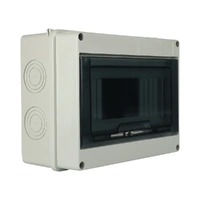
A weatherproof switchboard enclosure protects live electrical equipment from the outside environment using three layers of defence: a sealed body, a gasketed door, and rated cable entry points. Together, these prevent water, dust, and insects from reaching the busbars and switchgear inside.
The body is a single moulded shell or a welded enclosure with no penetrations other than designed entry points. A continuous EPDM or silicone gasket runs around the door perimeter, and door clamps or screws compress it evenly when closed. This compression creates the seal, so the gasket must remain clean, intact, and free of foreign material.
Cables enter through cable glands or knockouts fitted with sealed grommets. Each gland is itself IP-rated and matches the diameter of the cable. Unused entries must remain sealed with blanking plugs. A poorly fitted gland is the most common single cause of water ingress into an otherwise compliant enclosure.
Inside the enclosure, a 35mm DIN rail provides the mounting platform for circuit breakers, RCDs, and other modular devices. Pole counts on weatherproof boards range from 4 to 36 modules, with pole filler strips closing any unused positions. Wider rails and deeper enclosures accept double-tier configurations for high-density boards.
Choosing the wrong enclosure for an outdoor or wet location is a compliance failure and a safety hazard. Moisture inside a switchboard accelerates corrosion on terminals, tripping nuisance trips on RCDs, and in worst cases, can cause arc faults or fire.
Australian conditions punish electrical equipment. Driving rain in tropical regions, salt mist along the coast, fine dust in inland areas, and washdown sprays in food and processing sites all attack standard switchboards within months. A correctly rated weatherproof enclosure isolates the electrical work from these stresses for the design life of the installation.
AS/NZS 3000:2018, the Wiring Rules, requires switchboards to be suited to the environment of installation. For outdoor or damp areas this means an IP rating that addresses both expected water exposure and any mechanical risk. Using an indoor IP20 board outdoors will fail inspection and void insurance in the event of a fault.
Common applications include garden sub-boards, pool equipment circuits, shed and garage power, marina pedestals, construction site temporary supplies, and rural pump panels. Pair the enclosure with appropriate main switches and isolators to give a single point of disconnection for safe maintenance.
The IP rating system, defined in AS/NZS 60529, is the universal way to describe how well an enclosure resists solid objects and liquids. Two digits follow the letters IP. The first describes solids protection on a scale of 0 to 6. The second describes liquids protection on a scale of 0 to 9.
The first digit ranges from 0 (no protection) to 6 (dust tight). The second digit ranges from 0 (none) to 8 (continuous immersion) and 9 (high-pressure, high-temperature jets). Most weatherproof switchboards sit in the IP54 to IP66 band, which covers the vast majority of Australian outdoor and washdown applications.
| IP Rating | Solids | Liquids | Typical Use |
|---|---|---|---|
| IP54 | Dust protected | Splashing water | Sheltered outdoor, garage, eaves |
| IP55 | Dust protected | Low-pressure jets | Light commercial outdoor |
| IP65 | Dust tight | Low-pressure jets | Exposed outdoor, agricultural |
| IP66 | Dust tight | Powerful jets | Coastal, washdown, industrial |
| IP67 | Dust tight | Temporary immersion | Flood-prone, below grade |
Match the rating to the worst conditions the enclosure will see, not the average. A board sheltered under eaves still needs IP54 minimum to survive wind-driven rain. An exposed pool pump panel should be IP65 or IP66. Coastal sites benefit from the dust-tight first digit even when liquid risk is moderate, because salt-laden mist behaves like a fine conductive dust.
Construction material drives long-term performance. The three common choices for weatherproof switchboards are polycarbonate, mild steel, and stainless steel. Each suits different environments, and getting the choice wrong shortens service life dramatically.
Polycarbonate is the dominant material in residential and light commercial weatherproof switchboards. It does not corrode, tolerates wide temperature swings, and accepts cable glands cleanly. Look for grades that carry a UV rating, because non-stabilised polycarbonate becomes brittle after a few years of direct sun.
Steel enclosures suit larger sub-boards, three-phase distribution, and any site exposed to impact risk. Powder-coated mild steel is the everyday choice. For coastal jobs within a few kilometres of the surf, 316 stainless steel is the only material that offers a long service life without progressive surface corrosion.
Direct sun on a north-facing wall in Queensland can drive enclosure surface temperatures above 70 degrees Celsius. Confirm the manufacturer's UV rating and operating temperature window. Many polycarbonate boards are rated to 60 degrees ambient, which may be insufficient when combined with internal heat from heavily loaded breakers.
Australia presents one of the toughest mixes of conditions for outdoor electrical equipment in the world. A switchboard installed in Cairns faces different challenges to one installed in Adelaide or Hobart. The right specification depends on the local climate.
Within five kilometres of the surf, salt fog penetrates any unsealed gap and corrodes terminals quickly. Specify IP66 minimum and prefer 316 stainless steel or marine-grade polycarbonate. Internal heaters or breather drains help manage condensation in humid coastal climates.
Wherever possible, mount weatherproof enclosures under shade or with a sun shield. Ventilation breathers that pass moisture vapour but block water can prevent internal condensation cycles that age components. Avoid mounting on a north-facing roof cavity wall without thermal allowance.
Food processing, dairies, abattoirs, and car washes use high-pressure cleaning. The enclosure must meet IP65 or IP66, and the cable glands must match. Stainless steel resists the caustic detergents commonly used in these settings far better than painted mild steel.
Weatherproof switchboards come in formats sized to the installation. The right choice balances pole capacity, mounting style, and access requirements. Pole counts of 4, 6, 8, 9, 12, 18, and 24 are common, with larger industrial boards going to 36 or more.
Single-door boards suit residential sub-boards and small commercial loads. Multi-door designs separate the metering compartment from the consumer side, which is the standard approach for combined meter boxes and switchboards required by network distributors.
Modular ranges let installers join enclosures side by side or stack them. This suits large sub-boards where a single moulded body would be too heavy to handle on site. Plan the cable management between modules at the design stage to avoid awkward field rework.
Padlock-ready hasps and key-locked doors protect against tampering on public sites, marinas, and construction yards. Some Energex and Ergon network areas in Queensland mandate specific lockable clasps on meter enclosures, so confirm local rules before specifying.
Sizing and selection follow a simple decision sequence: define the load and pole count, identify the environment, set the IP rating, then pick the material. Working through the steps in order avoids the common trap of buying a board that fits the breakers but fails the environment.
Residential outdoor sub-boards typically need 4 to 12 modules in IP54 or IP65. Commercial sites often run 18 to 24 module boards in IP65 polycarbonate or steel. Industrial three-phase distribution may demand IP66, larger frame sizes, and stainless construction. Pair the enclosure with the right three pole main switches for the supply.
Count every modular device the board will hold: incoming main switch, RCDs, MCBs, RCBOs, surge protection, contactors, and timers. Add the DIN rail width of each, then add at least 25 percent for future circuits. A board crammed to the last pole on day one becomes a maintenance nightmare in five years.
Future-proofing pays back quickly. EV chargers, solar inverters, batteries, and pool pumps are common additions to existing homes. Specifying the next size up at installation is cheaper than swapping boards later. Pole filler strips close the unused gaps neatly until they are needed.
The difference between weatherproof and standard switchboards is not cosmetic. It comes down to gasket sealing, cable entry method, and material specification. Substituting one for the other in the wrong environment leads to predictable failures.
| Feature | Weatherproof Enclosure | Standard Enclosure |
|---|---|---|
| IP rating | IP54 to IP66 | IP20 to IP30 |
| Door seal | Continuous gasket | None or basic dust strip |
| Cable entry | Sealed glands or grommets | Open knockouts |
| Material | UV polycarbonate, stainless or coated steel | Plain steel or basic plastic |
| Cost | Higher | Lower |
| Suitable for outdoor | Yes, when correctly rated | No |
A weatherproof board costs more than an indoor equivalent of the same pole count. The premium reflects the gasket, the rated glands, and the moulding tolerances that maintain sealing under thermal cycling. For any wet or dirty location, the extra spend is the cost of compliance.
Weatherproof construction is required wherever the enclosure is exposed to rain, irrigation overspray, washdown, condensation cycling, or significant dust. AS/NZS 3000 leaves the rating decision to the installer based on conditions, but inspectors apply common-sense expectations for the location.
An undersized IP rating fails in two ways. The immediate way is failed certification at inspection, requiring replacement. The slower way is degraded equipment over months and years, leading to fault trips, board fires, or insurance disputes after a loss. Either outcome costs more than specifying correctly the first time.
Weatherproof switchboard installation in Australia is regulated work. Only licensed electricians may carry it out, and several standards govern how the board is built, mounted, and connected.
AS/NZS 3000:2018 sets the rules for switchboard location, enclosure suitability, identification, and accessibility. Section 2.9 covers switchboards specifically. Compliance is mandatory for every domestic, commercial, and industrial installation across Australia and New Zealand.
AS/NZS 61439 governs low-voltage switchgear and controlgear assemblies. It covers temperature rise, dielectric properties, short-circuit withstand, and degree of protection. Boards used in commercial and industrial settings should be supplied with documentation referencing this standard.
Only an electrician licensed in the relevant state or territory may install or alter a switchboard. DIY work on a switchboard, including replacing the enclosure of an existing live board, is illegal everywhere in Australia. Always engage a licensed contractor and request a Certificate of Compliance on completion.
Even a correctly specified board fails if it is installed poorly. Three areas drive long-term reliability: orientation, cable entry sealing, and earthing.
Mount the enclosure with the door opening downward or sideways, never upward. Leave clearance at the top, sides, and front for ventilation and access. Confirm the mounting surface is solid, level, and clear of irrigation, drip lines, and roof runoff paths.
Use the correct gland for each cable diameter. Tighten to the manufacturer's torque, not by feel. Fit blanking plugs to every unused entry. Cable glands enter from the bottom or side, never from the top, because top entries channel water into the enclosure under heavy rain. Match the gland thread to the entry: M20, M25, M32, and M40 are the common sizes from the cable gland range.
Bond the enclosure body to the main earth bar where the construction is metallic. Fit a breather drain at the lowest point of the enclosure if condensation is expected, because trapped moisture is more damaging than the rain the board was designed to keep out. Internal heaters help in cold-climate or marine sites prone to condensation cycles.
A correctly specified weatherproof board needs minimal maintenance, but it is not zero. Annual inspection extends service life and catches problems before they become outages.
Open the door and run a finger along the gasket. Look for cracking, hardening, or compression set. A gasket that no longer rebounds after door closure has lost its seal, and continued service allows water in. Replacement gaskets are available from most major manufacturers.
Check cable glands for tightness. Look for rust streaks below entries, which indicate water has been tracking in. Check terminal screws on the busbar for tightness using the device manufacturer's torque value. Loose terminations cause heat damage that is often blamed on water intrusion.
Keep a maintenance log on the board. Record gasket changes, gland replacements, and any inspection findings. A polycarbonate board in moderate Australian conditions typically lasts 15 to 25 years before the body itself ages out. Steel and stainless steel enclosures last longer when paint and gaskets are maintained.
Buying weatherproof switchboards online is the standard approach for trade purchasers. The catch is that not every online listing is the same product. Build a buying checklist before clicking purchase.
Sparky Direct supplies weatherproof switchboards from Clipsal, Hager, Legrand, NLS, Connected Switchgear, and Queensland Switchboards. Trade pricing and Australia-wide delivery apply across the range.
Budget enclosures look similar to specification-grade boards in photos but differ in gasket quality, plastic UV stabilisation, and gland thread accuracy. The difference shows up after two summers of sun exposure. For installations expected to last more than five years, specification-grade boards from established brands repay the price difference.
Three problems account for the majority of weatherproof switchboard failures: water ingress, wrong IP rating for the location, and installation errors. Each has a clear cause and a clear fix.
If water is appearing inside an enclosure, suspect the cable glands first, the gasket second, and the body itself last. Check that all unused entries have blanking plugs. Replace any hardened or cracked gasket. Confirm cables enter from the bottom or side, not the top.
Incorrect IP Rating Selection: If the board was specified at IP54 but sees direct hose-down or driving rain, replacement with an IP65 or IP66 unit is the only fix. Adding silicone sealant to a lower-rated board is not compliant and not effective long term.
Enclosures mounted at an angle, with the door hinge on the upper edge, or in a roof runoff path concentrate water at the seal. Re-mounting the board in the correct orientation is the only durable fix. Field-modified enclosures with ad-hoc penetrations should be replaced rather than patched.
Club Clipsal is Australia's largest electrician community offering trade rewards, business support, and exclusive benefits. When you nominate Sparky Direct as your preferred wholesaler, we automatically apply your Clipsal spend points to your Club Clipsal account daily.
Entry-level offering coaching, mentoring, and training discounts
Unlock exclusive industry tools and networking events
Access Toyota fleet offers and business software discounts
Maximum benefits, including VIP experiences and rewards
1. Sign Up: Create your Club Clipsal account at clipsal.com/club-clipsal or via the iCat mobile app
2. Nominate Sparky Direct: Select Sparky Direct from the wholesaler dropdown menu in your profile
3. Add Email: Enter your Sparky Direct account email address in the membership number field
4. Start Earning: Every dollar spent on Clipsal products earns points automatically
Redeem points from the rewards store, including gift cards, tools, and experiences. Access business summits, product training, and industry networking events. Receive early access to new product launches and special promotions. Connect with fellow electricians via the Club Clipsal community app.
Watch Legrand 601974 | 4 Module Surface Mount Weatherproof Switch Board IP65 IK09 video
Watch NLS 30296 | 6 Pole Surface Mount Weatherproof Switch Board IP54 video
Watch NLS 30298 | 18 Pole Surface Mount Distribution Board | IP54 Rated video

Having tried other enclosures which leaked I looked to Sparky for an IP66 initial. The unit has the necessary hardware for easy use. The din rail has only a small space to run wiring behind it so careful planning is necessary. Else, the quality is good and the price is OK. So far there has been no water ingress.
Size as stated, this was an issue and just fitted, plenty of space inside the box. Exchanged a fuse chassis with RCDBO’s, this was an easy job with the layout and space available.
Good product as it fills a niche where you need lots of boring DIN-rail mounted parts. I'm using these as DC solar combiner boxes and they fit the bill nicely.
Quality products in stock • Fast Australia-wide delivery • Competitive trade pricing
Browse Weatherproof Switchboards → Get Expert Advice →Yes, their sealed design helps protect internal components from moisture and dust.
Sparky Direct supplies weatherproof distribution boards Australia-wide, offering durable and compliant electrical protection solutions with convenient delivery.
They are securely packaged and delivered via standard courier services.
Unused products are generally eligible for return according to the seller’s returns policy.
Warranty coverage varies by manufacturer and typically covers defects in materials or workmanship.
Some are supplied pre-configured, while others are supplied as empty enclosures.
Yes, choosing the correct size and rating ensures safe and compliant operation.
Yes, they are usually surface-mounted and visible.
Quality boards are designed to withstand harsh environmental conditions.
Many designs allow additional circuits to be added if space permits.
Yes, they are commonly used in sheds, workshops, and outdoor work areas.
Modern designs are compact while still offering robust protection.
They are designed for straightforward access by licensed professionals when required.
Weatherproof distribution boards are electrical enclosures designed to safely house circuit breakers and electrical components in outdoor or exposed environments.
Yes, they are a standard solution for exposed or external electrical installations.
It provides reliable electrical protection in outdoor or harsh environments.
Yes, they protect electrical components from environmental exposure and accidental contact.
Yes, they are available in various sizes and configurations to suit different circuit requirements.
They typically house circuit breakers, RCDs, switches, and related electrical protection devices.
Yes, they are widely used in commercial and light industrial electrical projects.
Yes, they are commonly used in residential properties where outdoor electrical protection is required.
They feature sealed enclosures, gaskets, and rated protection to help prevent water and dust ingress.
They are commonly installed outdoors, in garages, plant rooms, sheds, and commercial or industrial settings.
Quality weatherproof distribution boards are manufactured to meet relevant AS/NZS electrical and safety standards when installed correctly.
They are used to distribute and protect electrical circuits where exposure to weather, moisture, or dust is possible.