Search Results:
Search Results:
Search Results:
Search Results:
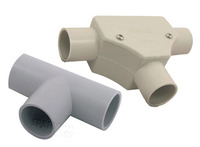
Find the best Straight Tees Conduit Fittings here at Sparky Direct. [ Read More ]
A conduit tee fitting is a moulded or machined three-port junction component. One port accepts the incoming main conduit run while a second port continues that run through to the next section. The third port branches perpendicular to the main axis at exactly 90 degrees. Cables travel through the main conduit, then divide at the internal junction to feed two separate destinations. The fitting protects the conductors at the branching point while maintaining mechanical continuity throughout the installation.
The majority of tee fittings used across Australian electrical installations are manufactured from PVC. These components glue or push-fit onto rigid conduit and form a chemically bonded, sealed joint when installed correctly with the appropriate solvent cement. Galvanised steel and other metallic tees serve industrial and high-impact installations where the conduit run requires additional mechanical strength and impact resistance beyond plastic capability.
Branching requirements are unavoidable in real-world electrical installations. A single supply circuit rarely terminates at a single destination outlet. Conduit tees allow electricians to divide the cable path cleanly without resorting to multiple junction boxes, surface-mounted enclosures or non-compliant open-cable workarounds. They keep the entire installation fully enclosed, professionally presentable and compliant with Australian wiring regulations.
Tee fittings also significantly reduce the total number of mechanical joints required throughout a conduit run. A single tee fitting replaces what would otherwise require a junction box plus two additional short conduit segments. Reducing joint count translates directly into fewer potential leakage points and fewer mechanical stress concentrations.
An elbow fitting changes the direction of a conduit run using two perpendicular ports. A coupler joins two conduit lengths together in a continuous straight line. A tee fitting introduces a third branching port in addition to the main through-run. Each fitting handles a fundamentally different routing geometry. The tee is the only standard fitting type that physically splits a single run into two independent paths.
Tee fittings shape the physical layout of an installation. They define where branches drop, where supplies split and where future expansion can attach. Designers plan tee positions early because moving them later is disruptive.
The straight tee is the most commonly specified type for general electrical installations. All three internal ports sit aligned in the same horizontal plane. The branching port exits the main run at exactly 90 degrees perpendicular. This compact configuration represents the workhorse fitting specified for most residential and commercial conduit installations.
Inspection tees incorporate a removable threaded or screw-fixed cover plate at the junction point. The cover plate provides direct internal access to the fitting interior after the installation has been completed. This becomes critical when conductors require redrawing through the branch port at a later date, or when fault-finding investigations require direct visual inspection of the cable transition. Inspection tees are physically bulkier than equivalent straight tees, but they justify the additional space requirement when future access matters.
Some specialised tee designs incorporate threaded screw-on covers, drainage ports or female threaded entries for compression gland fittings. These designs suit installations exposed to moisture infiltration, accumulated dust contamination or frequent maintenance access requirements. Specification cost is higher, but the extended service life justifies the investment in harsh environmental conditions.
Tee fittings sourced from different manufacturers can vary significantly in moulded wall thickness, internal bend radius and port dimensional tolerance. This dimensional variation is precisely why matching the tee fitting brand to the conduit manufacturer brand matters substantially. NLS-branded tees fit NLS-manufactured conduit cleanly without modification. Mixing fittings across manufacturer brands can produce loose mechanical joints, require excessive adhesive application to seal properly or fail standards compliance verification.
PVC dominates the Australian conduit fitting market. It is light, easy to glue, resistant to most chemicals and inexpensive. Grey PVC suits indoor and concealed work. Orange PVC indicates heavy duty rated fittings, typically used for underground or impact-prone runs.
Steel and galvanised tees handle mechanical impact and high temperatures better than PVC. They are used in plant rooms, industrial sites and exposed external runs where vehicles or equipment might strike the conduit. Metal fittings cost more and require thread sealing rather than solvent glue.
PVC resists corrosion from most household and commercial chemicals. It does degrade under prolonged UV exposure, which is why outdoor PVC runs need shading or UV-stabilised fittings. Galvanised steel resists rust in dry conditions but can corrode in marine or chemical environments. Stainless steel is the choice for coastal and corrosive sites.
Heavy duty PVC tees rated for orange (HD) duty handle ground burial and concrete encasement. Medium duty grey tees suit indoor wall and ceiling runs. The duty rating refers to impact resistance and crush strength, not just material thickness. Always match the tee duty to the run duty.
Conduit tees are sized by the nominal conduit diameter they accept. The most common sizes in Australian electrical work are 20mm and 25mm. 16mm tees suit light data and control runs. 32mm and 40mm tees serve larger feeders and main supply runs. Sizes above 50mm exist but are mainly used in industrial settings.
The tee size must match the conduit it joins. A 25mm tee will not seat correctly on 20mm conduit, even with extra glue. The internal port diameter is engineered to fit one specific conduit size. If you need to step up or down, use a reducer at the tee port rather than forcing a mismatched fit.
Standard PVC tees are designed for rigid conduit. Flexible corrugated conduit uses different fittings, typically with internal threads or barbed couplings. Mixing rigid tees with corrugated conduit produces loose, non-compliant joints.
Mismatched fittings are one of the most common causes of conduit failure on inspection. The joint may look acceptable initially but leaks, separates under load or fails compliance checks. Always confirm the tee matches the conduit size, duty rating and material type before fitting.
Pick the tee type based on access needs. If the branch needs future inspection or cable changes, choose an inspection tee. If the branch is fixed and final, a straight tee is cheaper, smaller and faster to install.
Indoor work uses medium duty grey PVC. Outdoor and underground work uses heavy duty orange PVC or UV-stabilised fittings. Industrial work may require metal tees for impact and temperature resistance. Match the tee specification to the environment, not just the conduit.
The branch port has a tighter internal radius than the main run. This limits how many cables can be pulled through cleanly. Plan tee positions to allow some spare capacity. A tee that is full on day one leaves no room for future circuits.
Three mistakes recur: wrong size, wrong duty rating and wrong fitting type. Buyers often grab a 25mm tee for a 20mm run because it was on the shelf. Or they fit a medium duty grey tee where the run is rated heavy duty. Both create compliance and reliability problems.
Tees branch sub-circuits off main feeder runs at the switchboard. They keep the conduit work tidy where multiple circuits leave the board. Without tees, the same job needs three or four junction boxes instead of one fitting.
Office fit-outs and shop refurbishments lean on tees to drop power and data feeds from ceiling runs into wall positions. The branch port carries the drop while the main run continues to the next location. Inspection tees are common here because tenant changes often require recabling.
Industrial sites use larger 32mm and 40mm tees with metal construction. Tee fittings carry power and control runs through plant rooms and along production lines, branching off to motors, sensors and control panels.
Adding a new circuit to an existing run usually means cutting the conduit and inserting a tee. This is faster and tidier than running a parallel conduit alongside. Inspection tees suit retrofit work because they allow the new cables to be pulled in after fitting.
Plan the intended branch direction carefully before cutting any conduit. The branch port orientation is permanently fixed at 90 degrees relative to the main run axis. If the branch needs to exit upward toward the ceiling, the entire tee must rotate so the branch port faces upward during installation. Once solvent cement has cured, the orientation cannot be changed without destroying the joint. Always dry-fit the complete assembly first, mark the correct orientation with a permanent marker, then proceed with adhesive application.
Cut all conduit ends square and perpendicular to the conduit axis. A skewed angled cut leaves an inadequate sealing surface and significantly weakens the resulting joint. Deburr the freshly cut edge thoroughly so the conduit slides cleanly into the tee fitting port without resistance. Wipe both the conduit exterior and the tee fitting port interior with a clean, dry cloth before applying PVC conduit cement.
Apply solvent cement liberally to both the conduit external surface and the internal surface of the tee fitting port. Insert the conduit fully home into the port, hold firmly in position for the cure time specified on the adhesive container, then release the assembly. Wipe excess cement immediately from external surfaces before it sets. Support the tee fitting structurally with conduit saddles within 300mm on each side to prevent mechanical strain transferring onto the cured adhesive joint.
Visually inspect every completed joint for full conduit seating depth and clean continuous adhesive lines around the port circumference. Pressure test conduit runs that will be subsequently buried or concealed before the installation is permanently covered. Pull a stiff draw wire through the tee fitting to confirm the branch port internal passage remains clear and that no excess adhesive has migrated into the bore and reduced the effective internal diameter.
If the branch port is rotated even 10 degrees off the intended direction, the cable enters the run at an angle. Over time this creates a stress point at the cable sheath. The cable can chafe or fail prematurely. Always dry-fit and check orientation before glueing.
The branch port has a tighter internal radius than the main run. Pulling too many cables through the branch causes binding, sheath damage and pulling tension that can dislodge the joint. Stay within the cable fill capacity rated for the conduit size.
A 25mm tee on 20mm conduit will leak, separate or fail compliance. A medium duty tee on a heavy duty run reduces the rating of the entire installation. Material substitution is one of the fastest ways to fail an inspection.
Sealing matters most in concealed work: A loose tee joint hidden in a wall cavity or buried in concrete cannot be repaired without significant disruption. Apply glue generously to both surfaces, hold the joint for the full cure time, and verify the joint is solid before the run is covered.
Every fitting in a run adds friction to the cable pulling effort. A tee adds friction at both the main port and the branch port. Plan pulls so the heaviest tension section avoids multiple tees. Lubricant such as cable lube reduces tension noticeably on long runs with several fittings.
The branch port radius is the friction hotspot. Cable pulled hard through this radius can shave PVC off the inside of the fitting and damage the cable sheath. Pull steadily, never jerk, and use lubricant on runs of more than 5 metres.
Tees naturally organise the cable run by separating the through cables from the branch cables. This makes the installation easier to trace later and reduces the time needed for fault finding or future modifications.
Inspection tees give direct access to the branch point. When a circuit needs to be tested, isolated or replaced, an inspection tee makes the work straightforward. A buried straight tee on the same run would require cutting the conduit.
All electrical conduit fittings used in Australia should comply with AS/NZS 2053 series for rigid PVC conduit and fittings. AS/NZS 3000:2018 (the Wiring Rules) sets the broader installation requirements. Non-compliant fittings can fail inspection, void insurance and create safety risks.
Quality tees have consistent wall thickness, smooth internal bore and clean port edges. The branding is moulded into the fitting, not printed on. Cheap tees often show flash marks, uneven walls and inconsistent port tolerance. The price difference is small. The reliability difference is significant.
Indoor concealed work suits medium duty grey PVC. Outdoor, exposed or underground work needs heavy duty orange PVC. Marine, chemical and high-temperature environments need specific material selection. Match the fitting rating to the environment, not the cheapest option on the shelf.
Sparky Direct stocks fittings that meet the relevant AS/NZS standards for the application. The product listing shows the duty rating and standards reference where applicable. If a fitting is required for a regulated installation, confirm the rating matches the project specification.
An elbow fitting changes the direction of a conduit run. A tee fitting branches a single run into multiple paths. These two fitting types are not interchangeable in installation practice. Substituting an elbow where a tee is required forces the installer to introduce a second parallel conduit run for the branch, doubling both material costs and labour requirements.
A junction box is significantly larger, allows electrical wiring connections to be made internally and accepts multiple conduit entries from various directions. A tee fitting carries continuous cables through without requiring termination. Specify a junction box when conductors need to be physically joined or terminated at the branching point. Specify a tee when the cables continue through the branch unbroken to their final destination.
| Scenario | Best Choice | Why |
|---|---|---|
| Branching a continuous cable run | Tee fitting | Compact, sealed, no termination needed |
| Joining or terminating cables at branch | Junction box | Provides space for connections and inspection |
| Future access to branch cables | Inspection tee | Removable cover allows cable changes |
| Permanent concealed branch | Straight tee | Compact, low cost, fully sealed |
If the branch is short and the cable count is low, a tee is the cleanest solution. If the branch carries many cables or needs terminations, a junction box is better. If the branch follows a complex path, multiple elbows may be more practical than a single tee.
The right tee saves material, labour and future maintenance time. A correctly chosen tee installs in minutes, seals reliably and serves the run for decades without intervention.
Tee fittings keep the electrical conductors fully enclosed at the branching point. This enclosure protects cables from physical impact, abrasion damage and rodent attack throughout the installation lifetime. The enclosed branching also keeps the installation visually tidy and makes circuit tracing significantly easier during future maintenance work.
A correctly installed tee fitting transfers no mechanical stress onto the cable itself. The conduit and fitting system carries the entire mechanical load while the conductor sits inside the protected internal passage without tension. Poor installation practice reverses this load relationship, transferring all mechanical stress onto the cable sheath instead of the conduit system.
PVC conduit and tee fittings, when installed according to manufacturer instructions, typically last the full operational life of the building structure. Tees do not wear mechanically, corrode chemically or degrade thermally under normal indoor or concealed installation conditions. They function as fit-and-forget components when correctly specified and properly installed during initial construction.
Inspection tees should be examined during routine periodic electrical inspections for general installation condition. Look carefully for stress cracks, adhesive joint failure or visible signs of cable strain at the branch port entry. Standard straight tees require no scheduled maintenance under normal indoor conditions and continue to perform reliably without intervention.
Standard PVC straight tees are inexpensive. Sparky Direct typically prices 20mm and 25mm PVC tees in single-digit dollars per unit, with significant savings on bulk purchases. Inspection tees cost more because of the additional cover plate. Heavy duty orange tees carry a small premium over medium duty grey.
Tradies on a project should always price the bulk pack against the single unit. Bulk packs typically cut the per-unit cost by 20 to 40 percent. A single tee for a small repair is fine to buy individually. A new fit-out should always be costed in bulk.
Generic imported tees can be 30 to 50 percent cheaper than branded equivalents. They may not meet AS/NZS standards. They may fit loosely on standard conduit. They may fail inspection. The saving disappears the first time the installation needs rework. Buy compliant fittings from named brands.
Online wholesalers cut overhead and pass the saving on. Sparky Direct ships nationally with trade pricing on bulk orders. The product range matches what the major branch suppliers stock, often at lower prices and with delivery direct to site or workshop.
Stock availability matters when the project is on a deadline. Sparky Direct holds stock of common tee sizes, ships same day for orders placed before cutoff and delivers Australia-wide. Ordering ahead of project start avoids the cost of branch trips during the job.
Small jobs need a handful of common sizes. Larger projects need a planned mix of sizes, duty ratings and tee types. Spec the order against the cable schedule and conduit run plan rather than guessing.
Buying the wrong size is the single most common mistake. Confirm the conduit size before ordering. The second most common is buying medium duty when heavy duty is required. The third is ordering straight tees when the job needs inspection tees for later access.
Order 10 to 15 percent more than the cable schedule shows. Variations, breakages and future expansion will use the surplus. Tees do not have a shelf life in normal storage, so unused stock can carry to the next job.
Sparky Direct is one of Australia's leading online electrical wholesalers, supplying licensed electricians and trade buyers nationwide. The conduit fittings range covers tees, elbows, couplings, junction boxes, glue and saddles from NLS, Clipsal, AussieDuct, HPM and Trader. Order online with fast delivery to anywhere in Australia.
Watch NLS 30079 | Straight Tee 20mm PVC video
Watch NLS 30080 | 25mm Straight Tee PVC video
Watch Inspection Tee 25mm | IT25 video

This is a very compact tee and great if space is limited and looks so much better than the bulk inspection tees. Wires are easy to pass through the branch section, however consideration must be given to wire qty and sizing along with the number of through wires due to the minimal area for the radial turn of the branch wire, This tee was perfect for my job and I had no problem using it at all
This is the second time I am ordering from Sparky and I am satisfied with the prices, the products, the service and the delivery. Thank you!
Perfect for joining 2 split system drains into one. Fast postage and great price.
Quality products in stock • Fast Australia-wide delivery • Competitive trade pricing
Browse Conduit Tee Fittings → Get Expert Advice →Yes, they are a standard fitting in many conduit installations.
Sparky Direct supplies inspection and straight tee electrical conduit fittings Australia-wide, offering reliable conduit junction solutions with convenient delivery.
Straight tee fittings are securely packaged and delivered via standard courier services.
Unused products are generally eligible for return according to the seller’s returns policy.
Warranty coverage varies by manufacturer and typically covers defects in materials or workmanship.
Yes, straight and inspection tee fittings are typically sold as individual conduit accessories.
Yes, correct planning ensures accessibility, neat layout, and compliance.
Yes, they are often used when extending or modifying existing conduit systems.
Quality straight tees are designed to withstand everyday installation conditions.
Yes, they are commonly used in surface-mounted installations.
Yes, they maintain conduit continuity and cable protection.
Yes, they are designed to allow access without dismantling conduit runs.
Yes, they help create clean and professional conduit layouts.
Straight tee fittings are conduit accessories used to create a T-shaped junction that branches conduit in a straight-through direction.
Inspection tees are useful when future access to cables may be required.
They allow neat and organised branching of conduit runs.
Yes, they are suitable for residential, commercial, and light industrial applications.
Yes, they are commonly used in indoor electrical conduit systems.
Yes, inspection tees are designed with removable covers for access to wiring.
Yes, they are available to suit common conduit sizes such as 20mm, 25mm, and 32mm.
They are typically made from durable PVC or similar materials suitable for electrical installations.
Yes, they are designed for use with rigid electrical conduit.
Quality tee fittings are manufactured to meet relevant AS/NZS electrical and safety standards when installed correctly.
They are used to branch electrical conduit runs while maintaining continuous cable protection.
Inspection tees include an access cover that allows cables to be inspected or pulled at the junction point.