Search Results:
Search Results:
Search Results:
Search Results:
Every conduit run has corners. A bend is the fitting that takes the run around them while keeping the cable jacket safe and the pulling force within sensible limits.
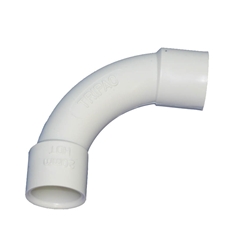
A conduit bend is a pre-formed length of PVC or metal pipe shaped to a fixed angle, usually 90 degrees. The fitting glues or pushes into a straight conduit at each end. Cables run through the bend exactly as they would through straight pipe, but the curve carries them to the new direction without sharp internal edges.
Cable insulation can be damaged by tight angles, sharp burrs, and excessive pulling tension. A factory bend gives a clean radius that protects the conductors during installation and across the life of the cable. Compliance with AS/NZS 3000 also requires that conduit systems give cables adequate mechanical protection at every change of direction.
The internal radius of a standard bend keeps the cable arc gentle. That matters most during the pull, when friction multiplies at every corner. Smooth, generous bends reduce that friction and protect both single core and multicore cables from jacket abrasion.
Straight medium duty rigid conduit carries cables along the run. Bends carry them around it. Trying to bend straight pipe by hand without a bending spring often produces a kinked or flattened section, which restricts cable pulling and can fail inspection.
Bends are sold by shape, angle, and radius. Picking the right combination is mostly a matter of run geometry and how many cables need to fit through.
Pre-formed standard bends arrive ready to glue in. Site-formed bends are made on the job by heating PVC conduit with a hot air tool or shaping it around a bending spring. Pre-formed fittings are faster on commercial jobs and produce a consistent radius every time.
The 90 degree bend is the workhorse for vertical to horizontal transitions. 45 degree fittings are used for offsets around obstructions or to soften a cable pull. 22.5 degree bends pair up to navigate shallow angles where a full 45 would overshoot.
Standard bends have a tighter internal radius and suit most domestic runs. Long radius fittings, often called sweep bends, give cables a much gentler curve. Sweep bends are the right choice for long underground feeds, larger cable bundles, and any pull where tension is a concern.
Rigid bends hold their shape and are glued into the run. Where a route changes direction in a way no rigid fitting can match, a short length of corrugated conduit can be used as a flexible substitute. Corrugated conduit is not a direct replacement for a rigid bend on visible or compliance-critical runs, but it has its place in tight cavities.
The bend material decides how the fitting handles UV, impact, and corrosion. PVC dominates Australian general wiring; metal still has a place in heavy industry.
PVC is the standard for residential and commercial wiring. It is light, easy to glue with PVC conduit cement, and resistant to most internal moisture. Grey PVC is used for medium duty above ground, while orange PVC is the heavy duty profile rated for buried and impact-prone runs.
Galvanised steel and stainless bends appear in factories, switchrooms, and any location with high mechanical or fire risk. Metal fittings are heavier and more expensive but resist impact, heat, and rodents in ways PVC cannot.
PVC absorbs minor knocks and flexes slightly under load. Metal does neither, but it carries far higher impact loads before cracking. The choice between them is usually settled by the specification, not the price.
PVC will not corrode. It can become brittle under long term UV exposure unless it is rated for outdoor use. Metal conduit corrodes in coastal, chemical, or wash-down environments unless it is galvanised, painted, or stainless. Match the material to the site, not the catalogue price.
Bend size is dictated by the conduit diameter. Bend radius is dictated by the cable inside the conduit.
Bends are made in 20mm, 25mm, 32mm, 40mm, and 50mm to match the standard PVC conduit range. The fitting sleeve is sized to slip over the conduit and seal with cement. Mismatched sizes will leak, fall apart, or refuse to glue.
Each cable type has a minimum bend radius set by its manufacturer, typically four to eight times the cable diameter. The conduit bend must respect that figure or the insulation can be damaged. Larger conductors need larger radius fittings, which is where sweep bends earn their keep.
Friction on a 90 degree bend can roughly double the pulling force needed for the run. Three or four bends in series can make a long pull impossible without an intermediate conduit junction box as a draw point.
Site-formed PVC bends often crease on the inside of the curve when heated unevenly. A flattened or kinked bend reduces the usable diameter and snags cable jackets. If the deformation is visible, replace the section.
Selection is a short list of questions about the run, the cable, and the location.
Domestic rewires usually call for grey medium duty 20mm and 25mm standard bends. Underground feeds and submains step up to orange heavy duty. Communications cabling in 50mm rigid runs almost always wants long radius sweeps to protect the data pairs.
Indoor concealed runs accept the cheapest compliant fitting. Outdoor and exposed runs need UV-stable PVC or metal. Industrial sites with chemical or impact exposure usually drive the choice towards heavy duty rigid conduit systems and matching heavy duty bends.
Surface mounted runs in commercial fit-outs are often visible to occupants. Choose a clean finish, plan the bend positions to look intentional, and use conduit saddles at consistent intervals so the run reads as a deliberate detail, not a workaround.
Three mistakes appear repeatedly: undersized bends for the cable count, mixing medium and heavy duty pieces in one run, and using indoor-grade fittings outdoors. Each one shows up either at the pull or at the first hot Australian summer.
Bends turn up in every category of electrical work. The specifics change with the building type.
New homes use 20mm and 25mm bends through slabs, wall cavities, and roof spaces. Renovation work often needs short runs of 25mm bends to drop a circuit down a wall to a new point.
Commercial sites use larger bends for shared submains, exposed riser conduits, and service corridor runs. The aesthetic standard is higher because surface mounted conduit is on display in plant rooms and back of house.
Factories, water plants, and substations rely on heavy duty bends and metal fittings. Sweep bends are common because the cable sizes are larger and the pulling distances longer.
Service cupboards, ceiling spaces, and switchboard backs often have no room for a standard radius. Where a normal bend cannot fit, an inspection elbow with a removable cover makes both the corner and future cable changes possible.
The installation routine is short. Skipping any step usually shows up later as a failed pull or a leaky joint.
Mark both the bend position and the conduit length on the run before any glue comes out of the can. Cut squarely with a PVC pipe cutter for a clean joint. Square ends seal properly and stop cement from running inside the pipe.
Most domestic and light commercial work uses pre-formed bends rather than site bending. Where a custom angle is needed, a hot air gun and a bending spring give a controlled site bend. Powered benders are mainly an industrial tool for metal conduit.
Bends should sit square to the run, not twisted. Glue each joint while the conduit is still indexed to the wall, then hold the alignment until the cement grabs. Saddle the run on each side of the bend to lock the geometry in place.
Pre-formed bends remove almost all the over-bending risk. With site bending, a short reheat will straighten a poor curve once. After that, the PVC is usually too compromised to reuse and the section gets cut out.
A clean bend pays for itself the first time someone has to pull a heavy submain through the run.
Pulling tension rises sharply at every bend. The shorter the radius and the more cables in the conduit, the more force is needed. AS/NZS 3000 limits how many bends can sit between draw points for exactly this reason.
Cable lubricant on long pulls and sweep bends instead of standard bends are the two biggest friction reducers. A draw box at every third bend gives a recovery point if the pull stalls.
Inspection elbows at corners give future trades a way to add or replace cables without ripping out the run. They cost slightly more upfront and save hours later.
Consistent saddle spacing, square cuts, fully glued joints, and clean alignment are the visible signs of a professional run. None of them cost extra. They simply require taking the time to set out the work before installing it.
The environment around the conduit matters as much as what runs inside it.
UV-stable PVC bends are essential for any run exposed to direct sun. Standard grey conduit can become brittle and crack within a few years if it is not rated for external use. Orange heavy duty conduit and matching bends are the safer choice outdoors.
Loading docks, garages, and plant rooms see regular knocks. Heavy duty fittings absorb impact better and resist cracking when a forklift clips a wall mounted run.
Acid wash-down areas, food processing plants, and chemical sites can attack standard PVC. Specify materials that match the chemical exposure, or move to metal conduit and bends rated for the environment.
A correctly specified PVC bend in a concealed indoor run will outlive the cable inside it. The failures come from miss-specified outdoor fittings, glue joints made on dirty pipe, and bends installed under mechanical stress.
Bends are not the only way to change direction. Each alternative has a niche.
Corrugated conduit follows almost any path but offers less mechanical protection and a less professional finish. It suits short cavity transitions, not main visible runs.
A standard bend gives a long, smooth curve. An elbow gives a tight turn in a small footprint. Inspection elbows add a removable cover for future cable access. The right choice depends on the available space and the maintenance plan.
| Fitting | Profile | Best Use | Cable Pulling |
|---|---|---|---|
| Standard bend | Long curve, fixed angle | General concealed and surface runs | Good |
| Sweep bend | Extra-long radius | Underground, large cables, long pulls | Excellent |
| Solid elbow | Tight 90 degree corner | Tight cavities, neat surface finishes | Limited |
| Inspection elbow | Tight corner with removable cover | Corners needing future cable access | Limited |
Pre-formed wins on speed, consistency, and inspection appearance. Custom bends earn their place when the run sits at an awkward angle that no factory fitting will match.
Marking bend positions on the drawing or wall before any pipe is cut keeps the run clean and the saddle pattern consistent. It also prevents the classic mistake of running out of bends mid-job.
Conduit bends are low-cost items that punch above their weight. A few cents in fitting price difference rarely matters next to job time and compliance.
Grey 20mm and 25mm bends sit at the cheap end of the conduit fittings catalogue. Orange heavy duty fittings cost a little more. Larger 40mm and 50mm bends and metal fittings rise from there. Pricing in the Sparky Direct catalogue is shown per piece on each product page.
Trade buyers ordering for new builds usually save money buying bends in carton quantities rather than singles. The unit price drops, freight is consolidated, and the supply does not run short on day three of a wiring job.
Imported, non-rated PVC fittings are sometimes offered at very low prices. They may not meet AS/NZS 2053 requirements and can fail in service. The savings vanish the first time a non-compliant fitting fails an inspection.
Online wholesalers like Sparky Direct ship from Australian stock with same day or next day dispatch, and trade pricing is built into the catalogue. Local trade counters still serve emergencies, but planned jobs run more efficiently from an online order.
Conduit fittings are stocked in depth at Sparky Direct. The 20mm and 25mm grey and orange bends are usually shipped the same day on weekday orders, which keeps a job moving when site quantities run short.
The following guidance covers the small decisions that separate a smooth wiring job from one with three trips back to the supplier.
List the bend sizes and angles needed for each circuit before placing the order. Add ten percent extra for breakage and miscounting. Match every bend to the conduit duty rating used on the same run.
Ordering only 90 degree bends and discovering the run needs 45s. Buying medium duty bends to pair with heavy duty conduit. Skipping the inspection elbows in the order then trying to pull cable through three blind corners. Each of these costs an extra trip.
Count bends per circuit, add a small buffer, and order the related fittings at the same time. Conduit couplings, saddles, and glue belong on the same purchase order so the entire wiring job arrives as one delivery.
The full conduit bends range is listed at Sparky Direct, alongside the matching PVC saddles and conduit plugs needed to complete the run. National Light Sources (NLS) manufactures the bulk of the standard bend range stocked.
Watch NLS 30183 | 20mm PVC Standard Bend 90° | Grey video
Watch NLS 30184 | 25mm PVC Standard Bend 90° | Grey video
Watch NLS 30185 | 32mm PVC Standard 90 degree bend video

This is the second time I am ordering from Sparky and I am satisfied with the prices, the products, the service and the delivery. I used all these products to make a crop protection cage for my backya
Couldn't believe how quickly these items were shipped, and delivered. Product was supplied as described. Will be purchasing again.
I use this distributor because they proved themselves to me time and time again. Great products, great service, and great prices
Quality products in stock • Fast Australia-wide delivery • Competitive trade pricing
Browse Conduit Bends → Get Expert Advice →Yes, they are a standard fitting in many electrical installations.
Sparky Direct supplies conduit bends Australia-wide, offering reliable electrical conduit fittings with convenient delivery.
Conduit bends are securely packaged and delivered via standard courier services.
Unused products are generally eligible for return according to the seller’s returns policy.
Warranty coverage varies by manufacturer and typically covers defects in materials or workmanship.
Yes, conduit bends are typically sold as individual conduit fittings.
Yes, planning ensures correct fitting selection and a compliant installation.
Yes, they are often used when modifying or extending existing conduit runs.
Quality conduit bends are designed to withstand everyday installation conditions.
They are compact and designed to fit neatly into conduit runs.
Yes, they are commonly used in surface-mounted installations.
Yes, they provide smooth direction changes that help protect cables.
They are straightforward to install as part of a compliant conduit system.
Conduit bends are pre-formed fittings used to change the direction of electrical conduit runs.
Yes, they help create clean and professional-looking conduit runs.
They provide a consistent angle and help save time during installation.
Yes, they maintain conduit integrity and protect cables where direction changes occur.
Yes, they are suitable for residential, commercial, and light industrial applications.
Yes, they are commonly used for indoor electrical conduit systems.
Yes, they are available to suit common conduit sizes such as 20mm, 25mm, and 32mm.
They are typically made from durable PVC or similar materials suitable for electrical installations.
Yes, they are designed for use with rigid electrical conduit.
Quality conduit bends are manufactured to meet relevant AS/NZS electrical and safety standards when installed correctly.
They are used to route conduit neatly around corners while maintaining cable protection.
They are commonly available in standard angles such as 90 degrees and 45 degrees.