Search Results:
Search Results:
Search Results:
Search Results:
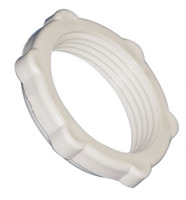
A conduit lock ring is a threaded ring that screws onto a male conduit adaptor or running thread. The adaptor passes through a knockout in an enclosure wall, and the lock ring tightens on the inside face to clamp the assembly together. This simple mechanical action keeps the conduit fixed in position and seals the entry point.
The fitting consists of a flat threaded ring with notches or lugs around its outer edge. The lugs allow a lock ring spanner to grip the ring and tighten it onto the adaptor thread. Once tight, the ring presses against the back of the enclosure wall, while the adaptor's flange or shoulder presses against the front. The conduit and enclosure become a single rigid assembly.
Without a lock ring, a conduit adaptor can pull free under the weight of cable runs or vibration. The result is exposed wiring, a broken seal at the entry point, and potential breach of compliance. Lock rings are the small component that holds the entire conduit-to-enclosure interface together.
Lock rings differ from conduit couplings and conduit bends. Couplings join two conduits in a straight line. Bends change the direction of a conduit run. Lock rings perform a different job: they secure a conduit entry to an enclosure or junction box.
Vibration from machinery, thermal cycling, and the dead weight of long cable runs all act on conduit entry points. The lock ring resists these forces. A correctly installed ring keeps the entry tight for the life of the installation.
Conduit entries take constant load. The cable inside has weight. The conduit itself flexes with temperature changes. Without a lock ring holding the assembly tight, gaps appear and water, dust, or pests can enter the enclosure.
In metallic conduit systems, the conduit itself often acts as the earth continuity path. The lock ring forms part of that path. If the ring is loose or missing, earth continuity breaks. A star washer is sometimes fitted between the lock ring and the enclosure to bite into the metal and guarantee a low-impedance earth bond.
A loose lock ring can lead to several failure modes: loss of earth continuity, ingress of moisture, separation of conduit from enclosure under load, and exposure of live wiring at the entry point. Each of these is a serious safety concern.
AS/NZS 3000:2018 (the Wiring Rules) requires conduit systems to be mechanically secured and, where metallic, electrically continuous. Lock rings are the standard fitting for meeting both requirements at enclosure entries. Inspection failures often trace back to missing or finger-tight lock rings.
PVC lock rings suit standard PVC conduit installations. They are lightweight, corrosion-proof, and pair with PVC adaptors and solid elbow conduit fittings. They are the most common choice for residential and light commercial work.
Steel lock rings are used with galvanised or zinc-plated rigid steel conduit. The metallic ring provides both mechanical clamping and the earth continuity needed for metal conduit systems.
Stainless steel rings are specified for marine, coastal, food-processing, and chemical environments. The grade (typically 304 or 316) is chosen to suit the corrosion exposure.
Most major suppliers (including Clipsal and NLS) produce lock rings in standard Australian conduit sizes. Tooth patterns, ring thickness, and finish vary slightly. Always pair the lock ring with a compatible adaptor from the same system.
PVC lock rings will not rust, will not corrode, and will not react with most chemicals. They are also lightweight, easy to fit, and inexpensive. They suit PVC conduit installations in dry, damp, and most outdoor environments.
Steel rings carry mechanical loads that PVC cannot. They also conduct, which matters for earth continuity in metallic conduit systems. Zinc plating adds basic corrosion protection for indoor and sheltered outdoor use.
Salt air, industrial fumes, and high humidity all attack standard zinc-plated steel. In these conditions, stainless steel or PVC is the better choice. Matching ring material to the operating environment is a basic compliance step.
The general rule: PVC lock ring with PVC conduit, steel lock ring with steel conduit. Mixing materials at the entry point can create galvanic corrosion or compromise the earth continuity path.
Australian conduit follows nominal outside diameters: 16mm, 20mm, 25mm, 32mm, 40mm, 50mm, and 63mm. Lock rings are produced to match each size and screw onto the matching adaptor thread.
The lock ring size must match the adaptor and the conduit. A 25mm lock ring fits a 25mm plain to screw adaptor. Mixing sizes is not possible and will not seal.
Switchboard and meter box knockouts are punched to standard conduit sizes. The adaptor passes through the knockout, the lock ring tightens on the inside face. Some screwed reducers allow a smaller conduit to enter a larger knockout when needed.
Common errors include forcing a too-small ring onto a larger thread, or trying to use a coupling in place of an adaptor. Both leave the assembly loose. Always check the size stamp on the ring and the adaptor before installation.
Specify PVC for PVC systems and steel for steel systems. For mixed installations or transition points, consult AS/NZS 3000:2018 and the manufacturer's compatibility data.
Indoor switchboards and adaptable boxes accept standard PVC or zinc-plated steel rings. Outdoor enclosures benefit from UV-resistant PVC or stainless steel. Industrial sites with vibration, chemicals, or extreme temperatures often require stainless steel.
Heavier conduit runs and large cable bundles place more load on the entry point. Pick a ring rated for the conduit's wall thickness and the installation environment. Ring diameter, thread pitch, and material grade all matter.
The most frequent errors are: choosing PVC where steel is required for earth continuity, mismatching ring and adaptor sizes, and selecting cheap unbranded rings that do not meet Australian standards. Sticking with established brands like Clipsal or NLS avoids most of these problems.
Every conduit entering an electric switchboard needs a lock ring. The ring secures the entry, helps maintain the IP rating, and (with metallic conduit) carries the earth continuity through the panel wall.
Lock rings are equally common at adaptable boxes and conduit junction boxes. Each conduit entering the box needs an adaptor and lock ring to fix the assembly.
Industrial installations often use long running threads with multiple lock rings to position equipment along a conduit run. The lock ring's ability to grip anywhere on the thread makes this approach practical.
Street lighting, traffic signals, and utility cabinets all use conduit lock rings at every entry point. The exposed nature of these installations makes correct ring selection (often stainless steel) and proper torque essential.
Punch or drill the knockout cleanly. Remove all swarf and burrs that could damage cable insulation. Check that the hole matches the adaptor diameter so the ring will seat flat against the wall.
Push the adaptor through the knockout from outside. Hand-thread the lock ring onto the adaptor from inside. Use a lock ring spanner to engage the lugs and tighten. Hand-tight is not enough; the ring must be properly torqued.
Tighten until the ring is firm against the enclosure wall. Stop when the spanner meets resistance. Over-tightening can crack PVC enclosures, distort thin metal panels, or strip the adaptor thread.
After tightening, check the assembly by hand. The conduit should not rotate or move at the entry point. For metallic systems, perform an earth continuity test from the conduit through the enclosure to the main earth bar.
Compliance note: AS/NZS 3000:2018 requires every conduit entry to be mechanically secure and (for metallic systems) electrically continuous. A missing or loose lock ring fails both checks.
Lock ring spanners have notched ends sized for the lugs on standard rings. They allow proper torque without slipping. Multi-grip pliers are a poor substitute and can damage the lugs.
A star washer fits between the lock ring and the enclosure wall in metallic systems. The washer's teeth bite through paint or coating to create a low-impedance earth bond. This is good practice on painted or powder-coated enclosures.
In confined enclosures where a spanner will not fit, a lock ring can sometimes be tightened with a punch and hammer, tapping the lugs around. This is a last resort and risks damage. Plan the entry layout to allow tool access where possible.
A trade-quality lock ring spanner pays for itself many times over. Pair it with a star washer kit, a deburring tool for clean knockouts, and a torque-aware approach to tightening.
A coupling joins two conduits. A lock ring secures a conduit to an enclosure. The two fittings serve different purposes and are not interchangeable.
A nylon bush protects cable insulation at the entry point. It does not lock the conduit in place. Bushes and lock rings are often used together on the same entry.
| Fitting | Function | Typical Location |
|---|---|---|
| Lock Ring | Secures conduit entry to enclosure | Inside face of switchboard or box |
| Coupling | Joins two straight conduits | Mid-run conduit join |
| Bush | Protects cable from sharp edges | Inside the conduit entry |
| Adaptor | Threaded male fitting on conduit end | Conduit-to-enclosure interface |
Lock rings are required at every conduit entry to an enclosure under AS/NZS 3000:2018. They are not optional in compliant work. Some screw-in fittings have built-in lock features that perform the same function, but a separate lock ring is the standard approach.
Correct lock ring installation gives a secure, compliant, and durable conduit entry. It supports earth continuity in metallic systems, maintains the enclosure's IP rating, and prevents premature failure of the installation.
A properly torqued lock ring keeps the entry point tight for years. The clamping force resists the cyclical loads that loosen lesser fittings.
Vibration is the enemy of any threaded fitting. Lock rings paired with star washers or thread-locking compound can hold tight even in machinery rooms or transport applications.
For metallic conduit, the lock ring is part of the protective earth path. Regular inspection confirms continuity has been maintained over time. Any sign of loosening calls for re-tightening and a continuity test.
Routine switchboard inspections should include a check of all conduit entries. Loose rings, signs of corrosion, and broken seals all warrant attention. Replacement is straightforward: undo the ring, fit a new one, re-torque.
Conduit lock rings are inexpensive per unit. PVC rings are the cheapest, followed by zinc-plated steel, then stainless steel. Trade pricing applies on bulk purchases and through wholesale accounts.
Pack quantities of 50 or 100 give the best per-unit price for production work. For one-off jobs or repairs, single units are available. Stocking a small inventory of common sizes saves trips back to the wholesaler.
Unbranded imports may be cheaper but can fail to meet Australian dimensional standards. A ring that does not seat properly is a compliance failure waiting to happen. Stick with recognised brands for trade work.
Bricks-and-mortar trade counters offer immediate pickup but limited stock. Online wholesalers like Sparky Direct hold a wider range and ship Australia-wide. The choice depends on time pressure and project size.
Most common sizes ship same-day from stock. Larger or stainless steel rings may take a day or two longer. Plan ahead for projects with uncommon size requirements.
List the conduit sizes used on the job. Count the entry points. Add a margin for spares. Order by size, material, and quantity. For mixed jobs, group orders by enclosure or area to avoid confusion on site.
Ordering only the exact count leaves no room for losses or breakages. Buying the wrong material (PVC for a metal system) wastes money and time. Forgetting to order the matching adaptors is a classic site-day frustration.
A 10 to 15 percent margin on lock rings covers normal site losses. For large projects, pack quantities work out cheaper and ensure consistent supply.
Sparky Direct stocks NLS, Clipsal, and other trade brands across all common sizes. Combine an order with related conduit fittings, rigid conduits, or corrugated conduits for a complete project supply.
Set up a wholesale account for pricing visibility across the Sparky Direct range. Repeat orders for standard fittings can be saved as templates to streamline ongoing project work.
Club Clipsal is Australia's largest electrician community offering trade rewards, business support, and exclusive benefits. When you nominate Sparky Direct as your preferred wholesaler, we automatically apply your Clipsal spend points to your Club Clipsal account daily.
Entry-level offering coaching, mentoring, and training discounts
Unlock exclusive industry tools and networking events
Access Toyota fleet offers and business software discounts
Maximum benefits, including VIP experiences and rewards
1. Sign Up: Create your Club Clipsal account at clipsal.com/club-clipsal or via the iCat mobile app
2. Nominate Sparky Direct: Select Sparky Direct from the wholesaler dropdown menu in your profile
3. Add Email: Enter your Sparky Direct account email address in the membership number field
4. Start Earning: Every dollar spent on Clipsal products earns points automatically
Redeem points from the rewards store, including gift cards, tools, and experiences. Access business summits, product training, and industry networking events. Receive early access to new product launches and special promotions. Connect with fellow electricians via the Club Clipsal community app.
Watch Clipsal 242-20-GY | 20mm PVC Coupling video
Watch 4C | 25mm Orange PVC Plain Coupling | 040.040.0349 video
Watch Inspection Elbow 25mm | IE25 video

Needed some single entry 20mm Junction boxes for a renovation wiring project. Not use to buying small amounts of electrical fittings ?? Sparky Direct made it easier & simpler, at a competitive cost. Good price, and a varied range of fittings via a prompt post made it easier to finish my project. Saved running around 30 km + and sorting through numerous half depleted shelves, to come away with nothing useful. Direct to your door .....what you want .... easy choice!
Very easy to purchase from this company. I did not have to put up with - I can’t sell to you unless you have an electrical license like I have had with other companies. Information on the website made it very easy for me to purchase the correct item(s) I required.
This is the second time I am ordering from Sparky and I am satisfied with the prices, the products, the service and the delivery. I used all these products to make a crop protection cage for my backyard crop to protect from birds:)
Quality products in stock • Fast Australia-wide delivery • Competitive trade pricing
Browse Conduit Lock Rings → Get Expert Advice →Yes, securing fittings reduces the risk of movement or cable damage.
Sparky Direct supplies lock rings Australia-wide, offering reliable electrical fastening accessories with convenient delivery.
Lock rings are securely packaged and delivered via standard courier services.
Unused products are generally eligible for return according to the seller’s returns policy.
Warranty coverage varies by manufacturer and typically covers defects in materials or workmanship.
Yes, lock rings are typically sold as individual electrical accessories.
Yes, choosing the correct size ensures a secure and compliant connection.
Once installed correctly, they generally require no maintenance.
Yes, they are commonly used when modifying or upgrading existing conduit systems.
They are usually located inside enclosures and not visible externally.
Quality lock rings are designed to withstand everyday installation conditions.
They help create a neat and professional finish inside enclosures.
They are simple for trained professionals to fit as part of a compliant system.
Lock rings are conduit accessories used to secure conduit fittings or glands firmly to enclosures such as junction boxes or switchboards.
Yes, they are a standard accessory in many electrical installations.
They prevent conduit fittings from loosening over time, helping maintain a secure installation.
Yes, they are designed to work with standard conduit glands and threaded fittings.
Yes, they help ensure fittings remain secure and properly seated.
Yes, they are suitable for residential, commercial, and light industrial applications.
Yes, they are widely used in indoor electrical enclosures and conduit systems.
Yes, they are available to suit common conduit and fitting sizes such as 20mm, 25mm, and 32mm.
They are typically made from durable plastic or metal suitable for electrical installations.
Yes, they are commonly used with rigid conduit and threaded fittings.
Quality lock rings are manufactured to meet relevant AS/NZS electrical and safety standards when used correctly.
They are used to lock threaded conduit fittings in place to prevent loosening and movement.