Search Results:
Search Results:
Search Results:
Search Results:
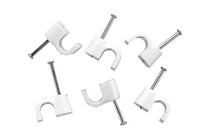
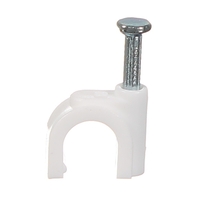
A cable clip is a simple fastener that does one job well. The plastic, nylon, or metal body cradles the cable, and an integral nail, screw, or adhesive pad anchors the clip to a surface. Once driven home, the clip locks the cable in position so it does not slip, sag, or rub against rough material.
The clip wraps around the cable on three sides and pinches against the mounting surface on the fourth. This creates a friction grip that holds without crushing the insulation. Spaced clips along a run keep the cable on a straight, intended path from one accessory to the next.
On a clean install, every cable is supported, parallel, and easy to trace. Cable clips give an electrician the speed and consistency to make that happen quickly. They are the most common method of fixing flat TPS cable and small round flexible cables in residential rough-in.
Unsecured cables fail in three ways: physical damage, thermal stress, and accidental contact. Cable clips address all three by holding the conductor in a fixed, controlled position over the life of the install.
A sagging cable can rub on a joist, get crushed by stored items, or catch on equipment. In ceiling and wall cavities, an unsecured cable may also get pierced by later trades driving fixings into the lining. Properly clipped runs sit flat against the structural member and stay clear of those hazards.
The Wiring Rules require cables to be supported so that mechanical stress is not transferred to terminations or insulation. Cable clips are the standard means of meeting that requirement for surface-fixed and concealed wiring on solid backing. Spacing must keep the cable straight without visible sag between fixings.
Insulation degrades faster when a cable is repeatedly flexed at a fixed point. Correctly spaced clips eliminate that flex by holding the run static. The result is a wiring system that performs to specification for decades, not years.
Cable clips are one of three common solutions for fixing cables in place. Each has a defined use case, and using the wrong one wastes time and material.
| Solution | Best For | Limitations |
|---|---|---|
| Cable Clips | Single cables fixed direct to timber, brick, or plasterboard in residential and light commercial rough-in | One cable per clip; not suited to bundled runs or open-air spans |
| Cable Ties | Bundling multiple cables together, lashing to existing supports, securing in tight or curved spaces | Need an existing anchor point; UV-rated ties needed for outdoor use |
| Cable Trays | Heavy bundled runs in commercial, industrial, and ceiling-void installations | Higher cost, requires structural fixing, overkill for residential single-cable runs |
A clip provides both the anchor and the cable hold in one piece. A cable tie only provides the hold and needs something to tie to. Use clips where you are fixing directly to a surface. Use ties where you are bundling or attaching to an existing support.
Trays are the right call when you have multiple cables running together over long distances. For a single TPS run on a wall stud, a tray is overkill. A row of correctly sized cable clips does the same job at a fraction of the cost.
In most domestic rough-in work, cable clips dominate. In commercial switchboards and data rooms, cable ties take over for bundling. In data centres and large industrial sites, trays handle the bulk runs. A typical job uses all three in different areas.
Cable clips fall into four main families based on how they fix to the surface.
Three variables decide which clip you need: cable size, surface type, and the environment. Get these right and the clip will do its job for the life of the install.
Cable clips are sized to suit a specific cable. A 1.5mm Twin and Earth uses a different clip from a 6mm one. The clip must hold the cable firmly without crushing the insulation. Sparky Direct stocks 1.5mm cable clips, 2.5mm cable clips, 4mm cable clips, and 6mm cable clips to match the standard TPS range.
Timber takes a softer nail; masonry needs a hardened steel nail or a plug-and-screw combination; steel framing usually calls for a screw-fix clip. Trying to drive a masonry nail into hardwood will bend it. Driving a soft nail into brick will not penetrate. Match the fixing to the substrate every time.
Indoor clips are typically PVC or nylon in standard formulations. Outdoor clips need UV stabilisation to prevent the body becoming brittle and cracking. For coastal or external metal structures, brass pin clips or stainless steel options stop corrosion staining on the surrounding finish.
Standard residential clips are PVC or nylon. They are cheap, light, and easy to install. Nylon offers better impact resistance and a wider working temperature range than basic PVC. Both materials are fine for sheltered indoor service. Neither is suitable for prolonged direct sunlight unless specifically rated.
Metal clips are used where pull-out strength, fire resistance, or environmental durability matter. Galvanised steel covers most commercial and industrial requirements. 316 stainless steel is the choice for marine, coastal, and chemically aggressive environments where rust would otherwise stain or weaken the structure.
UV-stabilised polymer clips carry an additive package that resists sunlight degradation for years. Standard black polymer clips often perform better outdoors than white because the carbon black absorbs UV. Heat ratings matter inside roof spaces where summer temperatures can exceed 60 degrees Celsius for sustained periods.
The standard match-up for flat Twin and Earth TPS cables works as follows: 10mm clip for 1.5mm TPS, 12mm clip for 2.5mm TPS, 14mm clip for 4mm TPS, and a larger profile for 6mm TPS. Always check the cable cross-section against the clip jaw width before committing to a bulk pack.
Flat TPS uses a rectangular-jaw clip that grips the wide face. Round cables (orange circular submains, flexible cords, coaxial) need a round-profile clip that wraps the full circumference. Using a flat clip on a round cable allows the cable to roll out under load.
Australian manufacturers like NLS and Clipsal mark clip jar labels with the cable type and size the clip suits. Stick to the manufacturer's guide rather than estimating by eye. A 0.5mm mismatch can be the difference between a clip that lasts twenty years and one that lets go in five.
Standard spacing for surface-fixed TPS is around 300mm on horizontal runs and 400mm on vertical runs. Tighter spacing may be needed where the cable changes direction, passes over a sharp edge, or terminates at an accessory. The cable should never sag visibly between fixings.
If the cable curves between two fixings, the clips are too far apart. Add an intermediate clip to keep the run straight and the insulation off any contact points.
Hold the clip body, not the cable. Position the nail head over a sound part of the substrate (not a knot, edge, or split). Tap the nail in with controlled hammer strokes. Stop as soon as the clip body sits flush against the surface. Driving past flush will crush the cable insulation.
Never use the hammer face to seat a clip if the cable is between hammer and clip. Always strike the nail head directly. If the cable is hard to keep in position, hold it in place with the non-dominant hand a few centimetres from the clip and tap the nail with light strokes until it bites.
Compliance Note: Under AS/NZS 3000:2018, cables installed in wall and ceiling cavities must be supported and protected from mechanical damage. Cable clips meet this requirement when sized and spaced correctly for the cable type.
An undersized clip crushes the cable and damages the insulation; an oversized clip lets the cable slip out. Both fail the basic purpose. Stock the right size for the cable on the truck, not a one-size-fits-all assumption.
Over-spaced clips let the cable sag, creating wear points and contact risks. Under-spacing wastes material, slows the install, and looks busy without adding compliance value. Stick to manufacturer or wiring-rules spacing guidance.
A standard indoor PVC clip exposed to sun and weather will turn chalky and crack within a few years. The cable falls away from the wall, potentially exposing it to damage or contact. Use UV-stabilised, brass, or stainless options for any external location.
Domestic rough-in is the highest-volume use. TPS cables get clipped to studs, plates, and joists in a consistent grid pattern. Speed and clip cost both matter at residential scale, which is why bulk jars of nail-in clips are the standard format on site.
Larger jobs use a mix of clips for individual cables and trays or ladder rack for bundled runs. Screw-fix and metal clips appear more often on steel framing and switchroom panels. Fire-rated clips are sometimes specified on egress paths and life-safety circuits.
Communications cables get gentler treatment. Adhesive clips suit finished surfaces where drilling is not appropriate. Smaller-profile clips handle Cat6, coaxial, and speaker cable. Sparky Direct stocks cable management accessories for these lower-voltage applications.
UV-stabilised polymer clips carry an additive that absorbs ultraviolet light before it can break down the polymer chain. Black UV-stabilised clips are the workhorse choice for external residential and commercial work where the cable runs along soffits, eaves, or external walls.
316 stainless steel handles the highest corrosion loads. It is the right choice for marine fit-outs, coastal homes, swimming pool enclosures, and process plants. The premium over zinc-plated steel pays back in not having to redo the work in five years.
Rooftop solar cables need clips rated for sustained sun, heat, and weather exposure. Standard residential clips will not survive the rooftop environment over a 20-year solar warranty period. UV-stabilised, high-temperature, and stainless clips are the appropriate options for PV array DC runs.
Most clip failures trace back to one of three causes: wrong size for the cable, wrong material for the environment, or wrong spacing. Get those three right at install and the run will outlast the surrounding finishes.
Roof spaces, switchrooms, and external walls all see thermal cycling that fatigues poor-grade plastic. Better-grade nylon and metal clips handle this cycling without losing grip. For locations with sustained heat above 60 degrees Celsius, specify a heat-rated clip from the outset.
The point of a cable clip is to disappear into the install and never need attention. Choose the right clip, install it correctly, and the cable run will perform as designed for the life of the building. Cutting corners on clip selection is one of the cheapest ways to create future callbacks.
Sparky Direct stocks the full Australian range of cable clips, including direct-match sizes for every standard TPS, round circular, and solar cable. Stock is dispatched from Australian warehouses with trade-grade products from established suppliers. The full cable clips category covers nail-in, screw-fix, brass, and stainless options.
Cheap import clips often use brittle plastic and undersized nails. They snap on installation, fail in service, and cost more in callbacks than they save on purchase. Trade-grade clips from NLS, Clipsal, CABAC, and Wattmaster use proper polymer formulations and properly sized fixings.
Cable clips are sold in jars, boxes, and bulk packs. Standard pack sizes range from 50 to 5,000 per container. Bulk buying brings the per-clip price down significantly and keeps the stock on the truck for the next job. Mixed packs of common sizes suit smaller operators who do varied work.
If a clip pulls out, the substrate was wrong for the fixing or the clip was undersized for the cable. Replace with a screw-fix clip into a stud, or step up to a clip rated for masonry. Do not just hammer harder on a clip the substrate cannot hold.
Sagging means the spacing is too wide for the cable weight. Add intermediate clips to halve the unsupported span. If the cable is bouncing in service (vibration from nearby equipment), add a clip closer to the source of the movement.
Cracked or chalky clips outdoors mean the original spec was wrong for the environment. Replace with UV-stabilised or stainless equivalents. If the clip is breaking on installation, the fixing nail is too long or the substrate is harder than the clip was designed for.
Club Clipsal is Australia's largest electrician community offering trade rewards, business support, and exclusive benefits. When you nominate Sparky Direct as your preferred wholesaler, we automatically apply your Clipsal spend points to your Club Clipsal account daily.
Entry-level offering coaching, mentoring, and training discounts
Unlock exclusive industry tools and networking events
Access Toyota fleet offers and business software discounts
Maximum benefits, including VIP experiences and rewards
1. Sign Up: Create your Club Clipsal account at clipsal.com/club-clipsal or via the iCat mobile app
2. Nominate Sparky Direct: Select Sparky Direct from the wholesaler dropdown menu in your profile
3. Add Email: Enter your Sparky Direct account email address in the membership number field
4. Start Earning: Every dollar spent on Clipsal products earns points automatically
Redeem points from the rewards store, including gift cards, tools, and experiences. Access business summits, product training, and industry networking events. Receive early access to new product launches and special promotions. Connect with fellow electricians via the Club Clipsal community app.
Watch NLS 30422 | 10mm Cable Clips to Suit 1.5mm Twin & Earth | 500 Jar video
Watch NLS 30363 | 12mm Cable Clips to Suit 2.5mm Twin & Earth | 500 Jar video
Watch NLS 30799 | CableFix 2 x 4.0mm Stainless Steel Cable Clips | Jar 100 video

What can I say - they do the task that they were designed for - holding firm 6 mm cable and they do it well.
I was very happy to find these stainless steel saddles as I have just had some electrical work done which included a fair bit of outside conduit. Being near the ocean I new it was only a matter of time before I had the rust marks dripping down walls. I have replaced all these standard saddles this the new stainless ones and stainless screws. Time will tell.
I live by the beach and everything rusts. 316ss saddles are very hard to find but well worth the effort and additional cost. The quality is excellent and will definitely save money in the long term. They also eliminate rust stains running down the wall of your house.
Quality products in stock • Fast Australia-wide delivery • Competitive trade pricing
Browse Cable Clips → Get Expert Advice →Yes, they help create clean and organised cable runs.
Sparky Direct supplies cable clips Australia-wide, offering reliable cable fixing solutions with convenient delivery.
Cable clips are securely packaged and delivered via standard courier services.
Unused products are generally eligible for return according to the seller’s returns policy.
Warranty coverage varies by manufacturer and typically covers defects in materials or workmanship.
Yes, cable clips are typically sold individually or in packs.
Yes, choosing the correct size ensures secure fixing without damaging the cable.
Once installed correctly, they generally require no maintenance.
Yes, they are commonly used when adding or re-routing cables.
They may be visible, especially in surface-mounted cable runs.
Quality cable clips are designed to withstand everyday installation conditions.
Yes, securing cables helps reduce wear and accidental damage.
They are straightforward for trained professionals to install.
Cable clips are electrical fixings used to secure cables neatly to walls, ceilings, or other surfaces.
Yes, they are a standard fixing used in most cable installations.
They help keep cables secure, tidy, and safely positioned.
Yes, they are suitable for residential, commercial, and light industrial applications.
Yes, they are commonly used in residential electrical work.
Some cable clips are suitable for outdoor use when correctly rated and installed.
Yes, they are widely used for indoor electrical installations.
They are typically made from plastic with steel or hardened pins for fixing.
Yes, cable clips are available in a wide range of sizes to suit different cable diameters.
They are suitable for common electrical cables such as TPS, data, coaxial, and low-voltage cables.
Quality cable clips are manufactured to meet relevant AS/NZS electrical and safety standards when used correctly.
They are used to hold electrical cables in place and prevent movement, sagging, or damage.