Search Results:
Search Results:
Search Results:
Search Results:
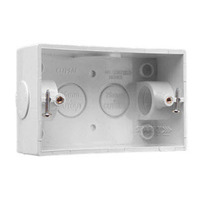
A mounting block is a moulded base that bridges the gap between a flat electrical accessory and an uneven, hollow, or unsuitable mounting surface. The accessory screws onto the front face of the block, while the back of the block fixes to the wall, post, purlin, or sheet metal substrate. Cables enter through pre-formed knockouts or grommeted entries.
A mounting block performs three jobs at once. It creates a flat fixing face for the accessory, contains and protects incoming cables, and lifts the accessory clear of any surface that cannot accept a flush install. Without it, fitting a switch or GPO to corrugated iron or a steel purlin would mean either an unsafe install or no install at all.
The block is fixed to the substrate with screws or rivets sized for the wall material. Once fixed, the block provides multiple captive thread points or moulded bosses that accept the accessory's mounting screws. This two-stage approach distributes load: the block carries the wall fixing forces, and the accessory only sees the lighter screws holding it to the block.
Surface-mounted installations are common in sheds, garages, workshops, factories, and any building where the wall lining sits flat against framing with no usable cavity. The block becomes the cavity, holding the wiring and the accessory body away from the structural surface. This approach is fully compliant under AS/NZS 3000:2018 when the block, accessory, and cable entry are all rated for the location.
Mounting blocks are not a finishing touch. They are a structural and safety component of the installation. Skipping them, or choosing the wrong type, results in loose accessories, exposed cables, and non-compliant work that may fail certification.
An accessory screwed directly onto a thin steel sheet or rough brick will not stay tight. Vibration, plug insertion, and switch operation all transfer load through the screws into the substrate. A mounting block spreads that load across a much larger contact patch and gives the screws solid plastic or metal to bite into.
Many surfaces cannot be cut into. Corrugated sheeting, structural steel, masonry walls, and tilt-up panels all rule out cavity installation. Mounting blocks let electricians fit standard accessories to these surfaces without specialty enclosures or compromised fixings.
A correctly chosen block produces a level, square, professional-looking install. The accessory sits true against the front of the block rather than tilted across an uneven wall. Cables stay hidden, screw heads stay clean, and the finished work passes visual inspection.
A loose GPO is not only a finish issue. It can break the earth path, work the cable terminations loose, and create an arc fault risk. The mounting block is what keeps the accessory rigidly fixed for the life of the installation.
Mounting blocks come in a range of formats matched to accessory size, wall type, and environmental conditions. Choosing the right type is the single biggest factor in whether the finished install looks and performs correctly.
Standard blocks suit most indoor switch and GPO installs. Single-gang blocks accept one accessory; multi-gang versions support 2, 3, 4 or more accessories side by side. The Australian standard plate format means most blocks accept both Clipsal Iconic switch grids and equivalent plates from other manufacturers.
Outdoor and exposed installs need blocks rated for water, UV, and temperature cycling. These work alongside weatherproof GPOs and weatherproof switches to maintain the IP rating of the assembly. The block itself must seal to the substrate and to the accessory front, with no compromised gasket points.
Deep blocks (typically 34mm to 40mm) give extra internal volume for thicker cables, multiple loops, or accessories with deep bodies such as dimmers and timers. Shallow blocks (around 14mm to 20mm) suit minimal cabling and a low-profile finish. The depth must accommodate the cable bend radius required by AS/NZS 3000:2018.
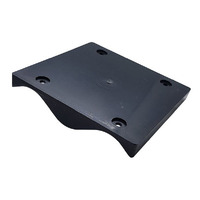
Some blocks suit specific applications: corrugated iron blocks for sheds and farm buildings, purlin blocks for steel-framed structures, and purpose-built blocks for double GPOs, quad sockets, and architectural fittings. Match the block to the accessory and the substrate, not the other way around.
Three questions decide the right block: what is the wall made of, what accessory is being fitted, and where is it located. Get all three right and the install is straightforward.
Different substrates need different fixing strategies. Brick and masonry need plug-and-screw fixings into solid material. Steel framing or sheet metal accepts self-drilling screws or rivets. Timber takes a standard wood screw. The block itself is the same; what changes is the fastener and the surface preparation. For corrugated sheet, choose a block specifically shaped to span the corrugations and seal at the high points.
The block must be designed for the accessory family. A Clipsal Iconic mounting block accepts Iconic grids, while a Classic-style block fits older 2000-series accessories. Mixing brands across the block-and-grid interface is not always reliable. Confirm compatibility before ordering, especially for USB powerpoints and other deep-body accessories.
Indoor blocks can be plain ABS or PVC with no UV inhibitors. Outdoor blocks need UV-stabilised plastic or treated metal, sealed cable entries, and a gasket interface to the accessory. Marine and coastal sites need additional corrosion resistance on any metal fixings.
| Wall Type | Recommended Block | Fixing Method |
|---|---|---|
| Brick or masonry | Standard solid block, 25mm or deeper | Wall plug and screw |
| Plasterboard on stud | Shallow block (where stud aligns) or plaster bracket alternative | Screw into stud |
| Corrugated steel sheeting | Corro-profile block, paintable | Self-drilling screw at corrugation crowns |
| Steel purlin or top hat | Purlin-specific mounting block | Self-drilling screw or rivet |
| External wall, exposed | Weatherproof block with gasket | UV-rated screw, sealed entry |
The right mounting block depends as much on the building type as on the accessory. Each environment has its own pressures and finish expectations.
Inside the home, mounting blocks rarely appear in finished living areas, where flush installs into stud cavities are standard. They come into their own in garages, laundries with brick walls, and renovation work where cutting into existing finishes is not viable. Sheds and garages with steel sheeting almost always use blocks.
Factories, warehouses, and workshops typically have exposed steel framing, concrete walls, and brick. Surface-mounted accessories on appropriately sized blocks are standard practice, often paired with conduit junction boxes for cable management. Heavy-duty blocks may be specified for high-traffic areas.
Renovation work often involves walls that cannot be cut: heritage masonry, tilt panels, finished tiles, or rendered surfaces. A surface-mount block lets the electrician add new outlets or switches with minimal disruption. Surface-mount enclosures handle larger assemblies where a single block is not enough.
The material a block is made from determines its lifespan, its appearance over time, and its suitability for the location. Cheap material in a harsh environment fails early.
Most blocks are moulded from ABS or PVC. These plastics are light, easy to drill, paintable, and electrically insulating. Indoors, a standard plastic block lasts the life of the building. Outdoors, the plastic must be UV-stabilised; otherwise it becomes brittle and discolours within a few years.
Metal blocks (typically powder-coated steel or aluminium) suit industrial sites, exposed locations, and applications where impact resistance matters. Metal blocks need careful earthing where they form part of an exposed conductive enclosure. They are heavier, more expensive, and harder to modify on site than plastic.
Australian sun is harsh on plastics. UV inhibitors in the polymer prevent the surface chalking, cracking, and going brittle. For exposed installations, look for blocks specifically rated for outdoor use, and confirm the gasket and seal arrangements maintain at least IP44 in conjunction with the accessory.
UV warning: A block sold for indoor use will not survive long-term outdoor exposure in Australia, even on a south-facing wall. Always specify outdoor-rated blocks for any external location.
Surface mounting on a block and flush mounting into a wall cavity are the two main install methods. Each has its place. The choice depends on the wall, the location, and the visual outcome required.
Flush mounting cuts a hole in the wall lining and uses a plaster bracket or wall box to hold the accessory inside the cavity. Surface mounting fixes a block to the outside of the wall and mounts the accessory on the front of the block. Flush installs are invisible behind the cover plate; surface installs project from the wall by the depth of the block, typically 14mm to 40mm.
Surface mounting works on any solid surface: concrete, brick, steel, render, tile. It is fast, requires no cavity, and is fully reversible. For renovation, additions, sheds, and industrial sites it is often the only practical option.
In finished living areas of a home, flush mounting gives a cleaner look. It needs a stud or batten cavity, a plaster bracket, and a wall lining that can be cut without damage. New homes are typically wired flush throughout.
| Factor | Surface (Mounting Block) | Flush (Cavity Install) |
|---|---|---|
| Wall types | Any solid surface | Stud and lining cavities only |
| Install speed | Fast, no cutting | Slower, requires cutting and bracket |
| Visual finish | Block visible behind plate | Plate sits flat on wall |
| Best for | Sheds, retrofit, masonry, industrial | New homes, finished interiors |
| Cable access | External, via knockout | Internal, through cavity |
All electrical work involving mounting blocks falls under AS/NZS 3000:2018 (the Wiring Rules) and must be carried out by a licensed electrician. The block itself is not a regulated item, but its correct use is.
Connecting any switch, GPO, or accessory mounted on a block is licensed electrical work in every Australian state and territory. Selecting and supplying the block is unrestricted, but the wiring, termination, and certification must be done by a licensed person.
The substrate must be clean, dry, and free of loose material. Fixings must match the wall: masonry plugs for brick, self-drilling screws for sheet metal, and wood screws for timber. The block must sit flat against the surface with no gap that could allow cable damage or moisture entry.
Cable entries must protect the cable sheath at the point of entry. Use a grommet, cable gland, or moulded entry as appropriate. The accessory must align square with the block, and the block must align with adjacent installs. Visual alignment is part of professional finish standards.
A few habits separate a clean install from a problem install. None of these add significant time on site, but each one prevents callbacks.
Mark the block position before drilling. For multiple blocks in a row, snap a chalk line or use a spirit level across all positions before any are fixed. Spacing should match adjacent blocks and respect any clearance requirements around the accessory (such as switch lever travel).
The internal volume of the block must accommodate the cable, the accessory body, and the bend radius. Crowded cables damage insulation, cause heat build-up, and make termination difficult. If cabling is tight, choose a deeper block or split the load across two blocks.
Two fixings minimum, ideally four for multi-gang blocks. Tighten progressively rather than driving each screw fully home before moving to the next. Check the block does not rock or flex before mounting the accessory.
Most mounting block problems trace back to one of three errors: wrong block, wrong location, or rushed install.
A shallow block on a deep accessory crushes cables. A deep block on a shallow accessory looks proud and amateurish. Check the accessory body depth, the cable load, and the required clearance before selecting block depth.
Standard indoor blocks fail outdoors. UV makes the plastic brittle, water ingress corrodes terminals, and the seal between block and accessory breaks down. Always use a block specifically rated for the location.
Drilling into a hollow point on corrugated sheet. Fixing into render that crumbles. Mounting on an uneven surface that warps the block. All of these create stress points that loosen over time. Spend the extra two minutes preparing the surface and the install holds for decades.
A correctly specified and installed mounting block should last as long as the building. Performance issues almost always reflect specification or installation faults rather than product failure.
The block-to-wall fixings carry all the load. Use the right fixing for the substrate, and use enough of them. A switch operated thousands of times over its lifetime will eventually find any weakness in the mounting.
UV-stabilised plastic stays white. Painted blocks need a primer suitable for plastic before topcoat. Powder-coated steel blocks resist scratches and chips far better than spray-painted equivalents. The finish is what the customer sees; it is worth the small extra investment.
Industrial, marine, and rural sites all attack plastic and steel in different ways. Specify accordingly: marine grade for coastal locations, UV-stable polymer for sun exposure, and corrosion-resistant fixings for dusty or chemically active environments.
Mounting blocks are a low-cost, high-volume item. Buying well means matching brand and product to the job rather than always chasing the lowest unit price.
Sparky Direct stocks blocks from Sureset, Trader, NLS, and Clipsal alongside related electrical accessories and Clipsal electrical accessories. Online ordering with trade pricing and Australia-wide delivery suits busy electricians who need stock on short notice.
Cheap blocks usually save a few cents on plastic quality, fixing accuracy, and pack consistency. Trade-grade blocks have tighter mould tolerances, better screw bosses, and clearer accessory compatibility. Over a job involving 50 or 100 blocks, the trade-grade choice saves time and reduces failed installs.
Confirm the block format matches the accessory range (Iconic, Classic, 2000-series, etc.). Check the depth against the cable load. For outdoor work, confirm the UV and IP ratings. For corrugated sheet, confirm the profile matches the sheeting pitch.
When a block install develops a problem, the cause is usually one of three things. Diagnose before pulling everything apart.
If the accessory works loose, check the block fixings first. Re-tighten and assess whether the fixing strategy was correct for the substrate. A loose block on plasterboard usually needs the fixings repositioned to a stud.
If the cover plate sits proud or terminals foul the block walls, the block is too shallow. Replace with a deeper version. Forcing the accessory home risks damaging the cable and the terminations.
Yellowed plastic, crazing, or surface chalking on outdoor blocks indicates UV damage. Replace with a UV-rated outdoor block. Discolouration alone is cosmetic; cracking is structural and needs replacement before the next service.
Club Clipsal is Australia's largest electrician community offering trade rewards, business support, and exclusive benefits. When you nominate Sparky Direct as your preferred wholesaler, we automatically apply your Clipsal spend points to your Club Clipsal account daily.
Entry-level offering coaching, mentoring, and training discounts
Unlock exclusive industry tools and networking events
Access Toyota fleet offers and business software discounts
Maximum benefits, including VIP experiences and rewards
1. Sign Up: Create your Club Clipsal account at clipsal.com/club-clipsal or via the iCat mobile app
2. Nominate Sparky Direct: Select Sparky Direct from the wholesaler dropdown menu in your profile
3. Add Email: Enter your Sparky Direct account email address in the membership number field
4. Start Earning: Every dollar spent on Clipsal products earns points automatically
Redeem points from the rewards store, including gift cards, tools, and experiences. Access business summits, product training, and industry networking events. Receive early access to new product launches and special promotions. Connect with fellow electricians via the Club Clipsal community app.
Watch Clipsal 238-WE | Solid Mounting Block 38MM Deep | White video
Watch Clipsal 450VC | Corro Mounting Block, For Vertical Corrugated 450VCWE video
Watch Purlmate 3650 | Mounting Block video

If you are installing standard size plates (power points, light switches, etc.) in a shed with Top Hat rails, these are magic. One note of caution though. Be careful driving those screws that attach the switch plate. They have to tap a fairly long thread into plastic and I have had problem removing these screws later. I think it was caused by using a powered screwdriver with excessive speed, possibly embedding the screw at high temperature. Removal is by destruction. :-(
I have been using these guys exclusively for my build off grid in Tabulam NSW, and they never disappoint me on the service, costs, speed of delivery. These mounting blocks are the bee's knees when it comes to simplicity of installation. Perfect for my needs.
Product type availability is great. Notification from purchase to delivery is outstanding. The quality of the mounting block is excellent.
Quality products in stock • Fast Australia-wide delivery • Competitive trade pricing
Browse Mounting Blocks → Get Expert Advice →Yes, they help space accessories correctly from uneven or textured surfaces.
Sparky Direct supplies electrical mounting blocks Australia-wide, offering reliable mounting solutions with convenient delivery.
Mounting blocks are securely packaged and delivered via standard courier services.
Unused products are generally eligible for return according to the seller’s returns policy.
Warranty coverage varies by manufacturer and typically covers defects in materials or workmanship.
Yes, mounting blocks are typically sold as individual electrical accessories.
Yes, choosing the correct size ensures secure fixing and compliance.
Once installed correctly, they generally require no maintenance.
Yes, they are commonly used when upgrading or relocating electrical accessories.
They may be visible, depending on the accessory and mounting method used.
Quality mounting blocks are designed to withstand everyday installation conditions.
Yes, they help create clean and consistent mounting of electrical accessories.
They are straightforward for licensed electricians to install.
An electrical mounting block is a base or spacer used to securely mount electrical accessories such as switches, sockets, or conduit fittings to a surface.
Yes, they are a standard accessory used in many electrical installations.
They provide secure fixing and help achieve a neat, professional finish.
Yes, they are suitable for residential, commercial, and light industrial applications.
Yes, they are commonly used in residential electrical work.
Outdoor-rated mounting blocks can be used externally when correctly specified.
Yes, they are widely used for indoor electrical applications.
Yes, they are available in various sizes to suit different electrical accessories.
They are typically made from durable PVC or similar non-conductive materials.
Yes, they are commonly used to support conduit fittings and accessories.
Quality mounting blocks are manufactured to meet relevant AS/NZS electrical and safety standards when used correctly.
They are used to provide a stable mounting surface and correct spacing from walls or cladding.