Search Results:
Search Results:
Search Results:
Search Results:
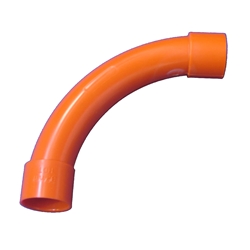
A sweep bend is a moulded PVC fitting that changes the direction of an electrical conduit run through a wide, gradual arc. The fitting joins two lengths of straight conduit using socket connections, glued with PVC conduit cement at each end. The wide radius means cable can be drawn through the bend without the sharp directional change that causes friction, kinking, or insulation damage.
Sweep bends are used wherever cable needs to change direction without compromising integrity. Underground power cables, mains supply, telecommunications feeds, and fibre optic runs all require gentle bends to meet manufacturer minimum bend radius specifications. A standard elbow forces cable through a sharp 90 degree turn, which can crack insulation, damage shielding, or strip the outer sheath.
Cable pulling tension rises sharply at every directional change. The wider the radius, the lower the friction coefficient, and the lower the pulling force required. This matters most for heavy multi-core cables and fibre optic runs, where excessive tension permanently degrades performance. Sweep bends spread the directional change across a longer distance, keeping pulling tension within safe limits.
Standard solid elbows turn cable through a tight radius in a compact fitting. They suit short cable runs with light loads, such as switch drops or lighting circuits. Sweep bends are designed for longer cable pulls, heavier conductors, and any installation where bend radius compliance is critical. The two fittings serve different jobs and are not interchangeable on infrastructure work.
The bend angle is the change in direction the fitting produces. A 90 degree sweep bend turns the conduit a quarter turn. Smaller angles allow gentler course corrections along a run, useful for following property boundaries, building setbacks, or trench profiles.
The sweep radius is the distance from the centre of the bend curve to the centreline of the conduit. A larger radius produces a longer, more gradual curve. Cable manufacturers publish minimum bend radius values for every cable type, usually expressed as a multiple of the cable diameter. The sweep bend radius must equal or exceed this value.
Sweep length is the overall physical span of the fitting from socket to socket. Long radius bends take more linear space than tight radius elbows. Installation planning needs to account for this, particularly inside pits, switchboards, and confined trench profiles where the fitting must clear other services.
Pulling tension increases exponentially as bend radius decreases. A 600mm radius bend produces far less drag than a 300mm radius bend with the same cable. On long runs with multiple bends, the cumulative tension can exceed safe pulling limits. Selecting larger radius sweep bends reduces this risk and protects the cable during installation.
PVC is the standard material for electrical conduit sweep bends in Australia. Medium duty fittings suit lighter mechanical loads and shallower burial. Heavy duty fittings, identified by the orange colour, are rated for deeper burial, vehicle traffic loads, and infrastructure work. The wall thickness and impact resistance differ between the two grades.
HDPE (high density polyethylene) sweep bends are used in civil projects, directional drilling, and high voltage utility installations. HDPE flexes under load rather than fracturing, which suits ground movement and difficult terrain. These fittings sit outside the standard PVC range and are typically specified by network operators on major projects.
Solid wall PVC is the standard construction for electrical conduit sweep bends. The material is uniform throughout, providing consistent strength and impact resistance. Foam wall variants exist in some communications products, where weight reduction matters more than mechanical strength. For electrical work, solid wall is the standard.
Standard sweep bends cover the angles and radii commonly required on residential, commercial, and infrastructure work. Custom radii can be ordered for specialised projects, but lead times and pricing vary. For most jobs, a stocked standard sweep bend is the practical choice.
Duty rating defines the mechanical strength and burial depth permitted for the fitting. Medium duty (grey) suits surface mount and shallow burial in residential applications. Heavy duty (orange) is required for deeper burial, areas subject to mechanical impact, and any installation under vehicle traffic. The colour coding makes selection straightforward on site.
Australian electrical conduit fittings comply with the AS/NZS 2053 standard, which covers materials, dimensions, performance, and marking. Compliant fittings carry the standard reference and the manufacturer identification. Using non-compliant fittings on regulated work can fail inspection and create liability for the installer.
Network operators including Telstra-spec conduit makers and state distribution authorities publish their own requirements for sweep bend selection on their assets. These typically mandate heavy duty grade, specific radii, and approved manufacturers. Confirm the relevant specification before ordering for utility-connected work.
The internal surface of a quality sweep bend is smooth and free of moulding flash. Rough internal surfaces increase friction during cable pulling and can damage cable sheathing. Visual inspection of the socket interiors and the curve internal surface is a quick quality check before installation.
Common sweep bend angles are 11.25, 15, 22.5, 30, 45, and 90 degrees. The 90 degree bend is the most frequently used for changing direction at corners, vertical risers, and pit entries. Smaller angles allow incremental course correction along a run, useful for navigating around obstructions or matching trench profiles.
Cable manufacturers publish minimum bend radius values, usually as a multiple of the overall cable diameter. Power cables typically require 6 to 12 times the diameter. Fibre optic cable can require up to 20 times the diameter for installation pulls. The sweep bend radius must equal or exceed the largest minimum bend radius among all cables in the conduit.
Underground installations generally use larger radius sweep bends than surface work. The greater radius supports longer cable pulls between pits, lower pulling tensions, and easier future cable replacement. Surface mount work often tolerates smaller radius fittings because runs are shorter and access for replacement is straightforward.
Each bend in a conduit run multiplies the pulling tension at the next bend. Two 90 degree bends in series can produce four times the tension of a single bend. Pulling tension calculations factor in the number of bends, the bend radii, the cable weight, and the friction coefficient. On long runs, plan bend placement carefully and use larger radii where possible.
The sweep bend size must match the nominal diameter of the conduit it joins. A 32mm sweep bend connects two lengths of 32mm conduit using glued socket joints. Mixing sizes requires reducer fittings or step-down sweep bends. Confirm the conduit OD matches the sweep bend socket ID before ordering bulk.
Standard sweep bend sizes for electrical work range from 20mm through 25mm, 32mm, 40mm, 50mm, 65mm, 80mm, 100mm, and up to 150mm for major infrastructure. The 25mm and 32mm sizes are the most commonly stocked for residential and light commercial applications. Larger sizes serve sub-mains, mains supply, and utility feeds.
Conduit fill ratios limit how many cables can occupy a single conduit. AS/NZS 3000 sets the maximum fill percentages based on cable count and cable type. Overfilling restricts heat dissipation, raises operating temperature, and can derate the cable current capacity. Sweep bend selection follows the same fill rules as the straight conduit.
Every cable datasheet includes a minimum bend radius for installation and a separate value for the installed condition. The installation value is usually larger because the cable is under tension during the pull. Sweep bend selection should reference the installation minimum bend radius, not the smaller installed value.
Underground power runs require heavy duty orange PVC sweep bends. Surface mount commercial work usually uses medium duty grey. Communications infrastructure has its own specification, often requiring approved long radius bends from listed suppliers. Match the duty rating, colour, and approval status to the environment before ordering.
PVC is the default material for the vast majority of electrical work. HDPE is reserved for civil and utility projects where ground movement is expected. Steel sweep bends exist for hazardous area work but sit outside the standard electrical range. For most jobs, heavy duty PVC is the correct choice.
Long radius sweep bends perform best for cable pulling but take more physical space. Tight installation locations may force a smaller radius or even a standard elbow. Where space limits radius selection, plan additional pulling pits to reduce cable run length and keep cumulative tension within safe limits.
Common mistakes include using medium duty fittings on installations that require heavy duty, mixing brand standards on infrastructure work, undersizing the radius for fibre runs, and treating sweep bends as interchangeable with standard elbows. Each of these can fail inspection or damage cable during installation.
Sweep bends are standard fittings on underground power cable runs from street to property, sub-mains feeds between buildings, and high voltage distribution circuits. The wide radius protects cable insulation during pulling and allows future cable replacement without excavating the entire run.
Communications infrastructure relies on long radius sweep bends to protect fibre optic cable during installation. Telstra and NBN specifications mandate specific bend types and radii for their assets. Approved communications conduit fittings must be used on connected work.
Commercial and industrial sites use sweep bends throughout their cable management systems. Mains feeds, sub-mains, motor feeds, and control wiring all benefit from gentle directional changes. Sweep bends also support future modifications by allowing cable swap-outs without rebuilding the conduit run.
Sweep bends form the transition between underground runs and surface entry points. They guide cable from the trench up into pits, switchboards, building entries, and pole risers. The gradual curve here is critical because the cable is often pulled vertically against gravity, multiplying the friction load.
Plan the conduit route to minimise the number of bends between pulling points. Each bend adds friction. Two 45 degree bends widely spaced apart pull easier than two 90 degree bends close together. Mark bend locations during trenching to confirm the route works before fittings are committed.
Use cable pulling lubricant on long runs with multiple bends. Lay out cable carefully to avoid twists before the pull starts. Pull steadily and avoid jerking, which spikes peak tension. Pre-fit a draw rope through the conduit during installation so future pulls can use the existing rope.
Deburr the cut conduit ends before joining to the sweep bend sockets. Sharp edges damage cable as it passes through. Use a PVC pipe cutter for clean square cuts, then chamfer the inside edge with a file. Apply PVC cement to both surfaces for a sealed joint.
Confirm burial depths meet AS/NZS 3000 minimums and any state utility requirements. Use orange marker tape above buried conduit. Test the run with a draw rope or mandrel before energising to confirm no obstructions. Record bend locations and depths on the as-installed drawings for future reference.
Cable damage during pulling is permanent and often invisible. Outer sheath abrasion, conductor stretching, and insulation cracking can all occur from excessive pulling tension. Sweep bends with adequate radius prevent these failures by keeping pulling forces within the cable manufacturer specifications.
Cable systems often outlive their first installation. Future upgrades, fault repairs, or capacity additions all require pulling new cable through existing conduit. A run installed with proper sweep bends supports these future works. Tight bends and sharp elbows make later replacement difficult or impossible without excavation.
Buried PVC conduit and fittings carry the weight of the soil above plus any traffic loads on the surface. Heavy duty sweep bends are designed for these conditions and resist deformation under load. Medium duty fittings used incorrectly in deep burial can crack over time, allowing water ingress and damaging the cable inside.
Underground conduit systems are difficult to inspect once buried. The maintenance approach is to install correctly the first time, document the route, and monitor surface signs (subsidence, water pooling) that can indicate problems below. Pit covers should be checked periodically for security and drainage.
| Feature | Sweep Bend | Standard Elbow | Flexible Conduit |
|---|---|---|---|
| Radius | Long (gradual curve) | Short (tight 90 degree) | Variable (within bend limits) |
| Cable Pulling | Low friction | High friction | Moderate friction |
| Best Use | Underground, comms, mains | Switch drops, light circuits | Surface routing, machine connections |
| Future Cable Pulls | Supported | Limited | Limited |
| Compliance Suitability | Infrastructure approved | Light electrical only | Specific applications |
Standard elbows turn cable through a 90 degree change in a compact fitting. They are quick to install and suit short cable runs. Sweep bends are larger, more expensive per fitting, but essential where pulling tension or cable bend radius is critical. The decision is driven by the cable type and the installation length.
Flexible corrugated conduit can be bent on site to follow any path. It suits surface routing and connections to machinery. Rigid conduit with sweep bends gives stronger mechanical protection and a smoother internal surface, which suits underground work and longer cable pulls.
Use long radius sweep bends for underground power, communications, fibre optic, and any heavy multi-core cable. Use tight radius elbows for switch wiring, lighting circuits, and short surface runs where pulling tension is not a constraint. Mixing the two appropriately controls cost without compromising the installation.
Proper sweep bend selection extends cable life, supports future works, and meets utility specifications first time. The fitting cost is small compared to the cable cost and the labour cost of correcting a damaged installation. Specifying sweep bends correctly at the planning stage avoids expensive rework later.
Sweep bend prices in Australia vary with size, duty rating, and supplier. A 25mm heavy duty sweep bend is a low-cost item, while 100mm and larger fittings represent a meaningful spend on a major project. Buying through trade suppliers like Sparky Direct gives access to competitive pricing on bulk quantities.
Buying in bulk for ongoing work reduces per-fitting cost and ensures stock availability when jobs come up. Project-based purchasing matches order quantity to a specific installation, useful for one-off works. Match the buying approach to your typical job profile and storage capacity.
Standard sweep bends carry standard pricing and are stocked for immediate dispatch. Custom radius or angle fittings are made to order, take longer to deliver, and cost more per unit. For most jobs, a standard sweep bend that meets the minimum radius specification is the most cost-effective choice.
General trade suppliers stock the common sweep bend sizes and grades that cover most jobs. Specialist conduit suppliers carry niche fittings, custom radii, and utility-approved products for specific networks. Sparky Direct stocks the standard National Light Sources heavy duty PVC sweep bend range used across most residential, commercial, and light infrastructure work.
Stock availability matters when projects are running to schedule. Buying from a supplier that holds stock and ships nationwide avoids delays. Online ordering with same-day dispatch on in-stock items is the standard expectation for trade buyers ordering routine fittings.
For residential rewires and small commercial work, 20mm and 25mm sweep bends cover most needs. For sub-mains and mains supply, step up to 32mm, 40mm, or larger. For communications work to NBN or Telstra spec, confirm the approved fitting list before ordering. Match the order to the actual project requirements rather than a generic stock list.
Common buyer mistakes include ordering medium duty when heavy duty is required, mixing imperial and metric sizes, undersizing for the cable specification, and assuming all sweep bends meet utility approval. Verify the duty rating, the size, and the standard compliance against the project specification before placing the order.
Install sweep bends with future maintenance in mind. Document bend locations, leave a draw rope in the conduit for future pulls, and maintain access pits at suitable intervals. A run that supports future cable replacement is worth the small additional cost in fittings and planning time.
Sparky Direct stocks heavy duty PVC sweep bends for trade buyers across Australia. Online ordering with fast dispatch covers the standard 20mm through 50mm range required for most residential, commercial, and infrastructure work. The full sweep bend range sits alongside the wider conduit fittings catalogue, making it straightforward to order all the fittings for a job in a single transaction.
Watch 20mm PVC Sweep Bend 90 degree orange Heavy Duty | 30190 video
Watch 25mm Sweep Bend 90 degree Orange Heavy SWB25-90 PVC video
Watch NLS SWB32-90 | 32mm PVC Sweep Bend 90 degree orange Heavy Duty video

Couldn't believe how quickly these items were shipped, and delivered. Product was supplied as described. Will be purchasing again.
I use this distributor because they proved themselves to me time and time again. Great products, great service, and great prices.
This is the second time I am ordering from Sparky and I am satisfied with the prices, the products, the service and the delivery. I used all these products to make a crop protection cage for my backyard crop to protect from birds:)
Quality products in stock • Fast Australia-wide delivery • Competitive trade pricing
Browse Sweep Bends → Get Expert Advice →Yes, they are a preferred option for longer or more complex conduit runs.
Sparky Direct supplies sweep bends electrical conduit fittings Australia-wide, offering reliable conduit solutions with convenient delivery.
Sweep bends are securely packaged and delivered via standard courier services.
Unused products are generally eligible for return according to the seller’s returns policy.
Warranty coverage varies by manufacturer and typically covers defects in materials or workmanship.
Yes, sweep bends are typically sold as individual conduit fittings.
Yes, planning ensures the correct fittings are chosen for the installation.
They have a larger radius, so slightly more space is required.
Yes, they are often used when extending or modifying existing conduit systems.
Quality sweep bends are designed to withstand everyday installation conditions.
Yes, the gradual curve reduces stress on cables compared to tight bends.
Yes, they are commonly used in surface-mounted installations.
They create smooth, flowing conduit lines that look neat and professional.
Sweep bends are conduit fittings with a gradual curve used to change the direction of electrical conduit runs.
Yes, cables can be pulled through more smoothly due to the gentle curve.
They make cable installation easier and help reduce the risk of cable damage.
Yes, their smooth curve reduces friction and helps protect cables during installation and use.
Yes, they are suitable for residential, commercial, and light industrial applications.
Yes, they are commonly used in indoor electrical conduit systems.
They are typically made from durable PVC or similar materials suitable for electrical installations.
They are available to suit common conduit sizes such as 20mm, 25mm, and 32mm.
Yes, they are designed for use with rigid electrical conduit.
Quality sweep bends are manufactured to meet relevant AS/NZS electrical and safety standards when installed correctly.
They are used where smooth cable transitions are required, especially for longer cable runs.
Sweep bends have a longer, smoother radius that allows easier cable pulling and reduced cable stre