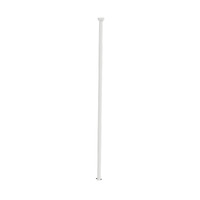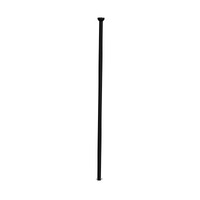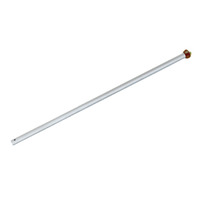

D-ROD
Martec MDRD36W | 900mm Ceiling Fan White Downrod w/Loom | Martec DC Fans
$38.45
$34.95 ex. GST
Search Results:
Search Results:
A drop rod is the rigid metal pipe that connects a ceiling fan motor housing to its mounting bracket. The rod transfers the fan's weight to the structure above the ceiling and carries the wiring through its hollow centre. Without the right drop rod, even a high-quality fan can wobble, run inefficiently, or sit at an unsafe height.
The drop rod (often called a downrod or extension rod) is the structural link between the ceiling bracket and the fan motor. It positions the blades at the correct distance below the ceiling, allowing air to flow freely across the room. The rod also conceals the cabling that powers the motor and any integrated ceiling fan lights.
Blade height affects how air moves through a room. Blades sitting too close to the ceiling cannot draw air freely, which reduces circulation and increases motor strain. Blades hung too low create a head-strike hazard and can disrupt airflow patterns near furniture and lighting. Australian Standard AS/NZS 60335.2.80 sets the minimum blade-to-floor clearance, and the right rod length keeps the fan within that limit.
Most ceiling fans ship with a short standard rod, typically 90mm to 150mm. A longer rod is required when ceilings exceed about 2.7 metres, when the ceiling is sloped, or when the fan needs to clear obstructions like beams or pendant lights. Flush-mount or hugger fans skip the drop rod entirely and sit close to the ceiling.
Getting the rod length right is the single biggest decision in drop rod selection. The goal is to position the blades at roughly 2.4 metres above the floor, which is the sweet spot for both airflow and clearance.
Air circulation depends on the space between the blades and the ceiling. A clearance of 250mm to 300mm allows the fan to draw air smoothly into the blade plane. Shorter clearances starve the fan and cause turbulence. Longer rods position the blades in the active airflow zone of the room, which is roughly the upper third of the wall height.
Use ceiling height as the primary guide. A 2.4-metre ceiling rarely needs more than the standard rod supplied with the fan. A 3-metre ceiling typically calls for a 300mm to 600mm rod. Ceilings above 3.5 metres often need 900mm to 1800mm extensions, with some specialist rods running to 2400mm for double-storey voids.
| Ceiling Height | Suggested Rod Length | Typical Application |
|---|---|---|
| 2.4m | Standard rod (90mm to 150mm) | Standard residential rooms |
| 2.7m to 3m | 300mm to 600mm | Lounge rooms, bedrooms |
| 3m to 3.5m | 600mm to 900mm | Open-plan living areas |
| 3.5m to 4.5m | 900mm to 1500mm | High-ceiling rooms, voids |
| 4.5m and above | 1500mm to 2400mm | Double-storey voids, halls |
Aim for blades that sit between 2.1 metres and 2.7 metres above the finished floor. The Australian minimum clearance is 2.1 metres. The ideal performance height is around 2.4 metres, which gives strong airflow at standing and seated levels without crowding the ceiling.
Drop rod length = ceiling height minus 2.4 metres minus the fan's own height. For a 3.2-metre ceiling with a fan that is 250mm tall: 3.2m - 2.4m - 0.25m = 550mm rod. Round up to the nearest stocked length, usually 600mm.
The terminology around drop rods can be confusing because the industry uses several names for the same component. Knowing the variations helps avoid ordering errors.
Drop rod, downrod, and extension rod all describe the same product: the vertical pipe that links a fan to its bracket. Some brands prefer one term over another. Hunter Pacific and Martec often use "extension rod". Mercator and Brilliant Lighting tend to use "drop rod" or "downrod".
Most drop rods sold in Australia are fixed-length, sized in standard increments such as 300mm, 600mm, 900mm, 1200mm, and 1800mm. Adjustable rods are rare in the residential market and are mainly seen on industrial high-volume low-speed fans. For homes and small commercial spaces, fixed-length rods cut to brand-specified sizes are the norm.
Some brands stock non-standard lengths to suit unusual ceiling heights. For voids, raked ceilings, or commercial fit-outs, lengths above 1500mm may need to be ordered specifically. Always confirm rod length availability before specifying the fan model on a job.
A drop rod must match the fan it supports. Brand, motor type, and thread specification all affect whether a rod will fit safely.
AC and DC ceiling fans use different motor designs but share similar drop rod attachment systems. The key difference is wiring: DC fans run a low-voltage signal between the receiver and motor, often with extra control wires. The rod itself is mechanically similar, but the wiring loom inside must match the fan's connection block.
Drop rods use threaded couplings to lock into the motor housing and the canopy bracket. Common diameters in Australia range from 16mm to 25mm. The threads must match the fan exactly, otherwise the rod cannot be secured. Mixing brands without checking thread specifications is the most common cause of fitting failures.
Most drop rods are brand-specific. A Hunter Pacific rod is engineered for Hunter Pacific fans. A Martec rod fits Martec models. Universal rods exist but are uncommon, and using one outside the manufacturer's recommendation can void the fan's warranty. Always pair the rod with the fan brand wherever possible.
Important: Never modify a drop rod by cutting, drilling, or shortening it. Any change to the rod compromises its load rating and may breach AS/NZS 3000:2018 wiring rules and the fan's warranty.
Ceiling shape changes how the rod hangs and how the fan sits. Flat ceilings are the simplest. Sloped, raked, and vaulted ceilings need extra hardware and longer rods.
Flat ceilings allow the standard mount and rod to sit vertically. The rod hangs straight down, the canopy meets the ceiling cleanly, and the fan blades remain level. Most pre-supplied rods are sized for flat ceilings around 2.4 metres high.
Sloped or raked ceilings require an angled canopy or a sloped ceiling adapter. Many fan brands sell these as accessories sized to handle pitches between 15 and 30 degrees. The drop rod itself stays vertical, but the canopy at the top compensates for the ceiling angle. For pitches steeper than 30 degrees, a specialist sloped mount is essential.
Vaulted, cathedral, and double-storey voids need long drop rods. Lengths from 900mm to 2400mm are common in this scenario. Long rods place greater leverage on the mounting point, so the ceiling joist or supporting beam must be capable of carrying the dynamic load of the fan plus the rod.
Drop rods are made from steel, aluminium, or steel coated in a protective finish. The choice depends on where the fan will be installed and the look the customer wants.
Steel rods are the industry standard. They handle the dynamic load of a spinning fan well and resist bending under torque. Aluminium rods are lighter and easier to handle but are typically reserved for smaller fans. For commercial installations and large blade spans above 1300mm, a steel rod is the safer choice.
Outdoor and coastal installations need corrosion-rated rods. A standard powder-coated steel rod can fail quickly in salt air. Look for fans with IP-rated outdoor housings paired with marine-grade or stainless rods, particularly within five kilometres of the coast. Hunter Pacific and Ventair stock fan ranges are designed for these environments.
Drop rods are typically supplied in colours that match the fan body. White, matt black, brushed nickel, antique brass, and timber-look finishes are common. Replacement rods should match the original fan finish for a clean appearance. Buying the rod from the same supplier as the fan keeps the finish consistent.
Drop rod installation is electrical work. In Australia, fixed-wired ceiling fans must be installed by a licensed electrician. The work falls under AS/NZS 3000:2018 wiring rules.
The mounting point must support the fan's full weight plus dynamic load. A standard 1200mm AC fan creates roughly 15kg of static load, with an additional 5kg to 10kg of dynamic load when running at high speed. The mounting bracket needs to be fixed to a structural joist or a fan-rated mounting box, never just to plasterboard.
Incorrect installation can cause wobble, premature motor wear, electrical faults, or, in worst cases, the fan falling from the ceiling. Common errors include: the rod not seated correctly in the canopy, the locking pin missing, the cable tension inside the rod pulling on the motor terminals, and the brackets fixed only to plasterboard. Each of these is preventable with a careful installation.
Any work on a fixed-wired ceiling fan requires a licensed electrician. Plug-in portable fans are exempt. Pulling down an existing fan, replacing a drop rod, or installing a new fan all involve disconnecting and reconnecting active wiring. Choosing the rod is straightforward, but fitting it is not a DIY task in most Australian states and territories.
Andrew Aranovitch (Licence #40389) confirms that all fixed-wired fan installations and rod replacements in Australia must comply with AS/NZS 3000:2018 and be carried out by a licensed electrician. Self-installation of hard-wired fans is not legal in any Australian state.
Selection comes down to three things: ceiling height, fan brand, and the look. Get those right, and the rod will perform well for years.
Bedrooms, lounges, and home offices benefit from blades positioned around 2.4 metres high for direct airflow. Open-plan kitchens and dining areas often benefit from a slightly higher position to avoid disrupting cooking surfaces and lighting. Outdoor alfresco areas typically need IP-rated fans with corrosion-resistant rods.
A long rod can become a visual feature in a high-ceiling room, drawing the eye to the fan as a centrepiece. A short rod keeps the fan low-profile and unobtrusive. Where the fan will be visible from a sitting position, finish matters as much as length. Coordinate the rod colour with surrounding ceiling fittings, downlights, and pendants.
Large rooms above 25 square metres often need fans with blade spans of 1300mm or larger. These fans carry more weight and apply more torque, so the drop rod and mount must be sized accordingly. Two smaller fans on shorter rods can outperform one oversized fan in long, narrow rooms.
Drop rods last as long as the fan in most cases. Replacement is only needed when the rod is the wrong length, when corrosion sets in, or when the original rod has been damaged.
Several signs indicate the wrong rod length. Blades sit too close to the ceiling and produce weak airflow. The fan feels too low when walking past it. Air moves only directly underneath the fan rather than across the whole room. Each of these points to either the standard rod being too short or being too long for the room.
Switching to a longer drop rod is often more effective than replacing the entire fan. A correctly positioned existing fan can outperform a poorly hung new one. If the fan motor and blades are still in good condition, a rod swap is the cheaper and quicker fix.
Full replacement makes sense when the motor is noisy, when blades are warped, or when the fan is more than 15 years old. Modern DC fans are much quieter and more efficient than older AC units. If a rod swap is being considered alongside other complaints, a new fan may be the better long-term investment.
Drop rods are widely available from specialist online stores, electrical wholesalers, and fan brand websites. Price, range, and delivery time vary significantly between suppliers.
Sparky Direct stocks drop rods compatible with leading Australian fan ranges, including options from Hunter Pacific, Mercator, Ventair, and CLA. Buying from a specialist electrical wholesaler typically yields better trade pricing than buying from general lighting retailers.
Cheap unbranded drop rods often fail the basic quality checks: thread tolerance, wall thickness, and finish durability. Trade-grade rods from established Australian fan brands carry tested load ratings and matching warranties. The price difference between cheap and trade-grade is small, but the reliability difference is significant.
Confirm five details before placing an order: fan brand and model, rod length needed, thread diameter, finish, and whether the rod includes its own wiring loom. Most fan brands sell rods as accessories rather than universal stock, so checking these specifications avoids returns.
Drop rods need very little maintenance, but a brief annual check keeps the fan safe and quiet. Catching issues early prevents bigger problems later.
Once a year, check the canopy at the ceiling for movement. The rod should not rotate or wobble in the bracket. Listen for ticking or clicking sounds when the fan runs. These are early signs of a loose rod or worn locking pin.
Wobble usually traces back to one of three causes: blade imbalance, a loose rod connection, or a flexing mounting bracket. A wobble that grows over time often means the locking pin or grub screw at the rod junction is backing off. A licensed electrician can re-tension the connection during a routine service.
A well-installed drop rod from a quality brand should last the life of the fan, typically 15 to 20 years. Outdoor and coastal rods may corrode sooner, particularly if exposed to salt spray. Replacing a corroded rod before it weakens is far cheaper than dealing with a fallen fan.
Most drop rod problems show up as wobble, weak airflow, or installation difficulties. Each has a clear cause and a clear fix.
Wobble points to either the rod or the blades. Check that all blade screws are tight and that no blade is bent. If the blades are fine, the rod is the next suspect. Loose locking pins, an undersized mounting bracket, or a rod fitted into the wrong canopy all cause visible wobble at running speed.
Weak airflow usually means the blades are too close to the ceiling. Try the formula in the length section above. If the calculated rod length is significantly longer than the one currently fitted, a longer rod will improve performance. Other causes include the motor running in the wrong direction and a build-up of dust on the blades.
Compatibility issues show up as threads that will not engage, canopies that do not cover the ceiling cleanly, or wiring that does not reach the motor. Each of these is a sign that the rod and fan brand or model do not match. Returning the rod and ordering the brand-correct part is the only proper fix.
Watch Clipsal Y3HS1300-WH | Airflow DC Ceiling Fan 3 Blade 1300mm | White video
Watch Hunter Pacific AIP2665 | Aqua 70" IP66 DC Ceiling Fan | Matt Black video
Watch Ventair GLA1203WH | Glacier DC 48"/1.2m 3 Blade Ceiling Fan | White video

These fans look lovely and blend effortlessly with our heritage listed house giving it a stylish finish in all rooms. Very quiet and speed level perfect and easily adjusted. No longer need to use the aircon all the time and the family now sleeping with a lovely gentle breeze from the fans. Loving the shape of the blades and so easy to clean with a damp cloth. Highly recommend!! Service was excellent, shipping fast.
I purchased this about a month ago and it’s been fantastic. The remote makes it easy to adjust brightness, fan speed, and colour settings, and it looks great in the room. It’s also wonderfully quiet, which makes it perfect for the bedroom. Highly recommend if you’re after a safe, compact fan that performs well.
Cant beat a Clipsal fan. Heaps of airflow and not noisy at all. Nothing complex with setting up the remote either. Recommend to anyone who’s looking to get a fan installed but doesn’t want to modify the switch wiring at all. Good price too.
Quality products in stock • Fast Australia-wide delivery • Competitive trade pricing
Browse Ceiling Fan Drop Rods → Get Expert Advice →Yes, drop rods are visible and are often colour-matched to the ceiling fan.
Sparky Direct supplies ceiling fan drop rods with fast Australian delivery to support correct ceiling fan installation.
Yes, drop rods form part of the fan installation and must be installed by a licensed electrician.
Warranty coverage varies by manufacturer and usually applies to manufacturing defects.
Check fan brand compatibility, required length, finish, and ceiling type.
Yes, drop rods are commonly sold separately to suit different ceiling heights.
Drop rods generally require no maintenance beyond routine checks during fan servicing.
Yes, provided the drop rod is compatible and rated for the installation environment.
Drop rods should not be modified unless specified by the manufacturer.
Yes, when compatible with the fan and installed correctly, they are designed for safe operation.
No, when correctly installed, drop rods should not increase noise.
Some fans can be retrofitted with compatible drop rods, depending on the model.
Many drop rods are available in finishes designed to match common ceiling fan styles.
Ceiling fan drop rods are used to extend the mounting height of a ceiling fan to achieve correct clearance and airflow.
Yes, it lowers the fan to a more appropriate height while maintaining safe clearance.
A drop rod is often needed if the ceiling is higher than standard to ensure effective airflow.
Yes, installation must be carried out by a licensed electrician as part of ceiling fan installation.
Correctly sized drop rods can improve airflow and overall fan efficiency.
Most drop rods are made from durable metal materials to support the weight and operation of the fan.
Some drop rods are suitable for sloped ceilings when used with compatible mounting kits.
Yes, drop rods are commonly used for high ceilings to ensure correct fan placement.
They are available in various lengths to suit standard, high, or sloped ceilings.
Drop rods are not always universal and must be compatible with the specific ceiling fan brand and model.
Yes, drop rods supplied in Australia should be compatible with fans that comply with relevant AS/NZS electrical safety standards.
They help position the fan at an optimal height for performance, safety, and comfort, especially with high ceilings.