Search Results:
Search Results:
Search Results:
Search Results:
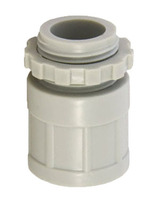
A plain to screw adaptor is a short PVC fitting with two different ends. The plain end is sized to slip over a standard length of medium duty rigid conduit and is glued in place with PVC solvent cement. The opposite end carries a moulded thread, either male or female, that mates with a threaded entry on an accessory. The adaptor converts an unthreaded conduit run into a screwed connection without cutting threads on site.
Most enclosures, isolators, and weatherproof junction boxes use threaded conduit entries, but standard PVC conduit comes plain. Without a transition fitting the conduit cannot lock into the accessory, so plain to screw adaptors close that gap by giving the conduit a thread on demand. They keep the system mechanically continuous and electrically safe.
A plain end relies on glue and a solvent weld to hold, whereas a threaded end relies on engaged threads and a locknut. Each method suits different parts of an installation: glue joints work best on hidden runs, while threaded joints work best where the conduit meets an accessory that may need to be opened later. The adaptor lets one run use both methods at the right points along its length.
An installation only protects cables when every joint stays sealed and held, and plain to screw adaptors maintain that continuity through their dual-end design. The plain end bonds to the conduit while the threaded end secures into the accessory, and together they form a single continuous path that resists pull-out, vibration, and impact damage.
Straight adaptors are the standard format and the most common version sold, with a plain socket on one end and a male or female thread on the other. The body runs in a single straight axis, and they suit any installation where the conduit meets the accessory in line.
Angled and offset variations appear less often in the Sparky Direct range. Most Australian installations rely on a straight adaptor combined with a separate solid elbow or conduit bend to handle direction changes. This keeps the parts list simple and the joint count predictable.
When a male threaded adaptor passes through a panel or gland plate, a separate locknut is needed to clamp it from the inside. The locknut is not always supplied with the adaptor and is often ordered separately. Female threaded adaptors do not need a locknut because the accessory's own male thread engages directly.
Plain to screw adaptors are sized to match standard PVC conduit dimensions. They are not interchangeable with metal conduit fittings, which use a different thread profile and material. For metal conduit work, dedicated steel adaptors are used. The adaptors stocked by Sparky Direct are PVC types intended for PVC conduit systems.
Almost all plain to screw adaptors used in Australian electrical work are made from rigid PVC. The material is light, dimensionally stable, and bonds reliably with PVC solvent cement. It resists most household chemicals and does not corrode. PVC adaptors carry the bulk of residential and commercial conduit work.
Metal versions exist for steel conduit systems but are not the focus of the Sparky Direct plain to screw range. Where mechanical strength is the priority, electricians select galvanised steel conduit and matched metal fittings rather than mixing PVC adaptors into a metal run.
PVC does not rust, and it resists moisture, salt, and most acids and alkalis encountered on a typical site. UV exposure can degrade unprotected PVC over years of direct sunlight, so outdoor runs are normally protected by enclosure positioning, conduit covers, or shaded routing where prolonged sun exposure is expected.
A PVC adaptor bonds only to PVC conduit, so the plain end is not designed to slip over corrugated conduit, flexible conduit, or metal conduit. Mixing materials at the joint produces a connection that will not seal and may fail under load, so always match the adaptor to the conduit system being used.
The standard PVC sizes stocked in Australia are 20mm, 25mm, 32mm, 40mm, and 50mm. The 20mm and 25mm versions are the highest volume sellers because they match the conduit sizes used in most residential and small commercial work. Larger 40mm and 50mm adaptors handle main supply runs and submains.
| Conduit Size | Typical Application | Common Use |
|---|---|---|
| 20mm | Lighting and power circuits | Domestic and light commercial |
| 25mm | Subcircuits and isolator entries | Air conditioning, hot water, GPO runs |
| 32mm | Larger feeders and switchboard tails | Commercial and industrial |
| 40mm | Submain runs | Multi-circuit feeders |
| 50mm | Main supply and large submains | Industrial and infrastructure |
The plain socket is sized to match the outside diameter of the conduit it accepts, so a 20mm adaptor only fits 20mm PVC conduit and a 25mm adaptor only fits 25mm PVC conduit. There is no useful tolerance between sizes, and mismatched parts will either not slide together or will not bond cleanly.
PVC plain to screw adaptors use the standard PVC conduit thread that mates with Australian threaded accessories, and the thread is moulded into the part during manufacture. It is not the same as a tapered pipe thread or a metric machine thread, so the two should never be cross-fitted.
The most common error is forcing a male adaptor into a female fitting that uses a different thread system. The first turn or two will go in, but after that the plastic teeth shear off and the joint is ruined. Always match the adaptor to the accessory by brand and stated thread compatibility before tightening.
Start with the conduit material, since each system has its own matched fittings. PVC conduit takes a PVC adaptor with a glue socket, and metal conduit takes a metal adaptor with a threaded socket. Corrugated conduit takes a dedicated corrugated coupling rather than a plain to screw adaptor. Mixing systems at the same joint creates problems that are hard to fix once the conduit is installed.
For interior work, standard grey PVC adaptors are the default. For external runs, the same parts are used but installation detail matters more, with attention to drainage, UV shielding, and sealing at the threaded entry. For industrial sites with mechanical impact risk, heavier conduit grades and metal alternatives may be specified by the project engineer.
A correctly installed PVC plain to screw joint will hold the conduit against normal pull and twist forces. It is not designed to carry mechanical load such as a person's weight or a heavy fixture. Where load is expected, separate brackets, saddles, or supports must take that load, not the joint itself.
Three errors come up regularly when selecting plain to screw adaptors. The first is buying the wrong size, often by counting internal diameter instead of nominal conduit size. The second is buying a male adaptor when the accessory needs a female, or the reverse, and the third is ordering the body and forgetting the locknut. A quick check before purchase saves a return trip to the wholesaler.
In domestic work, plain to screw adaptors appear at meter boxes, switchboards, air conditioning isolators, hot water isolators, and outdoor power outlets. They are also used wherever a 20mm or 25mm conduit run terminates into a junction box or weatherproof enclosure.
Commercial sites use the same fittings in larger sizes and higher volumes. A typical office or retail fit-out may include hundreds of 20mm and 25mm plain to screw adaptors at light fittings, sensor boxes, and switchboard terminations. Industrial sites add 40mm and 50mm versions for submains and heavier feeder runs.
For larger infrastructure work, plain to screw adaptors connect underground conduit runs to above-ground enclosures, pillar boxes, and pit lids. The threaded entry into the enclosure provides a sealed transition that the project specification can rely on.
The adaptor is also useful where one conduit type meets another, such as where a PVC main conduit run meets a flexible whip at the final connection to a piece of equipment. The plain to screw adaptor takes the PVC end and presents a thread that the flexible accessory can screw into.
Cut the conduit square so that a clean, perpendicular cut allows the adaptor to seat fully against the shoulder of the socket. Remove burrs from the inside and outside of the cut, since burrs prevent full seating and can damage cable insulation when wires are pulled through later. PVC pipe cutters produce a cleaner cut than a hacksaw and reduce the chance of leaving sharp edges on the prepared end.
Apply PVC solvent cement to both the inside of the plain socket and the outside of the conduit. Push the parts together with a small twist to spread the glue, then hold for several seconds while the bond sets. On the threaded end, hand-tighten into the accessory and stop when the joint is firm, since tools should not be used to over-tighten the connection.
Cross-threading happens when the adaptor enters the accessory at an angle: the first turn feels stiff, then suddenly easier as the threads strip. Over-tightening cracks the body of the adaptor or the entry boss of the accessory, and both faults are visible on inspection and require the joint to be replaced.
Start the thread by hand for at least two full turns before applying any torque. If it does not start cleanly within two turns, back it off and try again. Forcing the part is the single most common cause of failed plain to screw joints on site.
After installation, three things should be checked. The plain end should show a thin glue bead around the socket lip. The threaded end should sit square against the accessory with no visible gap, and the body should show no cracks, white stress marks, or visible deformation.
A loose joint usually means insufficient glue at the plain end or insufficient thread engagement at the screw end, and both are caused by rushing the installation. A few seconds of care during assembly prevents hours of fault-finding later.
Thread damage on PVC adaptors is almost always caused by cross-threading on first install or by repeated removal and refit during testing, and each cycle on a soft thread strips a little material. Where regular access is needed, a metal threaded entry or gland is more durable than a PVC equivalent.
Mixing brands sometimes produces threads that almost mate but not quite, and the joint feels tight when first assembled then cracks or leaks under load. Where possible, stay with one brand within a single installation, or check that the brands explicitly cross-reference for compatibility.
If the conduit run does not arrive square at the accessory, the adaptor will load up against the body of the box. Over time the stress shows as a hairline crack at the threaded shoulder. Plan the conduit run so the final approach is straight, or use a short bend or elbow to correct alignment before the adaptor is fitted.
A conduit coupling joins two pieces of plain conduit together. A plain to screw adaptor joins a piece of plain conduit to a threaded accessory. They look similar but solve different problems and are not interchangeable.
A bushing is a small protective ring that lines the inside of a sharp-edged entry, typically in metal enclosures, to protect cables from abrasion. An adaptor is a structural fitting that forms the joint itself. A connector is a generic term that may refer to either, depending on brand catalogue language.
Use a plain to screw adaptor whenever a PVC conduit run terminates into an accessory with a threaded entry. Use a plain reducer when the conduit needs to step down to a smaller size mid-run without a thread. Use a coupling when the conduit just needs to be extended.
The right adaptor produces a joint that is fast to install, mechanically secure, and sealed against the entry of dust and moisture. The wrong adaptor produces rework, so selecting carefully at the order stage saves time on site and keeps the inspection report clean.
A well-installed PVC plain to screw adaptor will outlast the cable it protects. The bond at the plain end and the engaged thread at the screw end share the load between two independent mechanisms, so a single point of wear does not bring down the whole joint.
The adaptor's primary safety role is to keep the cable inside the conduit and away from sharp edges. A failed joint exposes the cable to mechanical damage, environmental ingress, and possible contact with the enclosure body. Maintaining the joint maintains the cable.
PVC remains stable over decades of indoor service, while outdoor service is shorter where direct UV strikes the part. Where long-term outdoor performance matters, the run is shielded by enclosures, covers, or routing in shade, and junction boxes placed at exposed locations should be UV-rated to match the conditions.
Plain to screw joints are inspected visually during routine electrical maintenance, with attention to cracks, white stress lines, water staining inside the accessory, and any movement at the joint. Any of these indicate the joint should be replaced rather than refitted in place.
Plain to screw adaptors are inexpensive parts, and per unit, the smaller sizes are typically the cheapest in the conduit fittings range, with prices rising for the larger 40mm and 50mm versions. The cost per adaptor is low enough that buying spares for the job is the norm rather than the exception.
For trade buyers running multiple jobs, bulk packs work out cheaper per unit and reduce the chance of running short on site. For one-off domestic work, individual purchases avoid leftover stock. Sparky Direct stocks both formats where the supplier offers them.
Within Australian-stocked PVC adaptors, the quality difference between budget and premium brands is smaller than in many other product lines. Both NLS and Clipsal versions are made to the same Australian conduit standards. The choice usually comes down to price and stock availability.
Walk-in trade counters offer immediate stock but limited brand range. Online wholesalers carry deeper stock at trade prices, with delivery direct to site or workshop. For planned jobs, online ordering with next-day delivery often beats a trip to the trade counter on time and cost.
Sparky Direct dispatches stock items quickly from Australian warehouses. For most metro destinations, plain to screw adaptors arrive within one to three business days. For urgent jobs, the dispatch speed is the practical difference between finishing on schedule and pushing the job back a day.
Read the accessory specification before ordering. The accessory data sheet states the entry size and thread type. Order the adaptor that matches that statement, not the adaptor that looks similar to one already on the truck. Five minutes of checking saves an entire trip.
The recurring buyer mistakes are easy to list. Ordering male when female is needed. Ordering the body and not the locknut. Ordering 25mm because that's what the truck always carries, when the job actually needs 20mm. Each of these adds a return trip to the count.
For a typical job, allow at least 10 percent extra over the calculated count. Some adaptors will be cracked on first install. Others will be cross-threaded and need to be cut out. The spare allowance keeps the job moving without a stock run mid-shift.
Sparky Direct stocks the full size range from 20mm to 50mm in both Clipsal and NLS branded versions, with trade pricing on bulk quantities and Australia-wide dispatch. The category page lists current stock, sizes, and brand options in one place.
Club Clipsal is Australia's largest electrician community offering trade rewards, business support, and exclusive benefits. When you nominate Sparky Direct as your preferred wholesaler, we automatically apply your Clipsal spend points to your Club Clipsal account daily.
Entry-level offering coaching, mentoring, and training discounts
Unlock exclusive industry tools and networking events
Access Toyota fleet offers and business software discounts
Maximum benefits, including VIP experiences and rewards
1. Sign Up: Create your Club Clipsal account at clipsal.com/club-clipsal or via the iCat mobile app
2. Nominate Sparky Direct: Select Sparky Direct from the wholesaler dropdown menu in your profile
3. Add Email: Enter your Sparky Direct account email address in the membership number field
4. Start Earning: Every dollar spent on Clipsal products earns points automatically
Redeem points from the rewards store, including gift cards, tools, and experiences. Access business summits, product training, and industry networking events. Receive early access to new product launches and special promotions. Connect with fellow electricians via the Club Clipsal community app.
Watch Clipsal 258-20-GY | 20mm Plain to Screw PVC Conduit Female Coupling video
Watch NLS 30209 | 25mm PVC Plain to Screw adaptor | PS25 video
Watch NLS 30210 | 32mm PVC Plain to Screw adaptor | PS32 video

Again, a great substitute for Clipsal products, lower price but the same quality.
I selected this product and supplier because they are efficient and dispatch quickly
This is the second time I am ordering from Sparky and I am satisfied with the prices, the products, the service and the delivery. I used all these products to make a crop protection cage for my backyard crop to protect from birds:)
Quality products in stock • Fast Australia-wide delivery • Competitive trade pricing
Browse Plain to Screw Adaptors → Get Expert Advice →They are straightforward for trained professionals to install as part of a compliant system.
Sparky Direct supplies plain to screw adaptors Australia-wide, offering reliable conduit transition fittings with convenient delivery.
Plain to screw adaptors are securely packaged and delivered via standard courier services.
Unused products are generally eligible for return according to the seller’s returns policy.
Warranty coverage varies by manufacturer and typically covers defects in materials or workmanship.
Yes, plain to screw adaptors are typically sold as individual conduit fittings.
Yes, selecting the correct size ensures a secure and compliant installation.
Once installed correctly, they generally require no maintenance.
Yes, they help maintain conduit continuity and cable protection.
Yes, they are commonly used when modifying or extending conduit systems.
They may be visible in surface-mounted installations or concealed in walls or ceilings.
Quality adaptors are designed to withstand everyday installation conditions.
Yes, they provide clean transitions between plain and threaded components.
Plain to screw adaptors are electrical conduit fittings used to connect plain-end conduit to threaded (screw) fittings or accessories.
Yes, they are a standard solution in many conduit installations.
They allow different conduit connection types to be joined neatly and securely.
Yes, they are designed to work with standard conduit and threaded fittings.
Yes, they are designed to create a secure transition between conduit types.
Yes, they are suitable for residential, commercial, and light industrial applications.
Yes, they are commonly used in indoor electrical conduit systems.
Yes, they are available to suit common conduit sizes such as 20mm, 25mm, and 32mm.
They are typically made from durable PVC or similar materials suitable for electrical installations.
Yes, they are designed for use with rigid electrical conduit.
Quality adaptors are manufactured to meet relevant AS/NZS electrical and safety standards when installed correctly.
They are used to transition between plain conduit and threaded components in an electrical conduit system.