Search Results:
Search Results:
Search Results:
Search Results:
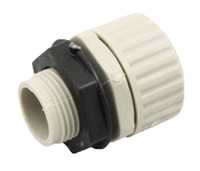
Find the best Straight Conduit Gland Fittings here at Sparky Direct. [ Read More ]
A straight gland is a two-part fitting that joins a length of conduit to an enclosure. The threaded body inserts through a knockout hole in the wall of a switchboard or junction box. A locknut or lockring secures the body from the inside. The conduit then pushes onto the external profile of the gland, completing the join. Cables run through the conduit and enter the enclosure through the open centre of the gland.
The point where conduit meets an enclosure is mechanically and electrically vulnerable. Without a proper fitting, the conduit can pull free, cables can chafe against bare metal edges, and dust or moisture can enter the enclosure. A correctly installed straight gland holds the conduit firmly, smooths the cable entry point, and helps maintain the IP rating of the enclosure.
Straight glands run the conduit perpendicular to the enclosure wall, which suits most surface-mounted runs. Angled glands turn the conduit through 90 degrees at the entry, useful when conduit runs parallel to a wall and must dip down into a switchboard. Straight versions are simpler, cheaper, and more common in standard residential and commercial work.
Cables entering an enclosure pass over a sheet-metal or plastic edge, which can be sharp or burred. The gland body lines this opening with a smooth bore, removing direct contact between the cable sheath and the enclosure wall. This prevents abrasion damage over time, particularly in applications where vibration or movement is present.
The gland body is the main threaded barrel that passes through the enclosure wall. One end carries the conduit attachment profile, which may be a smooth socket for solvent welding, a serrated socket for corrugated conduit, or a threaded section for screwed conduit. The opposite end is threaded to accept the lockring or locknut.
The lockring (sometimes called a lockring nut or backnut) sits on the inside face of the enclosure. When tightened against the inner wall, it clamps the gland body in place and prevents rotation or pull-out. Some PVC glands use a snap-fit ring rather than a threaded nut, which speeds installation but offers slightly less mechanical security.
Higher-grade straight glands include a bush or insert that sits in the bore where cables pass through. This protects the cable sheath against abrasion. IP-rated variants add a rubber sealing washer between the gland flange and the enclosure wall, plus a compression seal around the conduit.
Inside the conduit socket of the gland, a moulded stop limits how far the conduit can be pushed in. This ensures consistent insertion depth and gives the solvent cement (where used) the correct surface area to bond against. The stop also leaves a clear path through the gland for cables.
PVC is the most common gland material in Australian residential and light commercial work. It is light, non-conductive, resistant to most cleaning chemicals, and easy to work with hand tools. PVC glands are typically grey or orange, matching the conduit colour for medium-duty and heavy-duty applications. National Light Sources (NLS) is a widely stocked PVC fittings brand in this category.
Metal glands handle higher mechanical loads and heat than PVC. Brass resists corrosion in damp conditions and is preferred for marine, food-processing, and chemical environments. Galvanised steel glands suit heavy industrial conduit runs where the conduit itself forms part of the earthing path.
PVC glands resist most acids, alkalis, and salt spray, but UV exposure can make them brittle over years of outdoor use. Brass glands are stable in marine air. Zinc-plated steel needs paint protection in coastal sites. Always match the gland material to the worst environmental condition the installation will see.
Metal glands can support more weight at the entry point and resist impact better than PVC. In switchboards where heavy multi-core cables enter, metal glands stop the cable weight from pulling the conduit free. PVC glands are adequate for lighter cabling but should not be used where conduit is repeatedly flexed.
AS/NZS 2053 is the Australian and New Zealand standard for conduits and fittings used in electrical installations. It sets requirements for impact resistance, temperature performance, and dimensional accuracy. Compliant glands carry batch identification and meet the minimum classification needed for the installation type.
The AS/NZS 3000 Wiring Rules require that cables entering an enclosure are protected against mechanical damage and that the enclosure rating is preserved. Straight glands are the standard means of meeting both requirements at conduit entry points. They must be installed so the locknut is fully tightened and the conduit is properly engaged.
If an enclosure is rated IP54 or higher, every penetration through its walls must maintain that rating. A non-sealed gland in an IP-rated enclosure breaks the rating and creates a compliance failure. IP-rated straight glands with sealing washers are required on outdoor switchboards, weatherproof junction boxes, and washdown enclosures.
Installation of conduit and gland fittings on fixed wiring is licensed electrical work in every Australian state and territory. Unlicensed installation is illegal and voids insurance. The installer is also responsible for testing the installation and certifying compliance with AS/NZS 3000.
Gland size refers to the nominal conduit diameter it is built to accept. A 20mm gland fits 20mm conduit. Mixing sizes results in either a loose fit that pulls free or a forced fit that splits the gland body. Always check the size stamping on the gland body and the conduit itself before assembly.
The most common conduit sizes in Australian installations are 20mm and 25mm, with 32mm used for larger sub-mains and multi-cable runs. Cable glands at 20mm, 25mm, 32mm and 40mm cover most general work, with larger sizes available for industrial sub-circuits.
Corrugated conduit and rigid conduit use different gland profiles. A corrugated gland has internal ridges that lock into the conduit corrugations. A rigid-conduit gland has a smooth socket sized for solvent welding. The two are not interchangeable: a corrugated gland will not seal a rigid conduit, and a rigid gland cannot grip the wavy profile of corrugated conduit.
Most enclosures and switchboards have pre-stamped knockouts at standard 20mm and 25mm sizes. The gland body diameter must match the knockout. If the hole is too large, the gland will rotate or the locknut will pull through. If too small, the knockout must be enlarged with a step drill or hole saw before fitting.
Decide first whether the run uses corrugated or rigid conduit, then select the gland profile to suit. Mixing systems within a single run (for example, rigid conduit on the wall and corrugated in the ceiling) requires a transition coupling rather than a single gland.
Indoor concealed work suits standard PVC glands without sealing washers. Outdoor and washdown work needs IP-rated glands. Industrial sites with heavy mechanical loading, vibration, or chemical exposure usually justify metal glands. Match the rating to the worst expected condition.
Check the IP rating of the enclosure first. The gland rating must equal or exceed it. An IP65 enclosure with an IP20 gland is no longer IP65 in practice. Where multiple penetrations exist, each one must be sealed individually.
Four selection errors cause most failures: wrong material for outdoor use, undersized gland for the conduit, non-sealed gland in an IP-rated enclosure, and ignoring the enclosure knockout size. Each one causes either an immediate failure or a slow degradation of the installation.
Straight glands secure conduit entries into domestic switchboards and meter boxes. They protect TPS and submains cables as they enter the enclosure and help maintain the IP rating where the box is mounted outdoors. Standard 20mm and 25mm PVC glands cover most domestic work, often paired with junction boxes at branch points.
Office fit-outs, retail spaces, and warehouses commonly use surface-mounted rigid conduit with glands at every panel entry. Heavy-duty grey or orange PVC fittings are standard, often combined with conduit saddles to fix the run to walls and ceilings.
Manufacturing plants, food processing facilities, and chemical sites often require steel or brass glands. The gland forms part of an integrated mechanical and ingress-protection strategy, sometimes combined with explosion-proof or hazardous-area enclosures where the application demands it.
Solar PV, battery storage, and EV charger installations use straight glands at inverter cabinets, battery enclosures, and charger backplates. Outdoor-rated glands with UV-resistant materials are critical, as the installation is exposed to weather for the full system life of 15 to 25 years.
Knock out the entry hole cleanly. Deburr the edge with a file or reamer to remove any sharp ridges. The hole must be the correct size for the gland body, with no oval distortion that could prevent the locknut sealing flat against the wall.
Insert the gland body from the outside with the threaded section passing through the hole. Fit the lockring or locknut on the inside and tighten until the gland sits flush against the enclosure wall. PVC lockrings should be hand-tight plus a quarter turn. Do not over-tighten with pliers, as cracking the lockring is a common failure.
For rigid conduit, apply PVC conduit glue to the conduit end and the gland socket, then push the conduit fully home until it meets the internal stop. Hold for 10 seconds while the cement bonds. For corrugated conduit, push and twist the conduit into the gland until the corrugations engage the internal serrations.
After the gland is fitted, check the conduit cannot be pulled free with moderate hand force. Confirm the locknut is fully tight and sitting flat. For IP-rated installations, carry out the standard ingress test, or visually verify the sealing washer is compressed evenly around its circumference.
Field-Reported Failures: Most gland failures in service trace back to one of four installation errors, all of which are avoidable with care during fit-off.
Using a gland one size larger than the conduit results in a loose joint that pulls free under cable weight. Using one size smaller forces the gland onto the conduit and splits the body. Check both stamps before assembly.
PVC lockrings are not designed for high torque. Tightening with pliers or pump pliers cracks the ring, after which the joint relies on friction alone. Hand-tight is the correct method, with a small additional turn to seat the seal.
If the conduit run does not approach the enclosure squarely, the conduit forces the gland sideways. The seal then contacts the enclosure wall at an angle, leaving a gap on one side. Plan the conduit run so it enters the gland straight, or use conduit couplings with bends to correct alignment before the entry point.
Fitting a non-IP gland on an IP-rated enclosure, or omitting the sealing washer, drops the enclosure rating to whatever the gland provides (usually IP20 or below). The enclosure label may still claim IP65 but the installation will not perform as labelled.
| Fitting Type | Best Use Case | Conduit Path | Typical Cost |
|---|---|---|---|
| Straight Gland | Conduit entering enclosure perpendicular to wall | Through-wall, straight line | Low |
| Angled Gland | Conduit running along wall, dropping into enclosure | 90 degree turn at entry | Medium |
| Conduit Coupler | Joining two lengths of conduit in a continuous run | Straight, no enclosure entry | Low |
| Cable Gland (compression) | Sealing individual cables (no conduit) into enclosure | Direct cable entry | Medium to High |
Straight glands suit perpendicular runs and cost less. Angled glands are needed where the conduit must change direction at the enclosure face. Choose by run geometry, not by preference.
Couplers join two conduits together. Straight glands join a conduit to an enclosure. They serve different functions and are not substitutes.
A cable gland (compression type) seals around an individual cable rather than a conduit. Cable glands are used where flexible cable enters an enclosure without a conduit. Straight conduit glands are used where conduit terminates at the enclosure.
Use straight glands for perpendicular conduit-to-enclosure entries. Use angled glands when the conduit runs along the wall. Use couplers for in-line conduit joins. Use cable glands when no conduit is present.
The smooth bore of a properly fitted gland removes the metal or plastic edge that would otherwise contact the cable sheath. Over years of thermal cycling and minor cable movement, this protection prevents the slow abrasion that leads to insulation failure and fault current to earth.
A correctly tightened lockring holds the gland body rigidly. The conduit, glued or push-fit, holds firmly to the gland. The complete assembly resists pull-out from cable weight, vibration, and thermal expansion across the full service life.
IP-rated glands with sealing washers prevent water, dust, and insects from entering the enclosure. This protects connections, terminals, and circuit components from corrosion and tracking. Outdoor sites particularly benefit from the consistent sealing performance of IP-rated fittings.
Glands need little routine maintenance, but a visual check during the periodic inspection of the switchboard catches any cracked lockrings, loose conduits, or degraded seals before they cause a fault. Replace any gland showing UV damage, brittleness, or seal compression failure.
Standard PVC straight glands range from under one dollar each in 20mm to a few dollars for 32mm and larger sizes. Metal glands cost several times more. IP-rated variants carry a small premium over non-sealed equivalents.
Most fittings are sold individually but are also available in bulk packs of 10, 50, or 100. Trade buyers running a full installation save by ordering bulk, with single-unit pricing reserved for repair work or small fit-offs.
Very cheap unbranded glands may not meet AS/NZS 2053 impact and temperature requirements. Stick to recognised brands such as Clipsal, NLS, or other Australian-stocked names. The price difference is small and the compliance margin matters at certification.
Counter trade suppliers carry stock for immediate pickup but at trade-counter prices. Online wholesalers like Sparky Direct usually offer lower prices and broader stock, with delivery built in. The choice depends on whether the installer needs the product today or can plan a day or two ahead.
Sparky Direct holds the most common straight gland sizes in stock for next-business-day dispatch on orders placed before the daily cut-off. This covers the majority of jobs without the need to drive to a counter.
Start with the conduit type and size, then select the gland material based on environment, then confirm the IP rating matches the enclosure. This three-step check covers most selection cases. Clipsal Turbo Conduit systems use matched fittings designed to work together as an integrated installation.
The two most common buyer mistakes are ordering glands without confirming the conduit profile (corrugated vs rigid), and ordering non-sealed glands for outdoor enclosures. Both are easy to avoid with a quick check before placing the order.
Count the number of conduit entries on each enclosure, add 10 percent for breakages and offcut adjustments, and round up to the nearest pack size. This gives a working order quantity with a small spares buffer.
Sparky Direct stocks straight gland conduit fittings in the standard Australian sizes, with bulk options for larger projects. Stock includes medium-duty and heavy-duty compatible fittings for both grey and orange conduit systems.
Club Clipsal is Australia's largest electrician community offering trade rewards, business support, and exclusive benefits. When you nominate Sparky Direct as your preferred wholesaler, we automatically apply your Clipsal spend points to your Club Clipsal account daily.
Entry-level offering coaching, mentoring, and training discounts
Unlock exclusive industry tools and networking events
Access Toyota fleet offers and business software discounts
Maximum benefits, including VIP experiences and rewards
1. Sign Up: Create your Club Clipsal account at clipsal.com/club-clipsal or via the iCat mobile app
2. Nominate Sparky Direct: Select Sparky Direct from the wholesaler dropdown menu in your profile
3. Add Email: Enter your Sparky Direct account email address in the membership number field
4. Start Earning: Every dollar spent on Clipsal products earns points automatically
Redeem points from the rewards store, including gift cards, tools, and experiences. Access business summits, product training, and industry networking events. Receive early access to new product launches and special promotions. Connect with fellow electricians via the Club Clipsal community app.
Watch NLS 30188 20mm Corrugated Conduit Straight Gland video
Watch NLS 30189 25mm Corrugated Conduit Straight Gland video
Watch NLS 30313 32mm Corrugated Conduit Straight Gland video

Excellent product. Great Price and Quality. I am a purchasing officer for a trailer company and we use sparky direct for our electrical needs. These cable glands are excellent for our trailers ensuring the wiring is protected!
This is a very compact tee and great if space is limited and looks so much better than the bulk inspection tees. Wires are easy to pass through the branch section, however consideration must be given to wire qty and sizing along with the number of through wires due to the minimal area for the radial turn of the branch wire, This tee was perfect for my job and I had no problem using it at all
This is the second time I am ordering from Sparky and I am satisfied with the prices, the products, the service and the delivery. I used all these products to make a crop protection cage for my backyard crop to protect from birds:)
Quality products in stock • Fast Australia-wide delivery • Competitive trade pricing
Browse Straight Gland Conduit Fittings → Get Expert Advice →Yes, they provide a clean and professional finish at conduit entry points.
Sparky Direct supplies straight gland conduit fittings Australia-wide, offering reliable conduit termination solutions with convenient delivery.
Straight gland fittings are securely packaged and delivered via standard courier services.
Unused products are generally eligible for return according to the seller’s returns policy.
Warranty coverage varies by manufacturer and typically covers defects in materials or workmanship.
Yes, straight gland fittings are typically sold as individual conduit accessories.
Yes, choosing the correct size ensures a secure fit and compliant installation.
Once installed correctly, they generally require no maintenance.
Yes, they are commonly used when modifying or extending existing conduit systems.
They may be visible at the point where conduit enters an enclosure.
Quality straight gland fittings are designed to withstand everyday installation conditions.
Yes, they protect cables from sharp edges and movement.
They are straightforward for trained professionals to install as part of a compliant system.
Straight gland fittings are conduit accessories used to secure and terminate conduit into enclosures such as junction boxes or switchboards.
Yes, they are a standard fitting in many electrical conduit installations.
They help keep conduit connections secure and protect cables where they enter enclosures.
Yes, they are designed to suit standard electrical boxes and enclosures.
Yes, they help secure conduit and reduce stress on cables at entry points.
Yes, they are suitable for residential, commercial, and light industrial applications.
Yes, they are commonly used for indoor electrical conduit terminations.
Yes, they are available to suit common conduit sizes such as 20mm, 25mm, and 32mm.
They are typically made from durable PVC or similar materials suitable for electrical installations.
Yes, they are designed for use with rigid electrical conduit.
Quality straight gland fittings are manufactured to meet relevant AS/NZS electrical and safety standards when installed correctly.
They provide a secure entry point for conduit while protecting cables from movement and abrasion.