Search Results:
Search Results:
Search Results:
Search Results:

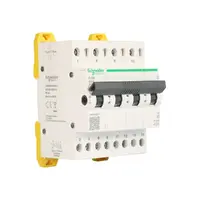
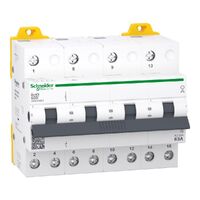
Find the best Acti9 circuit breakers here at Sparky Direct. [ Read More ]
Acti9 is Schneider Electric's flagship modular protection platform. The devices are compact, DIN rail mounted, and snap directly into a switchboard enclosure. Each unit protects a single circuit from overcurrent, short circuit, and in many models earth fault conditions. Acti9 covers residential consumer units, commercial distribution boards, and light industrial panels from the same product family.
The range is available in single-pole, double-pole, and triple-pole configurations. Single-pole units suit single-phase final circuits. Double-pole units suit single-phase circuits that need a switched neutral. Triple-pole units suit three-phase loads. The compact width means more breakers fit a standard enclosure, which matters when a switchboard has limited rail space.
An Acti9 breaker uses a thermal-magnetic sensor to detect current flowing through the circuit. The thermal element responds to sustained overloads. The magnetic element responds to sudden high-current faults. When either element reaches its trip point, an internal mechanism opens the contacts and disconnects the circuit.
The toggle handle moves to the tripped position on disconnect. After the fault is cleared, the breaker is reset manually by flipping the handle back to the on position. Advanced Acti9 models add electronic sensing, digital displays, and communication ports for remote status reporting and energy data.
Acti9 combines reliable protection with modern features. Energy monitoring, remote control, and arc fault detection are available within the same physical envelope as a standard MCB. The same rail layout supports a basic switchboard today and a fully monitored one later. Acti9 also integrates with the wider Clipsal by Schneider Electric ecosystem, so a commercial fitout or smart home rollout can use one consistent platform across every distribution board on site.
Acti9 is a family of related products, not a single device. Each sub-range targets a different application or feature set. Picking the right family is the first step in switchboard design. Sparky Direct stocks the full Schneider Acti9 range for next-day dispatch across Australia.
The iC60 is the core Acti9 MCB. It covers standard overcurrent protection for most residential and commercial final circuits. Ratings run from 1A to 125A, with Type B, C, and D trip curves available. The compact form factor allows more breakers per enclosure than older designs. The iC60H variant adds higher breaking capacity for installations where the prospective fault level is elevated.
The iC60N is an enhanced version of the iC60 with improved breaking capacity and performance in high-fault-level installations. It suits sites close to the distribution transformer where the available fault current is high. The form factor and DIN rail mounting are the same as the standard iC60, so the iC60N drops into existing designs without rework.
The iEM range adds integrated energy metering to standard protection. Each device measures circuit-level consumption in real time. Data can be read on a display module or streamed into a building management system for analysis. Energy monitoring helps identify waste, target retrofits, and verify that planned upgrades actually deliver the savings the design promised.
The iC60 RCD and Acti9 iID combine overcurrent protection with residual current detection in a single module. The combined device removes the need for a separate RCD on the supply side. Sensitivity ratings of 30mA, 100mA, and 300mA cover personal protection, fire protection, and equipment protection respectively. For applications that need a dedicated RCBO, the Acti9 iID range fits the same rail.
EV charging circuits need a Type B RCD because DC residual currents from inverter-driven chargers can blind a standard Type A device. The Acti9 A9Z51240 iID 2P 40A 30mA Type B is the part most Australian sparkies fit for hardwired AC chargers up to 7kW.
Acti9 breakers are classified by three core parameters: rated current, trip characteristic, and breaking capacity. Each parameter must match the circuit it is protecting. A mismatch in any one of the three can cause nuisance tripping at best and a serious fire hazard at worst.
Standard Acti9 ratings include 1A, 2A, 3A, 4A, 6A, 10A, 13A, 16A, 20A, 25A, 32A, 40A, 50A, 63A, 80A, and 125A. The rating must match the cable size and the continuous current the circuit will carry. Undersized breakers nuisance-trip and frustrate the user. Oversized breakers fail to protect the cable and create a serious fire risk in a fault condition.
| Trip Curve | Magnetic Trip Range | Typical Application |
|---|---|---|
| Type B | 3 to 5 times rated current | Residential lighting and general power circuits, resistive loads, heaters |
| Type C | 5 to 10 times rated current | Small motors, fluorescent lighting, commercial circuits with moderate inrush |
| Type D | 10 to 20 times rated current | Large motors, transformers, welding sets, high-inrush industrial loads |
Breaking capacity is the maximum fault current the breaker can safely interrupt without damage or dangerous arcing. Acti9 is available with breaking capacities of 6kA, 10kA, and 16kA. The required capacity is set by the prospective fault current at the breaker's location in the network. Sites near a distribution transformer or with low-impedance supplies need higher breaking capacity than rural sites at the end of a long feeder.
Acti9 breakers sit in the final distribution layer of the switchboard. They take a supply from a busbar fed by the main switch, and each one feeds a single circuit out to a load. The way they arrange on the rail and coordinate with upstream protection determines how the whole installation behaves under a fault.
Acti9 breakers mount on a 35mm DIN rail inside the switchboard enclosure. They sit in rows, with circuits grouped logically by area, load type, or RCD protection zone. The compact 18mm width per pole means more circuits fit a given distribution board than with older designs. That extra density matters when a property is being upgraded without a board changeout.
The main switch or service fuse provides backup protection if an Acti9 device fails to operate. The Acti9 itself provides the primary protection for the circuit and operates faster than the upstream device. Proper coordination means the smallest device closest to the fault trips first. That preserves supply to the rest of the installation while isolating only the faulty circuit.
RCDs detect earth faults by sensing imbalance between active and neutral current. They disconnect much faster than standard breakers can on earth fault. Modern wiring rules require RCD protection for socket outlets, lighting, and most final subcircuits in residential and commercial premises. Acti9 iC60 RCD and iID devices combine MCB and RCD functions in one module. That simplifies the board layout and reduces the number of devices needed for a given level of protection.
Communication-enabled Acti9 devices integrate with building management systems and smart home platforms. Remote monitoring lets facility managers see problem circuits without visiting the switchboard. Integration enables automated load management, demand response, and time-of-use control of major loads. The result is a board that supports both safe operation and active energy management from a single piece of hardware.
Acti9 breakers respond to three main fault types. Each type triggers a different element of the breaker, and the response time scales with the severity of the fault. Understanding what each protection mode does helps in selecting and troubleshooting the device.
An overload is a sustained current above the breaker's rated value but below the short-circuit range. The thermal element inside the breaker heats up under sustained current and bends a bi-metallic strip. After a delay, the heated strip triggers the trip mechanism. The delay allows brief surges such as motor starts to pass without nuisance tripping while still protecting the cable from long-term thermal damage.
A short circuit creates very high current in a fraction of a second. The magnetic element responds within milliseconds and trips the breaker before the cable insulation can fail. Fast disconnection on short circuit is what prevents fires and contains arc flash energy. The breaking capacity rating defines how high a fault current the breaker can interrupt safely without contact damage or external arcing.
Standard Acti9 MCBs provide limited earth fault protection through their overcurrent detection. Earth fault currents are often too low to trip an MCB before damage is done. Acti9 RCD and RCBO devices detect earth currents directly down to 30mA and disconnect within tens of milliseconds. Modern installations combine both: MCBs for overload and short circuit, RCDs or RCBOs for earth leakage and personal protection.
Selecting an Acti9 breaker is a methodical exercise. The breaker rating must match the cable, the trip curve must match the load type, and the breaking capacity must match the available fault current. Get any one of these wrong and the protection is either nuisance-tripping or, worse, ineffective.
The breaker rating must not exceed the safe current-carrying capacity of the circuit cable. A 20A breaker requires a cable rated for at least 20A continuous under the installation conditions on site. An oversized breaker on undersized cable is the classic cause of cable overheating and house fires. Always cross-check the cable size against AS/NZS 3008.1.1 derated for the installation method.
Resistive loads such as heaters and incandescent lights draw steady current and suit Type B breakers. Inductive loads such as motors and fluorescent fittings draw high inrush currents at start-up and need Type C or Type D to ride through the start without tripping. The wrong trip curve causes nuisance tripping at start-up or, in the opposite case, inadequate protection during a real fault.
High-risk circuits need RCD protection. That includes bathroom circuits, kitchen socket outlets, outdoor outlets, and most final subcircuits in newer installations. AS/NZS 3000 sets the rules and the residual current sensitivity needed in each location. For most personal protection in domestic and small commercial work, 30mA is the standard. 100mA and 300mA RCDs are used for fire protection and equipment protection rather than personal protection.
Important: Schneider Acti9 breakers must be selected and installed by a licensed electrician. Incorrect selection of rating, trip curve, or breaking capacity can leave a circuit unprotected without any visible warning. The breaker will look fine sitting on the rail but will fail to operate when called on.
The premium end of the Acti9 range adds intelligence on top of the protection function. These features turn the switchboard from a passive distribution point into a live source of operational data. The value shows up in commercial fitouts, multi-residential developments, and homes with solar and battery systems.
iEM-series devices track real-time and historical energy consumption for each circuit. The data points to circuits with unusual usage, equipment running outside hours, and loads ramping over time as plant ages. Integration with building management systems enables automated demand response and load shedding when needed. The same data also supports tenant submetering in commercial buildings without adding a separate metering layer.
Communication-enabled Acti9 devices transmit status and fault information back to a central system. Remote monitoring lets facility managers identify problem circuits without opening a switchboard door. Predictive diagnostics can flag circuits drifting toward failure before they cause an outage. The earlier the warning, the easier the maintenance window to schedule.
Properly sized and coordinated Acti9 breakers ensure the smallest device closest to a fault trips first. Discrimination prevents unnecessary disconnection of unaffected circuits. The whole installation does not go dark for a fault on one socket outlet. Selective coordination needs careful calculation against the fault current curves of every device in the path. It matters most in commercial and industrial work where downtime has a direct cost.
Some Acti9 models include arc fault detection. Arc faults occur from damaged cables, loose terminations, or aged accessories. They produce heat without necessarily producing enough current to trip a standard MCB. Arc fault detection identifies the characteristic signature of an arc and trips the circuit before the heat starts a fire. It is a meaningful upgrade for older properties where ageing wiring is a real risk.
Acti9 breakers are reliable but not maintenance-free. A short routine inspection picks up developing problems before they cause an outage or, in the worst case, a fire. The cost of the routine is small compared with the cost of an undetected fault.
Check that every breaker handle is in the correct position for the intended state. Look for signs of overheating such as discolouration, scorch marks, or melted plastic on the breaker body. The switchboard interior should be clean and free of dust. Dust impairs cooling and can ignite if a connection sparks. A quick visual pass during any routine switchboard visit catches most developing issues.
Periodically switch each breaker off and back on to confirm the mechanism operates smoothly. Test the RCD function on every RCD or RCBO device using the integrated test button. AS/NZS 3760 sets test intervals for portable equipment, and AS/NZS 3017 sets the verification regime for fixed installations. If a breaker fails to trip, trips too easily, or feels stiff, it is replaced by a licensed electrician.
Review energy consumption data on a regular cycle if the board has iEM devices fitted. Look for circuits with unusual patterns or rising consumption over time. Check for fault indications on any communication-enabled breakers. Investigate every repeat-tripping circuit until the root cause is found. Bypassing a tripping breaker is never the answer.
A breaker that fails to reset after tripping has an internal fault and must be replaced. Repeat-tripping breakers are investigated before replacement to find the underlying load issue. Replacement units must match the original in rating, pole count, trip curve, and breaking capacity. Mixing breaker types within a board is permitted, but each circuit's protection must match the circuit's design parameters.
Troubleshooting an Acti9 issue follows the same systematic approach as any protection problem. Identify the symptom, identify the most likely cause, and verify before replacing the device. Most Acti9 service calls fall into one of four patterns.
Repeat tripping points to an overload or a fault on the circuit, not to a faulty breaker. Check for too many appliances on one circuit, a faulty appliance drawing excessive current, or a developing short circuit in the cabling. An earth fault that trips an RCBO every few hours is a slow-developing insulation breakdown that needs professional investigation rather than a swap of the device.
A breaker that should have tripped but did not is the most dangerous failure mode. The circuit is unprotected and the fault may have already done damage. The breaker must be replaced immediately. Do not try to repair a failed breaker. The replacement must match the original in every specification so the circuit's design assumptions still hold.
Corrosion or mechanical wear can make a breaker handle stiff. Gently work the handle back and forth to free the mechanism. If the breaker remains hard to operate, replace it. A breaker that resists manual operation may also resist its own trip mechanism, and that is a safety problem.
If a communication-enabled breaker stops transmitting data, check the network connection first, then the breaker's own power and trip status. Verify the configuration in the building management system. A faulty communication module sometimes requires replacement of either the breaker or the communication interface module, depending on the Acti9 variant.
Acti9 is widely specified across Australian installations because it offers concrete advantages over older protection technologies. The advantages cover safety, maintenance cost, and capability.
Acti9 breakers can be reset without replacement, which removes a recurring maintenance cost compared with fuse-based boards. They respond faster and more predictably to fault conditions thanks to modern thermal-magnetic and electronic sensing. Newer Acti9 models add energy monitoring and remote control that fuses cannot match. The same DIN rail platform supports both basic and advanced variants, so a board can be upgraded over time without a full re-design.
All Acti9 breakers comply with AS/NZS 3000 (Wiring Rules) and the relevant product standards including AS/NZS 60898 for MCBs and AS/NZS 61009 for RCBOs. Selection and installation must be done by a licensed electrician. Regular inspection and testing keep the breakers in known good condition and provide the records needed for compliance audits.
Older switchboards with rewireable fuses or first-generation MCBs are routinely upgraded to Acti9 platforms during renovation work. The upgrade improves safety, simplifies maintenance, and unlocks integration with modern building systems. A licensed electrician can assess the existing installation, plan the upgrade in stages, and stage the work around the customer's available downtime.
Schneider continues to develop the Acti9 platform as the underlying technology and the installations Acti9 serves both evolve. Three areas are driving change at the moment: renewables, smart-home integration, and tighter coordination with safety-critical systems.
Acti9 breakers are increasingly used in solar and battery installations. Bidirectional energy flow needs devices that detect current in both directions and coordinate with inverter-level protection. Schneider's Schneider Charge EV charger range and the Acti9 Type B RCDs are typical components in a modern solar-plus-EV residential installation.
Acti9 with communication integrates into smart home platforms and IoT systems. Voice assistants, mobile apps, and home automation hubs can read circuit status, control non-critical loads, and report consumption. The protection function still operates autonomously, so a network outage does not leave the home without a working switchboard.
Advances in semiconductor technology are enabling faster, more selective, and more intelligent circuit protection. AS/NZS 3000 and the international product standards continue to update in line with evolving electrical system requirements. Future Acti9 developments are expected to extend diagnostics, support predictive maintenance, and deepen integration with building management systems and grid demand-response services.
Club Clipsal is Australia's largest electrician community offering trade rewards, business support, and exclusive benefits. When you nominate Sparky Direct as your preferred wholesaler, we automatically apply your Clipsal spend points to your Club Clipsal account daily.
Entry-level offering coaching, mentoring, and training discounts
Unlock exclusive industry tools and networking events
Access Toyota fleet offers and business software discounts
Maximum benefits, including VIP experiences and rewards
1. Sign Up: Create your Club Clipsal account at clipsal.com/club-clipsal or via the iCat mobile app
2. Nominate Sparky Direct: Select Sparky Direct from the wholesaler dropdown menu in your profile
3. Add Email: Enter your Sparky Direct account email address in the membership number field
4. Start Earning: Every dollar spent on Clipsal products earns points automatically
Redeem points from the rewards store, including gift cards, tools, and experiences. Access business summits, product training, and industry networking events. Receive early access to new product launches and special promotions. Connect with fellow electricians via the Club Clipsal community app.
Watch A9Z51240 Acti9 iID 2P 40A 30mA - B EV type | Residual Current Circuit Breaker | Schneider Electric video
Watch Schneider Electric A9SCO263 | 63A Changeover Switch Acti9 2P 415VAC video
Watch Clipsal MX9MS1100 | MAX9 Main Switch 1P 100A video

Sparky Direct have come through everytime I've used them. Their prices are second to none. I've never had any issues receiving my purchases and even though I live in rural north west Queensland, my items are delivered on time every time. Thank You
Easy to navigate the website and find what I needed, and the item arrived very quickly to Perth WA. Well packaged and protected.
Good quality product. The narrow form factor is very suitable for domestic applications.
Quality products in stock • Fast Australia-wide delivery • Competitive trade pricing
Browse Schneider Acti9 → Get Expert Advice →