Search Results:
Search Results:
Search Results:
Search Results:
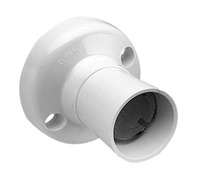
A batten holder is a single-piece light fitting that mounts flush to a ceiling or wall surface. Inside the housing sit two spring-loaded contacts and a set of terminals. The terminals accept the active, neutral, and earth conductors from the building wiring. The contacts press against the base of a screwed or pushed-in light globe. When the circuit is energised, current flows through the globe and produces light.
The fitting itself is a moulded base with a globe socket on top and a wiring chamber underneath. Most Australian models include a looping terminal so the electrician can run the circuit through to the next light without joining cables in a separate junction box. The base attaches to the surface with two screws, usually fixed into a ceiling joist or a fixing block.
Bayonet cap holders use two pins on the side of the globe. The globe pushes in, twists a quarter turn, and locks against the spring contacts. Edison screw holders accept the globe through a threaded sleeve. The thread itself carries one of the electrical contacts, with a centre pin completing the circuit at the base.
Batten holders are the workhorse of surface-mounted lighting. They appear wherever the priority is light output rather than decoration. Builders use them during construction so the site has working lights before final fixtures are installed. Property owners keep them in service areas where a bare globe is acceptable. They also serve as a fallback when an existing decorative fitting fails and a quick replacement is needed.
Despite the rise of LED downlights and decorative fittings, batten holders remain a core part of every electrician's stock. They cover the lighting needs that other fittings cannot do as cheaply or as quickly.
In residential work, batten holders light up laundries, walk-in robes, garages, and under-house areas. In commercial buildings, they cover storerooms, plant rooms, and back-of-house spaces where appearance is secondary to function. Both settings benefit from a fitting that delivers maximum light per dollar with minimal installation time.
A batten holder has very few parts. There is no driver, no transformer, no remote control, and no electronic ballast. Fewer parts mean fewer failure points. A quality holder fitted correctly will run for decades with only globe replacements needed. The unit cost is also a fraction of a complete light fitting, which matters on multi-fixture jobs.
All batten holders sold in Australia must comply with AS/NZS 60598 (luminaires) and the wiring rules in AS/NZS 3000:2018. Approved fittings carry the Regulatory Compliance Mark or an equivalent approval number. Installation must be carried out by a licensed electrician under state and territory law. Sparky Direct stocks only fittings that meet these requirements.
Batten holders break down into a small number of categories based on globe base, body material, and special features. Most jobs are covered by two or three common types.
Bayonet Cap (BC or B22) is the traditional Australian standard. Two pins on the globe lock into slots in the holder. The grip is positive, so the globe will not vibrate loose. Edison Screw (ES or E27) is the European and US standard. The globe screws into a threaded sleeve. Both are available, and both are sold as direct replacements at Sparky Direct. The choice depends on the existing globe stock and the customer's preference, since both bases are equally reliable when fitted correctly.
Plastic holders use a flame-retardant thermoplastic body. They are the most common type for indoor residential work. Porcelain holders handle higher operating temperatures and are preferred for high-wattage incandescent and halogen globes, or for any location where heat build-up is a concern. Metal holders are less common in domestic settings but appear in industrial fittings where impact resistance matters.
Standard batten holders are not rated for wet or damp areas. For outdoor use, eaves, or under-cover external positions, choose a sealed weatherproof model with a published IP rating. For full outdoor exposure, look at weatherproof batten LED lights or a dedicated outdoor fixture instead of a basic holder.
Some batten holders include an integrated pull-cord switch, which suits robes, pantries, and storerooms with no separate wall switch. Smart-compatible models are rare in this category, since the holder itself is passive. To add smart control, pair a standard holder with a smart globe or switch the circuit through a smart relay.
The globe drives the light output, colour, and energy use. The holder simply provides the connection. Matching the right globe to the holder is essential for safe operation and the expected lamp life.
Australian batten holders are rated for 240V AC at 50Hz. The maximum wattage depends on the body material and the holder design. Plastic holders typically carry a 60W incandescent or 100W LED equivalent rating. Porcelain holders can handle higher wattages where stated by the manufacturer. Always check the rating stamped on the holder body before fitting a globe.
A60 (standard pear shape), G95 (round), and tubular T38 globes all fit a B22 or E27 holder, provided the base matches. Some decorative globes have larger envelopes that may not clear surrounding surfaces. Measure the available clearance below the ceiling or near the wall before choosing a long or wide globe.
Modern LED globes work in any standard batten holder without modification. They draw less current than the holder is rated for, which extends holder life. For dimmed circuits, fit a dimmable LED globe and confirm the dimmer is LED-rated. Mismatched dimmers cause flicker, buzz, and shortened LED life.
Three questions cover most selection decisions: where will it go, what globe will run in it, and what does the existing wiring look like? Get these right and the rest is detail.
Batten holders go in places where the priority is reliable light, not appearance. The list of suitable locations is long, which is why this fitting remains in volume production decades after fancier alternatives appeared.
Garages, laundries, sheds, walk-in robes, pantries, under-house storage, and roof spaces all use batten holders. They handle the heat, dust, and occasional knocks that decorative ceiling lights are not built for. They also keep installation costs low when a property has many service spaces to light.
Plant rooms, switchboard cupboards, cleaner stores, loading docks, and back corridors all benefit from a basic batten holder. Where higher light output is needed across a larger area, the same circuit logic applies but the fixtures step up to LED highbays or linear fittings.
On construction sites, batten holders provide working light during the build. Electricians install them early in the rough-in stage and replace them with final fittings only at handover. Some holders stay in place permanently in garages and storage areas, since the trade-grade installation is already there.
The body material drives heat tolerance, impact resistance, and corrosion behaviour. Each material has a specific range of use cases.
Porcelain handles continuous high temperatures without softening or deforming. This matters for incandescent and halogen globes that produce significant heat at the base. Porcelain also retains its electrical insulation properties at temperatures that would compromise a thermoplastic body. For any holder running globes above 60W, porcelain is the safer choice.
Standard plastic holders resist corrosion well, since the body itself does not rust. The vulnerable parts are the brass or steel contacts inside. In coastal or high-humidity environments, choose a sealed weatherproof unit so moisture cannot reach the contacts. For full marine exposure, batten holders are not the right product. Use a marine-rated fitting instead.
Plastic holders handle most knocks well, but the lens and globe envelope remain exposed. In industrial spaces with forklifts, ladders, or moving stock, fit a guard or use a fully enclosed industrial fixture. Metal-bodied holders survive impact better than plastic but cost more and add complications around earthing.
Batten holder installation falls under the AS/NZS 3000:2018 wiring rules and the relevant state or territory electrical safety legislation. The work must be done by a licensed electrician.
In every Australian state and territory, fixed wiring work is restricted to licensed electrical contractors and qualified workers. This includes installing a new batten holder, replacing one on a live circuit, or extending wiring to add another fitting. Homeowners may change globes, but they may not work on the holder itself or its terminations.
The holder must be fixed to a solid substrate. On plasterboard ceilings, this means fixing into a joist or installing a fixing block above the lining. The screws must carry the weight of the holder, the globe, and any future replacement globes. Loose fixings cause the holder to sag, which stresses the cable terminations and creates a fire risk.
All conductors must be terminated cleanly into the holder's screw or push-in terminals. Strands must not protrude. Insulation must reach the terminal block. The earth must be connected, even on a holder where no metal is exposed, because any future fitting on the same circuit may need it. The looping terminal carries through-circuit conductors, not extra circuit cables.
Compliance reminder: Replacing a batten holder on a live circuit is electrical work under AS/NZS 3000:2018. It must be carried out by a licensed electrician. Working live without isolation breaches workplace safety law in every Australian jurisdiction.
Choosing between a batten holder and another fitting comes down to function, appearance budget, and ceiling type.
| Fitting Type | Best For | Typical Cost | Install Time |
|---|---|---|---|
| Batten Holder | Service areas, sheds, garages, temporary lighting | Low | Fast |
| Pendant Light | Dining and living areas requiring decorative effect | Medium to high | Medium |
| LED Downlight | Bedrooms, hallways, modern living spaces | Medium | Slow (cut-out required) |
| Linear Batten Light | Workshops, offices, large work areas | Medium | Medium |
A pendant light drops a decorative fitting from the ceiling on a flex or rod. Pendants suit dining tables and feature areas. Batten holders suit places where the globe itself is the light source. Pendants cost more and take longer to install, but deliver visual impact. Batten holders cost less and disappear into the ceiling line.
Downlights need a ceiling cut-out and a clearance void above the lining. Batten holders surface-mount onto the lining itself. In renovations where ceiling access is limited, a batten holder fits where a downlight cannot. Downlights deliver a cleaner look in finished living spaces, while batten holders do the working-light jobs.
Use a batten holder when light output and budget are the priorities. Use a pendant or decorative fitting when the room demands a visual feature. Use a downlight when the ceiling supports the cut-out and the look matters. Many homes use all three across different rooms.
A correctly installed batten holder will outlast many of the globes fitted into it. Long service life depends on the right product and the right install.
Heat is the main enemy of a batten holder. Excess wattage, poor ventilation, and dust build-up all raise operating temperatures. The most common failure mode is contact pitting from arcing inside the holder. Stay within the wattage rating, keep the housing clean, and replace any holder that shows signs of discolouration.
A loose globe arcs against the contacts and burns out both the globe and the holder. Bayonet pins should engage cleanly. Edison screw threads should turn easily without forcing. If a globe spins in the holder or falls out under vibration, the holder needs replacement, not the globe.
Holder springs lose tension over time, especially in fittings used daily. Switched holders also wear out their internal switch. As a guide, plan a holder replacement at any sign of intermittent operation. The cost of a new holder is far lower than the cost of a callback to chase a flickering light back to its source.
Sparky Direct ships batten holders Australia-wide with trade-grade brands at competitive pricing.
Buying online suits trade buyers who know the model they want and need it shipped to a job address. Sparky Direct stocks Clipsal, NLS, and other approved brands ready for next-business-day dispatch. Bulk orders attract trade pricing for licensed electricians and contractors.
Cheap import holders save a few cents per unit but often fail the heat and contact integrity tests over the long term. Trade-grade holders from established brands like HPM hold their rating, fit standard globes cleanly, and meet AS/NZS approvals. The price difference is small. The reliability difference is large. For matching globe stock, brands such as Philips and SAL Lighting offer reliable LED options across both B22 and E27 bases.
Check the base type matches the existing or planned globes. Confirm the wattage rating covers the intended use. Look for a looping terminal if the circuit needs to pass through. Verify the brand carries Australian compliance approvals. Sparky Direct lists these details on every product page.
For repeat residential work, keep a small mixed stock: ten plastic B22 holders, five plastic E27 holders, and a couple of porcelain B22 holders for high-wattage or high-heat positions. This range covers the majority of replacement and new-install jobs.
Most batten holder issues trace back to a small set of installation or selection errors. Avoiding these saves rework and callbacks.
Fitting a B22 holder where the customer has a stock of E27 globes (or vice versa) creates immediate friction. Confirm the existing base type before ordering. If the customer is rationalising stock, agree on one type and replace any mismatched holders during the same visit.
A standard plastic holder under an open eave will work for a while, then fail. Moisture reaches the contacts, the globe shorts, and the circuit RCD trips. Use a sealed weatherproof unit or a full outdoor fixture for any external position. The cost difference is small. The callback cost is not.
Fitting a 100W incandescent globe into a holder rated for 60W will run hot enough to discolour the body and degrade the contacts. With LED globes, wattage overload is rare because the LED draws far less power than the equivalent light output suggests. Always check the rating, especially when retrofitting older fittings.
Batten holders need almost no maintenance, but a periodic check catches early failures before they cause an outage.
Look for discolouration around the globe socket, looseness when a globe is fitted, or visible cracks in the body. Any of these signs means the holder is at end of life. A holder that flickers when the globe is moved by hand is failing internally and should be replaced.
Pitted or blackened contacts indicate arcing inside the holder. Heat damage shows as yellowed or warped plastic near the globe socket. A holder showing either symptom must come out. Continued use risks a permanent short circuit or a fire at the fitting.
Batten holders are not designed to be repaired. The unit cost is too low and the labour cost of dismantling exceeds the price of a new fitting. If a holder fails, replace it as a complete unit. Keep one or two spares in the van so the job can be closed in a single visit.
Three faults cover the great majority of batten holder service calls. Each has a clear diagnostic path.
First check the globe by swapping it into a known-good fitting. If the globe is fine, the holder contacts are losing pressure. Replace the holder. If the swap shows a faulty globe, fit a new one and check the holder afterwards for any heat damage caused by the failing globe.
A globe that will not seat is usually a base mismatch. B22 globes will not fit an E27 holder. The reverse is also true. If the bases match but the globe still does not seat, the holder may have a damaged socket from forced fitting. Replace the holder.
A discoloured holder is running hotter than its rating allows. Check the globe wattage against the holder rating. Replace the globe with a lower-wattage LED equivalent. Replace the holder if the body is already deformed. Damaged plastic does not recover its insulation properties even after the heat source is removed.
Club Clipsal is Australia's largest electrician community offering trade rewards, business support, and exclusive benefits. When you nominate Sparky Direct as your preferred wholesaler, we automatically apply your Clipsal spend points to your Club Clipsal account daily.
Entry-level offering coaching, mentoring, and training discounts
Unlock exclusive industry tools and networking events
Access Toyota fleet offers and business software discounts
Maximum benefits, including VIP experiences and rewards
1. Sign Up: Create your Club Clipsal account at clipsal.com/club-clipsal or via the iCat mobile app
2. Nominate Sparky Direct: Select Sparky Direct from the wholesaler dropdown menu in your profile
3. Add Email: Enter your Sparky Direct account email address in the membership number field
4. Start Earning: Every dollar spent on Clipsal products earns points automatically
Redeem points from the rewards store, including gift cards, tools, and experiences. Access business summits, product training, and industry networking events. Receive early access to new product launches and special promotions. Connect with fellow electricians via the Club Clipsal community app.
Watch Clipsal 530WE | Batten Holder video
Watch NLS 30411 | Batten Holder BC White video
Watch LED Lamp Tubular T38 10W 240V B22 5000K 1000lm | NLS 10016 video

Product has great connections , a ground and two or one more cable fittings to the back plate design is excellent , both advantage the support of wiring in, make and outer housing is a comparable consideration
These batten holders are good for use on any surface, they have good size terminals and a looping terminal if required.
Just what I needed 4 a up and coming project. These give far more light than down lights. They may be old school but far more practical and far less cost of copper wiring for the budget. Thanks Sparky
Quality products in stock • Fast Australia-wide delivery • Competitive trade pricing
Browse Batten Holders → Get Expert Advice →Light output depends on the globe used rather than the batten holder itself.
Sparky Direct supplies batten holders Australia-wide, offering reliable and practical lighting solutions with convenient delivery.
Batten holders are securely packaged and delivered via standard courier services.
Unused products are generally eligible for return according to the seller’s returns policy.
Warranty coverage varies by manufacturer and typically covers defects in materials or workmanship.
Yes, batten holders are typically sold as individual lighting components.
Yes, selecting the correct globe ensures safe operation and desired light output.
Yes, they are commonly used during construction or renovation stages.
Yes, they are visible as a basic exposed lighting fitting.
Quality batten holders are designed for long-term use in standard environments.
No, they have a compact design that sits close to the mounting surface.
Yes, they are often used for temporary or basic lighting needs.
Yes, maintenance is simple and usually involves replacing the globe.
A batten holder is a light fitting designed to hold a light globe directly, without a shade or enclosure.
Yes, they are a standard lighting component used in many installations.
They offer a simple, cost-effective lighting solution where decorative fittings are not required.
Yes, they include terminals for secure electrical connection during installation.
Yes, batten holders are designed for surface mounting to ceilings or walls.
Yes, they are used in residential, commercial, and light industrial environments.
Yes, they are primarily designed for indoor installations.
Yes, they are commonly available in white, black, and other finishes.
Yes, they are suitable for use with compatible LED light globes.
Common types include B22 bayonet and E27 screw batten holders.
Quality batten holders are manufactured to meet relevant AS/NZS electrical and safety standards when installed correctly.
They are commonly used for basic lighting in garages, laundries, sheds, workshops, and temporary installations.